
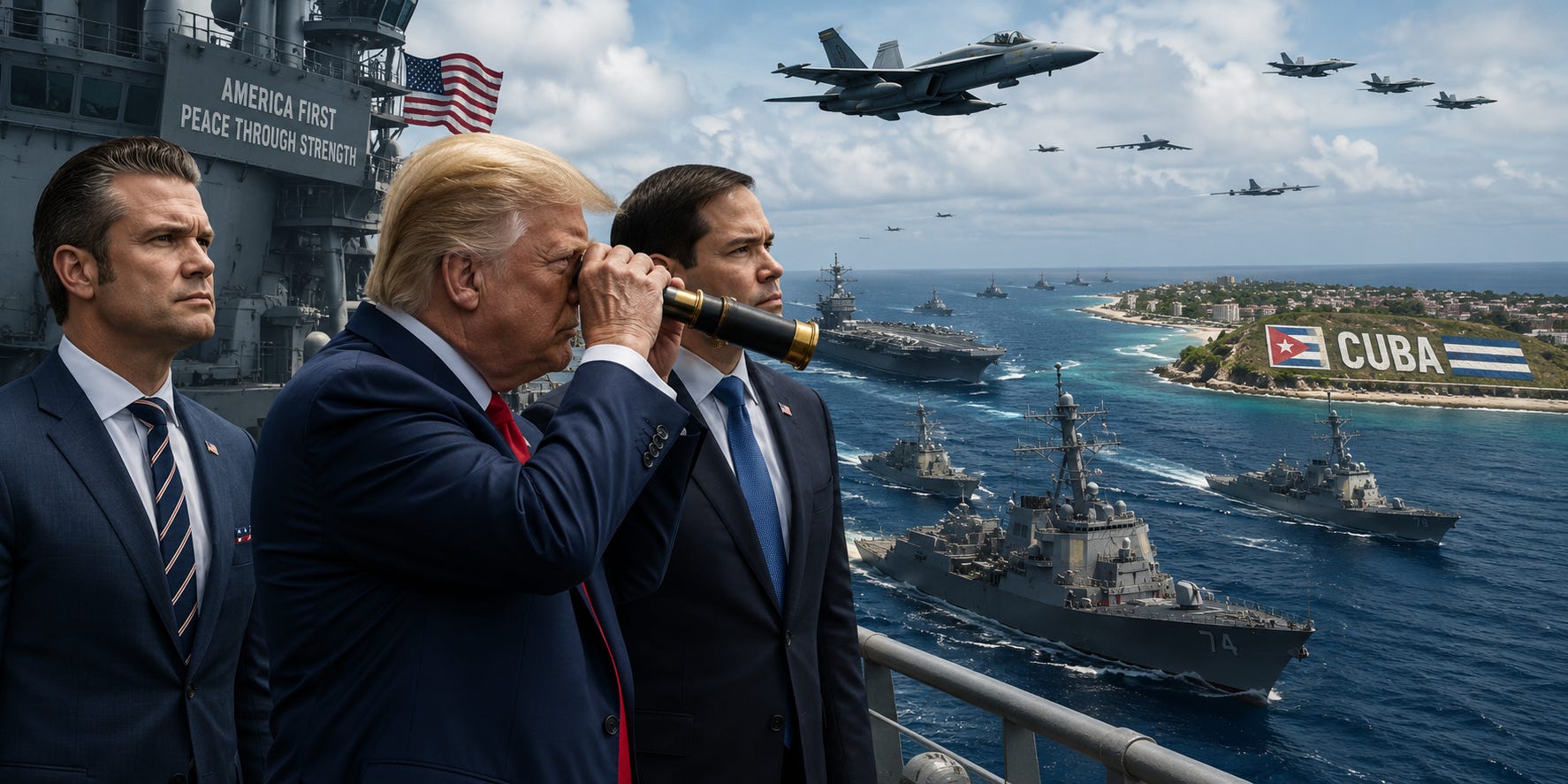
In Trump’s dithering, quivering, slithering mind, desperation for headlines appears to direct his presidential actions, both at home and abroad.
‘Stir things up, piss everyone off, and unbalance all that somehow remains in balance’
are his mantras.
Having kidnapped the democratically elected president of Venezuela, and his wife, barged into a wildly mistaken invasion of Iran (urged on by co-criminal Netanyahu of Israel), and put the US Navy to work blasting suspected drug runners out of international waters, it seems his next victim is Cuba, Marko Rubio’s homeland of origin.
I remember when Fidel Castro was in New York, begging for a re-established relationship with the United States.
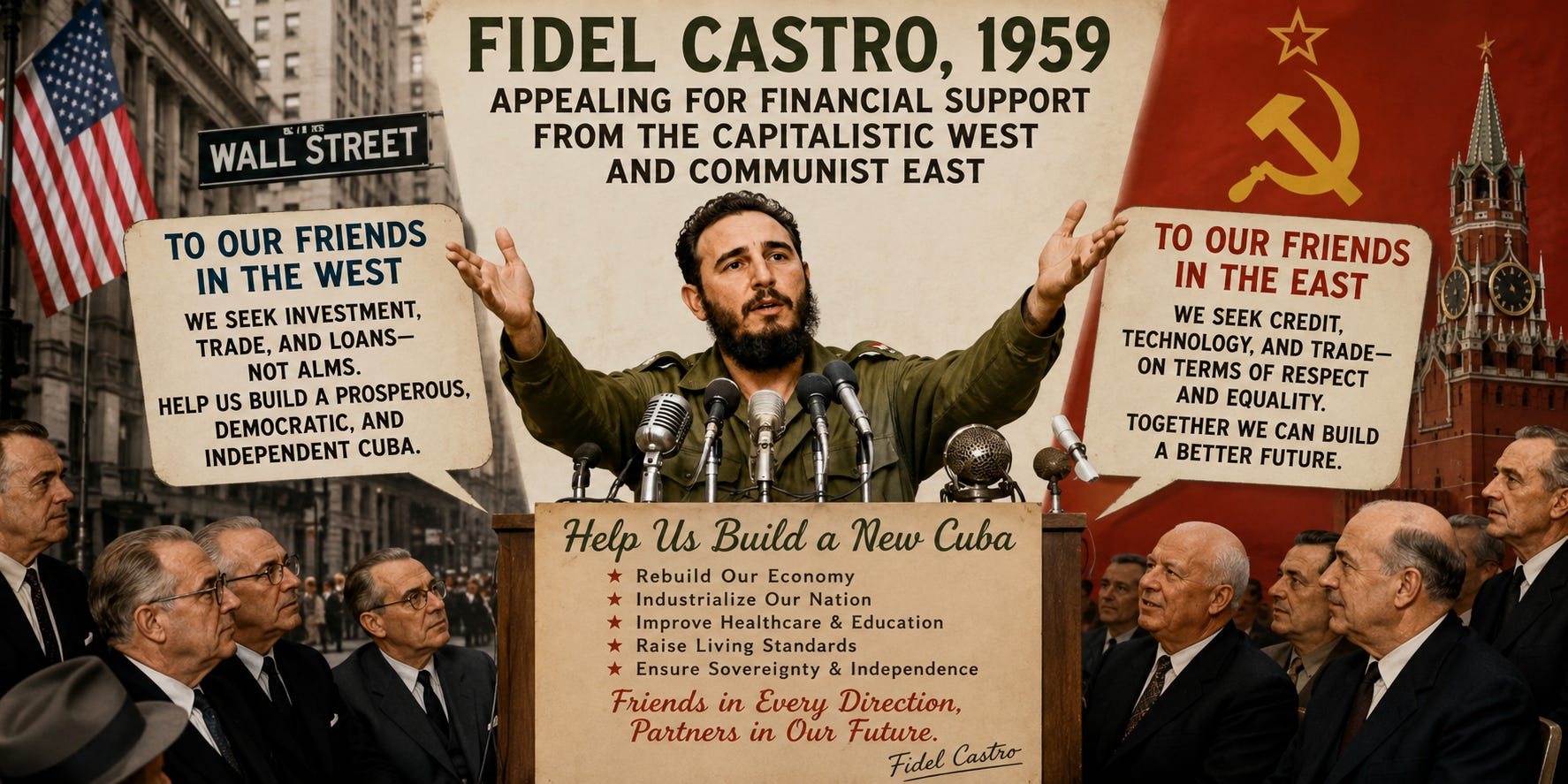
The year was 1959, and I was twenty-four years old.
Seeking a relationship with the United States, there he was, only about three months after dictator Batista had packed his bag and fled Cuba.
During this trip, Castro visited New York, Washington, Boston, Princeton, and other U.S. cities. He spoke to the American Society of Newspaper Editors, appeared on television, met business leaders, all the time seeking continued trade, investment, and good relations with the United States. Needing that return of relations in order to advance his socialist agenda for Cuba, he had no interest in communism at the time.
To step back for a moment, Castro didn’t simply fall out of the sky as a terrorist, which his beard and military fatigues might imply.
The son of a prosperous landowner with a successful sugar plantation, he attended prestigious Jesuit schools, developing a reputation for intelligence, athleticism, discipline, and a strong will. Studying law at the University of Havana, he took a deep interest in Cuban nationalism, social justice, anti-imperialism, and constitutional government, non of which existed at the time under its dictator, Fulgencio Batista.
A study in contrasts, on one hand, Cuba had one of Latin America’s highest per-capita incomes. Havana was a modern city, literacy and life expectancy were relatively high, and American gambling tourists flocked there for its casinos.
On the other hand, wealth was concentrated in relatively few hands, rural poverty was widespread, seasonal unemployment plagued sugar workers, political corruption was endemic, and the American mobsters owned the casinos and flashy hotels.
Cubans felt their country functioned entirely for wealthy Cubans and foreign investors.
If that sounds like America today, it’s no accident and (perhaps) something to think about.
Long story short, Castro’s movement attracted support from a remarkably broad coalition of students, peasants, middle-class professionals, Catholic reformers, liberals, and nationalists. They hoped for, and expected, a restoration of democracy, honest government, land reform, reduction of corruption, and greater Cuban independence from foreign influence.
Only after taking power, and being snubbed by Western financial help, did Russia offer to align Cuba with the Soviet Union. And, having no viable alternative, Fidel accepted.
It could have been different, but how did Cuba change?
Castro’s most widely recognized achievement was the creation of a universal healthcare system. By the 1970s, healthcare became free at the point of service, every community had access to clinics and physicians, infant mortality fell dramatically, and life expectancy rose to levels comparable with many developed countries.
Cuba developed a strong biotechnology and vaccine sector, while Cuban doctors have also served in dozens of countries after natural disasters and health crises, earning international recognition.
One of Castro’s earliest priorities was literacy. The 1961 Literacy Campaign mobilized hundreds of thousands of volunteers, many of them teenagers, to teach reading and writing in rural areas. Within a few years literacy became nearly universal, education became free through university, rural schools expanded dramatically, and Cuba today has one of the highest literacy rates in the Americas.
Reduced inequality. Before the revolution, much agricultural land was concentrated in large estates, while many rural families lacked electricity, schools, and medical care. The revolution redistributed land, expanded housing, extended electricity, increased pensions, as well as broadening access to healthcare and education.
National independence. Before 1959, the United States exerted major influence over Cuban politics, American corporations owned significant parts of the economy, and organized crime had visible interests in Havana’s casino industry. Castro ended much of that foreign economic influence, nationalized industries, and asserted Cuba’s independence. For supporters, this remains one of his greatest accomplishments.
Scientific development. Despite limited resources, Cuba invested heavily in medical research, biotechnology, pharmaceuticals, and vaccine development. The country became a notable exporter of vaccines and medical expertise relative to its size.
And what, dare say, was the cost?
All these achievements came with serious costs that are well documented, although that documentation is American, and comes with a light salt and peppering of prejudice.
It includes one-party rule, with no competitive national elections,
restrictions on freedom of speech, press, and association,
imprisonment of political opponents,
extensive state surveillance,
waves of emigration, with many Cubans leaving for economic or political reasons, as well as
chronic economic shortages, especially after the collapse of the Soviet Union, causing
limited consumer choice and low wages.
In fairness, many of these shortcomings we share in the United States, without the benefits of universal healthcare, reduction of inequality, and free education through university levels.
But America (an experiment in Republican Democracy), under Trump, simply cannot bear to have Cuba (an experiment in Socialist Universalism) existing within 90 miles of our national border.
The two Trump administrations have consistently pursued a policy of “maximum pressure” on Cuba, but probably eyeing them as another potential ‘American Riviera,’ such as those envisioned in Gaza and Lebanon by his son-in-law.
Specifics differed between his first and second administrations. The first included
Reimposing travel restrictions,
curtailing “people-to-people” educational travel,
prohibiting cruise ships from sailing from the U.S. to Cuba,
tightened rules on individual travel,
restrictions on remittances, limiting the amount Cuban Americans could send to relatives,
barring Americans from doing business with hundreds of Cuban hotels, shops, marinas, and companies connected to the military or security services, and
allowing Americans to sue foreign companies that profited from property confiscated after the Cuban Revolution. This created legal risks for foreign investors in Cuba, as well as
designating Cuba as a State Sponsor of Terrorism and thereby triggering additional financial and banking restrictions.
No doubt with Marco Rubio whispering in his ear, early indications for his second deep drink at the well of presidency are not favorable.
Reversing the Biden administration’s late-term easing, by reinstating Cuba’s designation as a State Sponsor of Terrorism, and restoring the expanded Cuba Restricted List,
Further restrictions on tourism,
Adding more Cuban hotels and accommodations to the prohibited list for U.S. travelers,
Increasing enforcement of restrictions on transactions involving military-linked entities,
Adding Visa and travel restrictions,
Imposing additional limits affecting some categories of Cuban nationals seeking entry to the United States (no more Marco Rubios),
Authorizing additional sanctions against individuals and entities involved in sectors such as energy, mining, finance, defense, and security, as well as officials accused of repression or corruption, which also increases the risk of sanctions for some non-U.S. firms doing business with sanctioned Cuban entities, as well as
Additional pressure, amounting to a blockade on Cuba’s oil imports, by targeting companies and countries that supply fuel to the island.
It’s fair to say that seldom (if ever) has a leader of America slathered the paint of hypocrisy over so wide a segment of the globe.
Or maybe it’s not fair to say.
You be the judge.
I will say it anyway.
Cuba is next on the Trump list of invasions, in order to distract attention from his national (and international) race-to-the-bottom of public support…