
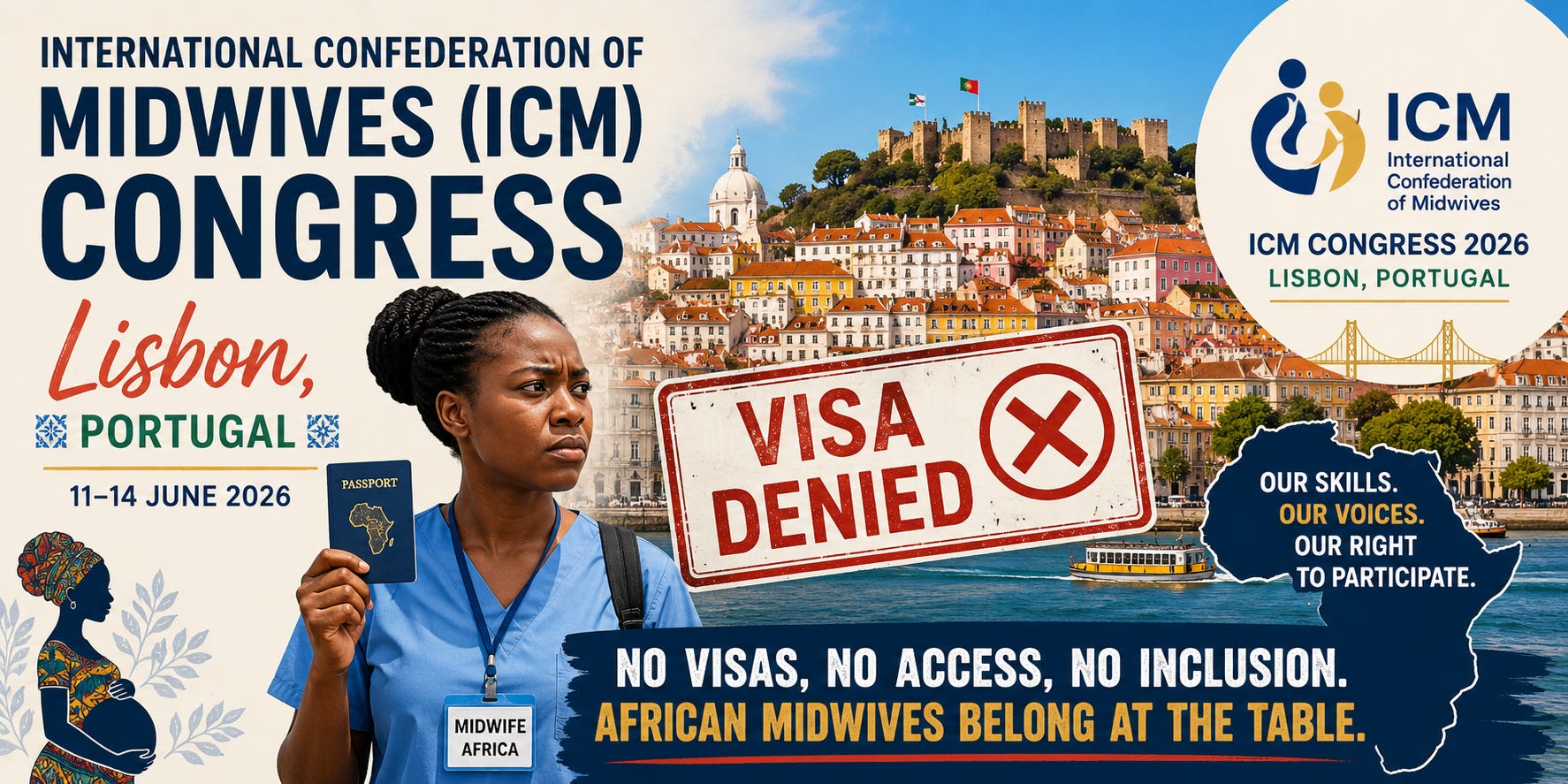
Written from the perspective of America, where the U.S. maternal mortality rate increased by 93 percent in the past year, we turn our heads toward a conference convened this week at the International Confederation of Midwives (ICM) congress in Lisbon, Portugal.
Midwives? They actually have a confederation? How unconventional is that, for a convention?
Not so, actually.
Worldwide, some 80 percent of babies are born with the help of midwives. That percentage isn’t quite as high in the U. S., though those numbers are on the rise.
This key conference was held by politicians, donors and UN agencies to discuss the millions of avoidable mother and baby deaths every year.
Apparently, for those gathered in Lisbon, it was not so key to some.
In that illogical scheme of things we have come to expect in such public parades of faux interest, those who are most in need were actually turned away.
Ah well, ‘God is in the details’ and all that, so it simply became another news event in a world over exposed and under informed. Shit happens, as Forest Gump once said. If it too often happens to those without a voice, at least we publicly display our disinterest.
Why this and, more importantly, why this now?
Because now is slipping through our consciousness, day by day, while we chuckle at the lesser insanities of present everywhere.
According to an article in today’s Guardian UK,
“Visa rejections have threatened progress on mother and baby health after experts from struggling countries were barred from talks, global midwife leaders have said. But last-minute visa refusals meant eminent midwives from Africa and Asia – where the majority of lives are lost – were excluded.
“Urgent appeals were lodged for delegates from countries including Nigeria, Ghana, Rwanda, Burundi, Uganda, Tunisia, Ethiopia, Sierra Leone, Bangladesh, India and Indonesia.”
How is that possible?
Portugal’s Ministry of Foreign Affairs said visa assessments happened “rigorously, objectively and factually” in line with Schengen rules.
That’s what Ministries do, when they are caught red-handed in an outright lie. They lie to cover the lie, and run for bureaucratic cover.
Back to the Guardian article,
“In Uganda, midwife Harriet Akello runs a lifesaving initiative that has caught the attention of the World Health Organization (WHO). She was due to speak in Lisbon on how fragmented, risky maternity systems can reorient to a “midwifery model of care” – where a mother is kept safe by a small team of skilled midwives.
“With her work at the NGO Mother Health International, Akello helps overwhelmed public maternity centres pivot to WHO standards, operating in a remote post-conflict region near the border with South Sudan, 95km (60 miles) from a referral hospital.
“Akello said, “The world’s policymakers are in Lisbon, yet here I am in Uganda, trying to explain to an embassy why I should have the right to travel. I am gutted and insulted. The WHO says we need ‘midwifery models of care.’ I have a rare example of this, but I’ve been silenced.”
I have always concentrated on a ‘follow the money’ concept, because it usually predicts outcomes.
Yet, the experts I contacted on this issue claimed that the principal issue is less ‘who profits?’ than ‘who gets a seat at the table?’
When visa policies disproportionately exclude frontline health workers from Africa and Asia, influence shifts toward Western institutions, such as universities, ministries, foundations, NGOs, and medical organizations.
Even so, that criticism has been voiced for years by organizations such as the World Health Organization, which has repeatedly argued that maternal-health policy works best when local midwives, nurses, and community health workers participate directly in decision-making rather than being treated merely as recipients of ‘expert’ advice.
If you can control the experts, you have far greater control over the outcomes, but that’s still a follow-the-money issue when you boil it down. When I’m doing my job properly, boiling down is the goal.
My three children were all born in hospitals, attended by expensive doctors. It’s all too easy for people like me to turn a blind eye to those who don’t have that ability as ‘the second-hand choices of the poor.’
Not true at all, but the hand-picked attendees in Portugal are unlikely to hear that argument.
Even so, the irony is that the delegates denied visas were exactly the people working in those frontline systems. If they’re not in Portugal, discussions are dominated by large international NGOs, academic medical centers, government health ministries, donor foundations, global-health consultants, and pharmaceutical and medical-device interests.
The World Health Organization and the International Confederation of Midwives (the latter are the very people holding this conference) have repeatedly found that well-trained midwives can provide most of the essential care needed during pregnancy, childbirth, and the post-natal period.
Such care has proven itself,
‘to provide lower rates of unnecessary cesarean sections, lower rates of induced labor, including the use of forceps and vacuum extraction, less use of surgical incisions to induce births, as well as higher rates of spontaneous vaginal birth, as well as breastfeeding initiation rates. Not to sound like I know more than I do, but studies find greater maternal satisfaction with care, and both comparable or improved outcomes for mothers and babies in low-risk pregnancies.’
A major 2021 analysis published in The Lancet Midwifery Series estimated that universal access to midwifery services could prevent a large share of maternal and newborn deaths worldwide.
In conclusion, the strongest evidence supports an integrated system where midwives handle routine pregnancies and births, while obstetricians handle high-risk cases, and patients move easily between the two when needed.
Obviously, that’s not possible in many parts of the world.
Certainly, those healers and midwives (many of whom are men) have no business in Portugal.
As a side personal note, fifty years ago I had a close friend who was a talented and successful obstetrician. His personal delight was in bringing newborns into the world. When his medical practice insurance exceeded $100,000 a year, he quite unwillingly had to give up his career and retire…
Absolutely no one profited from that, and yet the squeeze continues…