
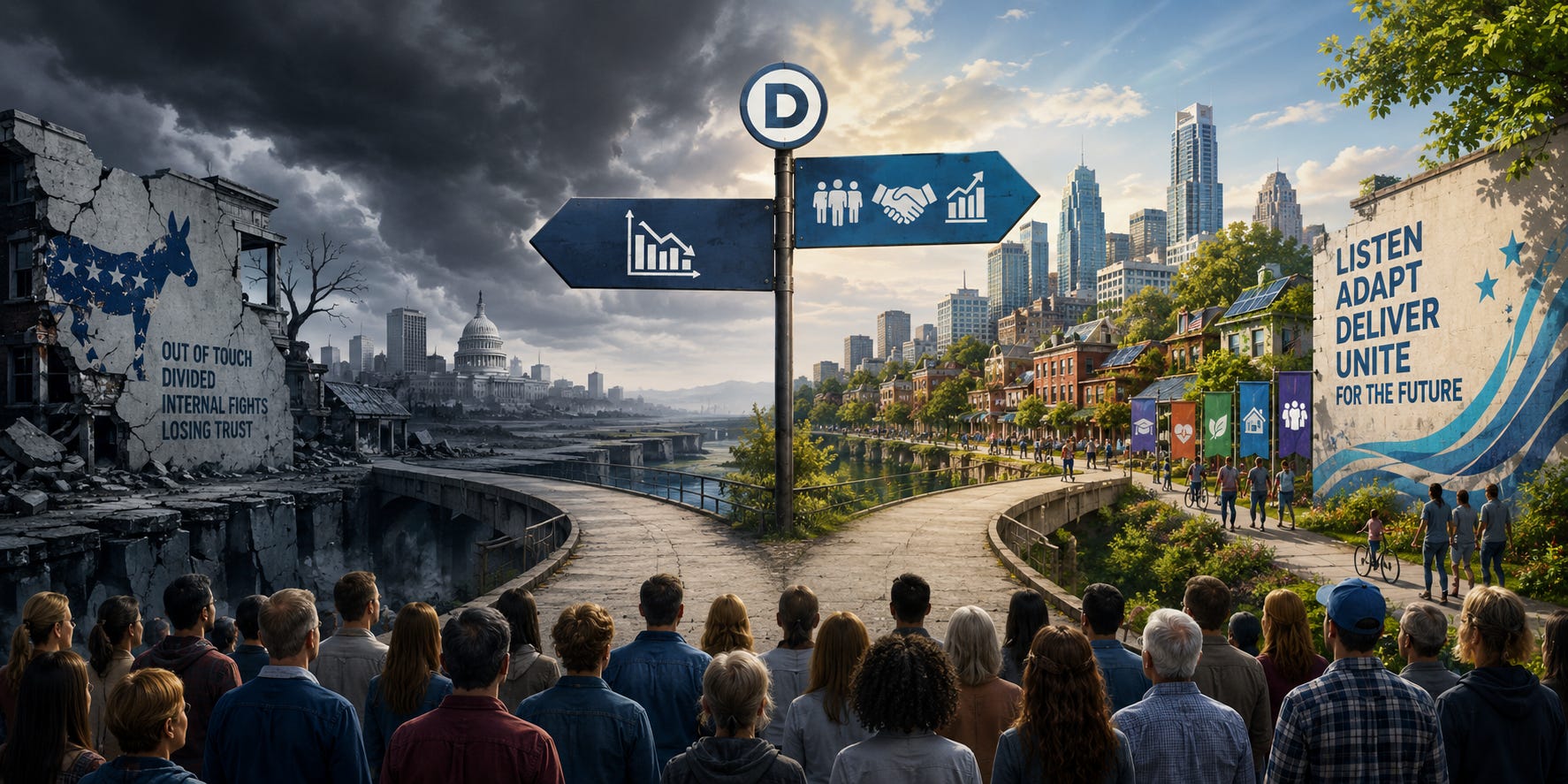
Anyone who doesn’t understand that the Chuck Schumer days of Democratic leadership (if it can even be called that) are over, simply hasn’t been paying attention.
There is a new sheriff in town, and his name is Socialist Sam.
But first, we need to discuss what happened to make law and order so distasteful over at the Democratic National Committee (DNC). Pay attention now, it’s not the election of Zohran Mamdani as Mayor of New York, it’s the full half century of the DNC abandoning those it once supported.
Remember Trade Unions? Do you have any vague recollection of support for the regulation of big business, a robust welfare state, natural skepticism toward concentrated wealth, and willingness to use government to reduce inequality. Those were once major tenets of what it meant to be a Democrat.
The Democratic Party of today is timidly fiddling around with what are described as WOKE causes, having abandoned-ship on its core values.
Voters today might not be able to put a name to many of the values Democrats once held, but they feel their loss. Republicans didn’t get us where we are today all by themselves, they had Democratic co-conspirators every step of the way.
If I had to characterize both parties, Republicans, would be Fred Astair to the Democrats Ginger Rogers. Ginger was once quoted as “doing every step Fred did, backwards, in high heels.”
Bill Clinton championed the North American Free Trade Agreement despite strong opposition from organized labor,
Clinton joined Republicans in repealing key parts of the Glass–Steagall Act through the Financial Services Modernization Act, as well as legislation limiting the regulation of derivatives, both of which enriched billionaires and set the stage for the 2008 financial crisis,
Good ol’ Bill “ended welfare as we know it,” approving the Personal Responsibility and Work Opportunity Reconciliation Act, imposing work requirements and time limits on federal welfare benefits, abandoning the FDR’s commitment to protecting the poor,
Beginning in the 1980s and accelerating in the 1990s, Democratic fundraising increasingly favored billionaire donors rather than labor unions.
Democrats essentially abandoned traditional New Deal values in the 1990s, when the party embraced free trade, financial deregulation, welfare reform, deficit reduction, and a more business-friendly philosophy, standing by saluting, as our industry-based Middle Class got sent off to China, for profit.
Those new-and-improved Democrats sure had learned to dance, following Republicans step-by-step, backwards, in high heels.
We Americans, who used to have two, now have three voter blocs, Democrat, Republican and Undecided. Let’s take a look at how those percentages have changed since 1990.
The short answer is that Democrats (35% to 27%) dropped eight percentage points, while Republicans (33% to 28%) lost five points, and Independents (33% to 45%) gained what both had lost.
But the move from party affiliation to fuck-them-both is significant. In a situation where Congress no longer gets anything done, and money now rules both parties, thank-you-we-hate-you-all is now our largest voting group.
Really?
Yep, which explains an apparent paradox, party identification has weakened, but electoral polarization has intensified, essentially ‘we don’t much like Ted Cruz, but we hate Chuck Schumer even more.”
And so?
That, as much as anything, probably suggests the reasons behind Zohran Mamdani’s astonishing popularity in New York and the rise of the DSA (Democratic Socialists of America). Its rise is one of the most significant developments inside the Democratic coalition over the past decade and, although the movement remains relatively small, it has become disproportionately influential in Democratic primaries, especially in large cities.
Unlike their parents, many younger voters entered adulthood facing enormous student debt, stagnant wages, soaring housing costs that had them living back in their childhood bedrooms, along with unaffordable health insurance.
America sheltered a long-term dislike of the term, but Bernie Sanders made ‘socialism’ respectable again.
Before 2016, calling yourself a socialist was generally considered political suicide in America. But then Bernie ran for president and, for the first time, millions of younger Americans heard proposals such as Medicare for All, tuition-free public college, stronger labor unions, wealth taxes, and campaign finance reform.
Bernie is the first (and only ever) socialist member of the Senate, although he caucuses with Democrats.
By all primary results, Sanders had won the Democratic nomination. But, in a weird move that only Democrats could pull off, the Democratic National Committee decided it was ‘Hillary’s turn,’ and decided upon her as its candidate. That was a step back to the old days when candidates were selected in the back rooms of conventions, and the very reason we decided to have primaries. Sorry Bernie…
Hillary lost the election that couldn’t be lost, and we lost the man who (I feel) would have, and should have, sent Donald Trump back to his New York business crimes.
But Democratic Socialists of America membership exploded after Sanders’ campaign.
Why it matters.
It matters because, even after breaking with the electorate it formerly represented, the Democratic Party still matters.
Wounded as it was, certain signs of life include
Alexandria Ocasio-Cortez defeating longtime Congressman Joe Crowley in 2018,
Rashida Tlaib becoming one of the first openly DSA-affiliated members of Congress,
Zohran Mamdani winning New York City while backed by DSA, and
growing successes on city councils in Chicago, New York, Seattle, and other major cities.
Even this week, DSA-backed candidates continued to defeat long-serving Democratic incumbents in some safe Democratic districts. Compared with mainstream Democrats, DSA generally advocates
universal health care,
much stronger labor unions,
public or nonprofit housing expansion,
higher taxes on wealth,
expanded public ownership in some sectors,
free or low-cost public higher education, and
much larger social welfare programs.
In other words, all their former core values.
Generally (and finally) GSA are more skeptical of corporate power and capitalism than mainstream Democrats, which is where perception and reality probably differs.
The DSA has never controlled the Democratic Party, but has become an energetic faction within it, much as the conservative movement reshaped the Republican Party over several decades. Logically many Democrats came to understand the party had sold itself off to corporate centrism during the 1980s, 1990s, and early 2000s. Thus, the DSA represents an attempt to reclaim an older tradition associated with Franklin D. Roosevelt’s New Deal.
While critics argue that the DSA’s agenda goes well beyond New Deal liberalism, making it less electable outside heavily Democratic urban districts, supporters argue circumstances require moving forward.
In these times when only fools predict outcomes, I guess we’ll simply have to wait and see.
And yet, socialism, that political system that makes the Nordic Countries rate so high on the world’s best-places-to-live surveys, may be on the rise in America.
Let’s hope.