
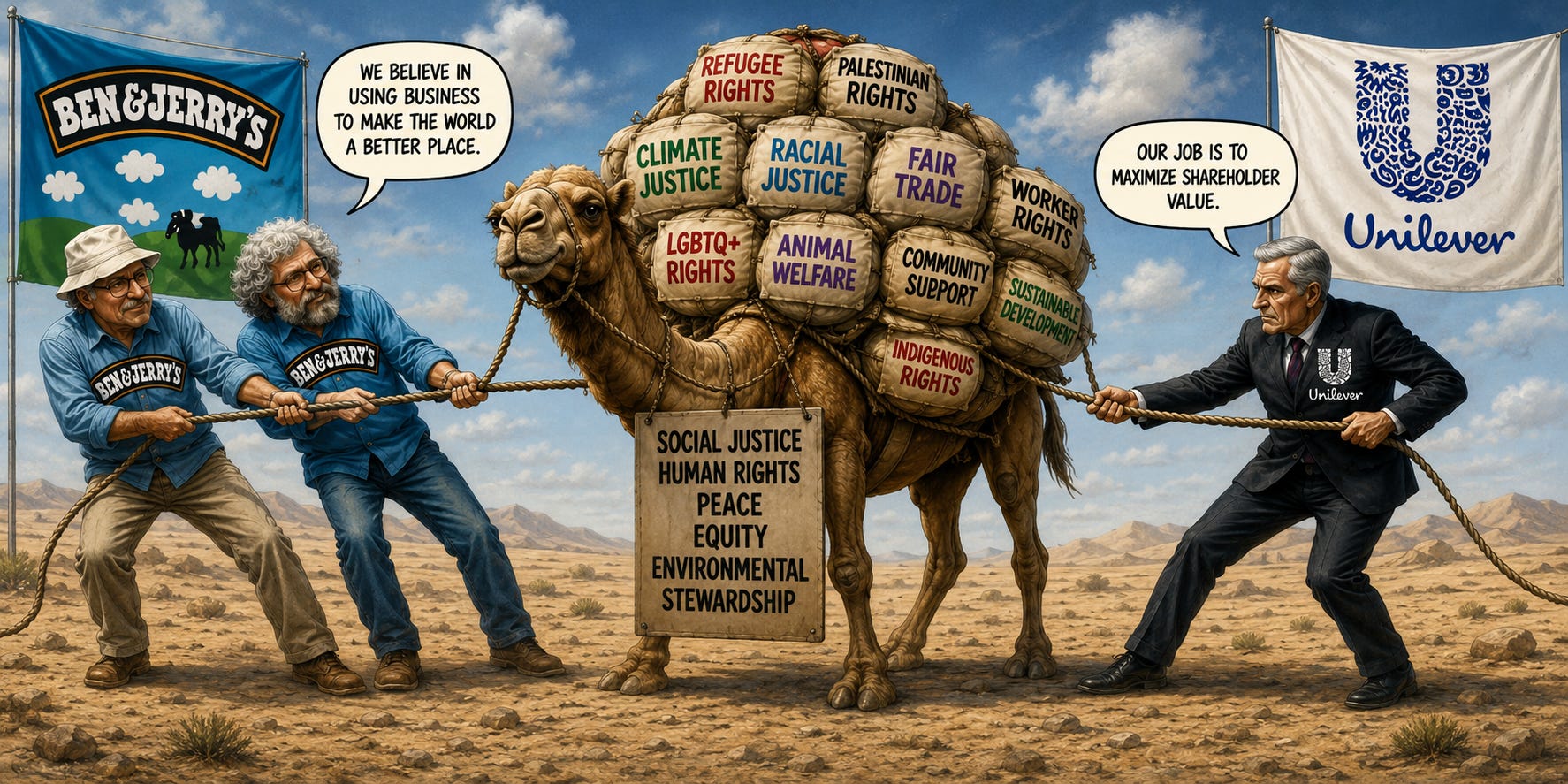
Who doesn’t love Ben and Jerry’s ice cream?
And who doesn’t love their decades-long support of various social issues? If it proved anything, it put paid the idea that all companies (as they grow larger) abandon their societal support.
Right this very minute in America, the issue is at maximum risk.
Need I reference Trump’s billionaire supporters moving toward ‘private equity” which continues to grab every public institution, or the American military support of Israeli ethnic cleaning going on in Gaza?
Probably not, except for the Gaza thing, which seems to have broken the Ben and Jerry camel’s back.
One of the reasons Ben & Jerry’s became famous wasn’t just the ice cream. It was the realization that a business could have a double bottom line that could support both profit and social impact. That worked so well they later expanded to a triple bottom line based on product quality, reasonable profits and social missions.
Before the merger, way back when Ben and jerry still ran things, their camel supported
Paying workers fairly. They were pioneers in limiting executive pay. For many years, Ben & Jerry’s had a rule that the highest-paid executive could earn no more than 5 times the salary of the lowest-paid employee.
Local sourcing. They emphasized buying ingredients locally whenever possible, such as milk and cream from Vermont dairy farmers, partnerships with nearby suppliers, and supporting small agricultural businesses. Their goal was to keep wealth circulating within local communities rather than concentrating it elsewhere.
Hiring people who faced barriers. They deliberately worked with organizations employing people who often struggled to find work, including people with disabilities, former prison inmates, and disadvantaged youth. Many of those partnerships continue today.
Charitable giving. One of the company’s most innovative policies was donating a fixed share of its success. It earmarked 7.5% of annual pre-tax profits to charitable causes through the Ben & Jerry’s Foundation and related programs, a percentage far above what most corporations contributed.
It was a pretty damned strong camel. But the list continued to
Environmental leadership. Long before climate change became a mainstream issue, they promoted reducing waste, recycling, energy conservation, sustainable agriculture, and environmentally responsible packaging.
Peace activism, which was all but unknown for a food company. Ben Cohen, especially, became active in campaigns supporting reductions in military spending, nuclear disarmament, diplomacy, and redirecting military expenditures toward needed domestic targets, as well as
Racial and economic justice. The company supported organizations working on poverty reduction, affordable housing, racial equality, criminal justice reform, and voting rights.
Even before the sale to Unilever, Ben & Jerry’s publicly aligned itself with many progressive causes. It was among the early large consumer brands to support LGBTQ+ rights, including opposing discrimination, advocating for marriage equality, and celebrating Pride events.
Even a camel could see this company would never survive going public, or merging with a larger entity.
But no one asked the camel.
As global sourcing expanded, B&J became one of the largest users of fairtrade-certified ingredients, helping ensure that farmers producing their core products, such as vanilla, cocoa, coffee, and sugar received fairer compensation.
Probably their biggest contribution wasn’t a single cause but a different vision of business itself.
Leading a camel that thought it had retired out of the barn, they set the argument that a corporation should serve multiple stakeholders squarely on its back, prioritizing
customers,
employees,
suppliers,
communities,
the environment,
and shareholders.
When Unilever came along with an intention to buy them out, Ben Cohen and Jerry Greenfield weren’t sure they could save everything on their shaky-legged camel’s back, but they were damned well going to try.
When Unilever acquired Ben & Jerry’s in 2000 for approximately $326 million, the merger agreement was designed to preserve the company’s unique social mission. Unilever assumed ownership and control of the business, manufacturing, and finances,
While an independent board retained authority over Ben & Jerry’s social mission, brand integrity, and charitable foundation. The agreement was intended to allow the company to continue its progressive activism and community commitments even as it became part of a global corporation. I
n recent years, however, Ben & Jerry’s independent board has alleged that Unilever violated those protections, leading to ongoing legal disputes over the scope of the board’s independence.
The breaking point was Israel and Gaza. Even the camel knew it.
In 2021, Ben & Jerry’s independent board announced that it would stop selling ice cream in the Israeli-occupied West Bank, saying that selling in the Occupied Palestinian Territory was “inconsistent with our values.” Further, the company said it intended to remain in Israel, but not in the settlements.
Some U.S. states moved to divest from Unilever under anti-boycott laws, Israeli officials condemned the decision, and Unilever faced pressure from both investors and governments.
Ice-cream eaters throughout the world might not care much about fairtrade-certified ingredients, but Israel, Gaza, and genocide were hot topics. And Unilever had its market and (probably more importantly) its shareholders to protect.
Camels seldom pay attention to those nuances. Contracts and courts of law care very much, as do Ben and jerry.
In 2022, Unilever reached a separate agreement allowing its Israeli licensee to continue selling Ben & Jerry’s products throughout Israel and the West Bank under the brand’s Hebrew and Arabic trademarks. Ben & Jerry’s independent board argued that Unilever had overridden its decision and sued, claiming this violated the 2000 merger agreement.
After the October 2023 Hamas attack and the ensuing war in Gaza, the conflict deepened. Ben & Jerry’s board alleged that Unilever prevented it from issuing statements supporting Palestinians or criticizing the war, while Unilever maintained that it had the authority to manage the company’s legal and commercial risks.
So, Israel and Gaza were not the original issue. The underlying issue was, and is, corporate governance.
The case is still before the court.
Will moral integrity win out over money and marketing? Hasn’t so far, says my decades of experience, but who knows?
And the camel has not yet made his opinion known.