
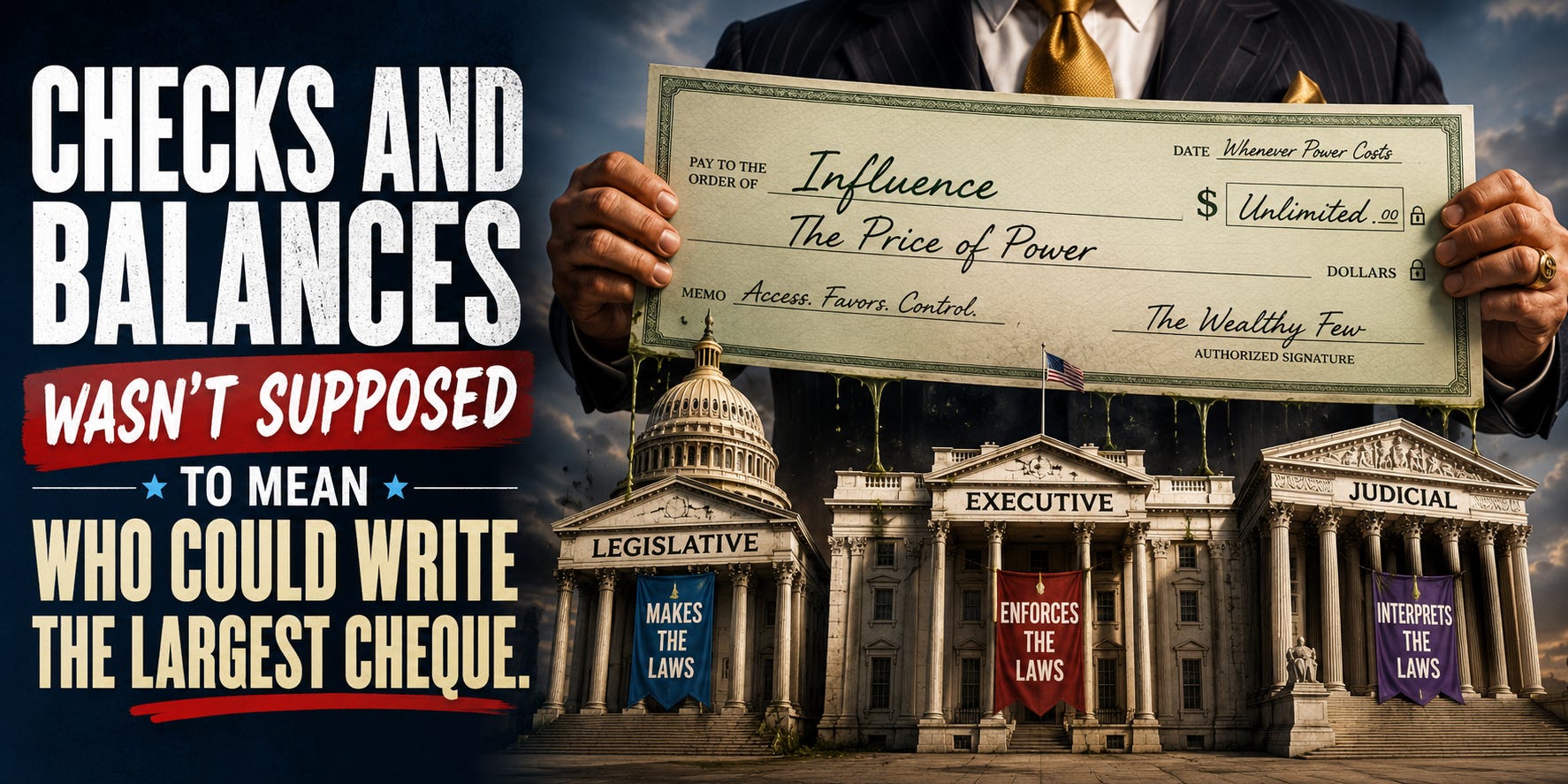
Briefly, to refresh your memory of why ‘checks and balances’ are part of our governmental history, the Founders harbored a deep fear of concentrated power. They’d just shaken off a king, but were equally wary of mob rule, military dictatorship, and corruption by wealthy interests.
Little did they know of monetary dictatorship or, perhaps, they knew all too well.
Their solution was to carefully divide government into self-correcting sections, each wary of the others. These Founding Fathers (as we are fond of naming them) were well-read and honorable men, doing their best to carve out a free nation from one still embracing slavery…not an easy task, and an imperfect one at best.
And they found the guidance they sought largely from the French political philosopher, Montesquieu. He wrote The Spirit of the Laws, which argued that liberty survives only when power is separated into different branches. James Madison, Alexander Hamilton, and (my favorite) Thomas Jefferson, adapted those ideas into the American Constitution.
Which established three branches: Legislative (a Congress to write laws), Executive (a President to enforce laws), and a Judicial (Supreme Court and lower courts to interpret laws).
The key element was that each branch could, and would, restrain the others.
Congress could impeach presidents and judges, presidents could veto congressional legislation, and courts could declare laws unconstitutional. Madison famously described the logic as “Ambition must be made to counteract ambition.”
Somehow fraud and bribery escaped the net, probably because honorable men do not practice that dark art, and these were honorable men.
Meanwhile, money increasingly bled into the equation.
Back in the day, senators were chosen by state legislatures, not directly by voters. Political campaigns, militias, foreign affairs, and government itself was small-scale and relatively inexpensive. But, within a hundred years, Industrialization changed all that dramatically. Railroad barons, bankers, and industrial magnates began exerting enormous influence over legislatures and parties.
By the late 20th and early 21st centuries, campaign financing had become central to American politics. Supreme Court decisions such as Citizens United v. FEC greatly expanded the role of money in political speech, allowing corporations, unions, and wealthy individuals to spend vast sums independently in elections.
Speech was still free, but the size of the megaphone was determined by money.
Critics argue (quite sensibly) that the original constitutional balance has shifted from institutional cross checks toward total financial control over governance.
I continue to remind my fellow citizens that, in 1950 (a mere 75 years ago), our government had no debt, financed itself entirely through taxes, and those taxes were agreeably paid by those who owed them. American business and individuals thrived as never before (or since) with a graduated tax that topped out at 92%.
The (or since) modifier is as wrecked as a head-on collision by the establishment of a $billionaire class, our first ever, that aim to become $trillionaires.
And they will, if unchallenged.
The answer is clear, and those who claim ‘we can never go back’ are wrong, and have been proven wrong.
We came back, enduring a Civil War that ended our history as a slave nation.
We came back, from two World Wars, the Great Depression, and an economic recession (on average) every 4 ½ years since.
We came back, from the horrific assassinations of the 1960s, when we lost President Kennedy, Attorney General Robert Kennedy, The Honorable Martin Luther King, jr., and Islamic leader Malcome X.
We are a nation of comebacks.
The overriding question is whether Americans, as a nation, are beaten, broken, and left by the side of the road of history…or not.
You may not know, or remember, much of what I’ve written so far, because you were not there.
Only 1% of those of us born in 1935 are alive today, and a large portion of those among us are in various stages of dementia.
I was there, every step of the way.
The first president I ever knew, until the age of ten, was Franklin Roosevelt. I listened to the Fireside Chats, heard Hitler speak, was there when our soldiers came home to free university educations, watched Harry Truman preside over the Marshall Plan, and was at lunch in my family’s kitchen when Kennedy was killed.
Those words are not braggadocio.
They are a lifetime remembrance of the pain and prosperity that illustrate the America in which I grew up. I’m old now, not ‘getting old,’ but truly old, and most of my brain cells are hitting on all cylinders. I’m telling you how it was and how it can be again, because too few of us are alive to comment.
Don’t believe the best of America is behind us.
Don’t believe it can’t be restored to the majesty it once enjoyed.
The billionaires are not in charge.