
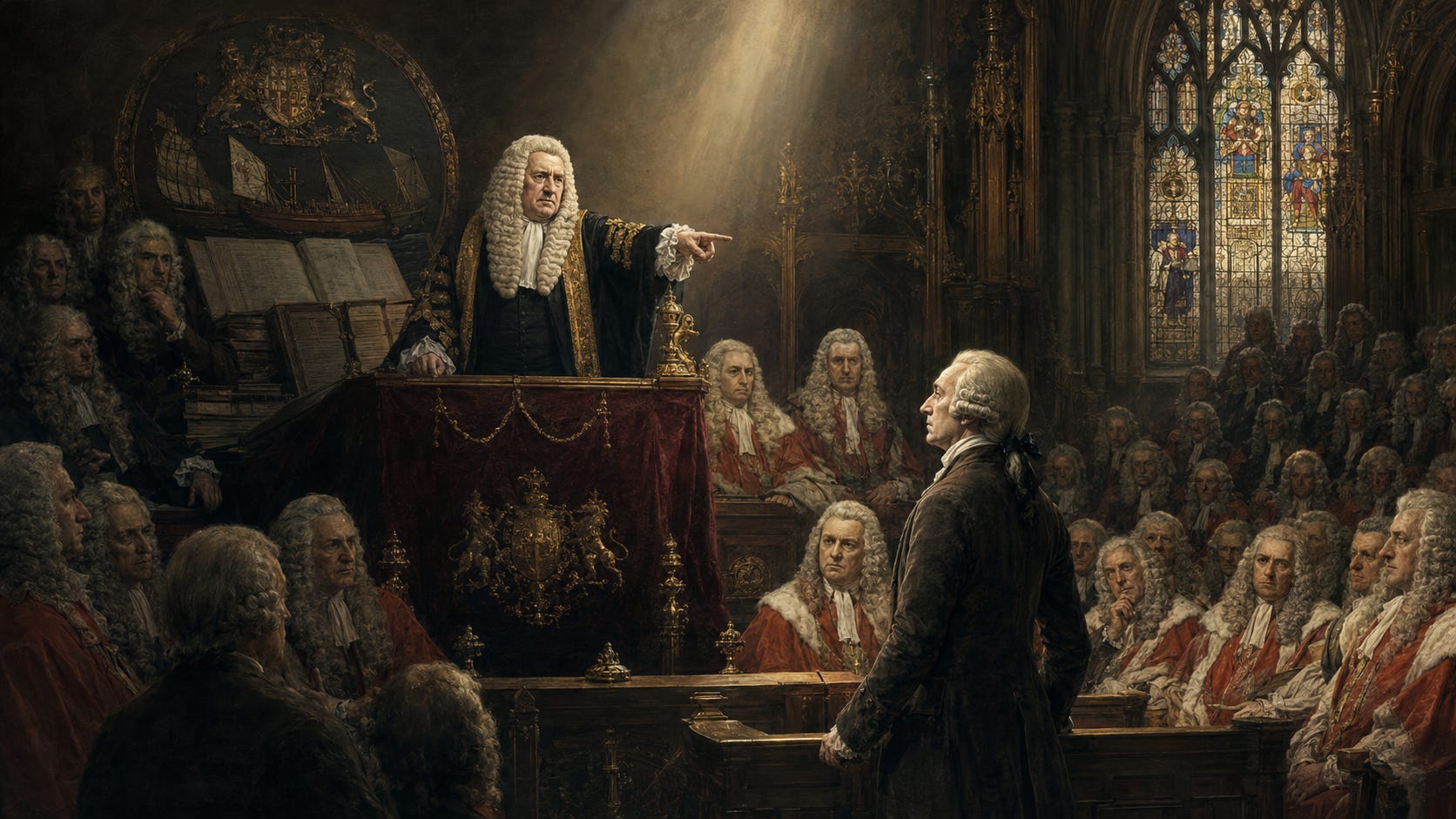
That was a quote from Edward Thurlow, a British lawyer and Tory politician who sat in the House of Commons from 1765 to 1778. They clearly knew a thing or two about corporations in those less controversial times.
At noon on Feb. 13, 1788 (so says today’s NYTimes), huge crowds gathered outside Great Britain’s Parliament to witness members of the House of Lords process into Westminster Hall. They were there to impeach the man who ran much of India as the East India Company’s governor general of Bengal. This was the moment when the British state finally flexed its muscles to take on the greatest corporate oligarch of his day, the Elon Musk of 18th-century London.
Ah well, there’s a comparison that will raise the hairs on your neck.
Warren Hastings was the man at trial, and the question at hand was an attempt to decide whether a private corporation—and the men acting through it—could be held responsible for governing and exploiting millions of people abroad.
How prescient is that, of America’s concerns regarding our present circumstances?
They wore wigs, pointed fingers and brooked no nonsense. The East India Company had begun as a trading corporation, but after its military victories in Bengal during the 1750s and 1760s, it acquired the power to collect taxes, maintain armies, wage wars and govern extensive territories. It was, in effect, a profit-seeking corporation operating as a sovereign state, not entirely unlike America’s military-industrial-congressional organization.
The difference was, the Brits (from whom we would soon establish many of our own laws) were having none of it.
It seems America today cannot get enough of it and, with our transformation to a technological operandi, have let our Elon Musks run off with the entire kit and caboodle. For those of you too young to recognize the reference, kit and caboodle is an idiomatic phrase meaning the whole lot or collection of things. Sometimes you can get away with stealing the kit but, when you include the caboodle, the illegality is complete.
Idiomatic might (or might not) refer to today’s automatic allegiance to idiots in high places.
But, getting back to Thurlow in his wig, the East India Company’s dude’s frequently returned to Britain immensely wealthy, while Bengal endured oppressive taxation, administrative disorder and the catastrophic famine of 1769–1770. When the Company itself approached financial collapse and sought government assistance, Parliament could no longer pretend that its conduct in India was merely private business.
Pretense is largely a political child, an American Yankee Doodle Dandy, born on the 4th of July.
The principal prosecutor, Edmund Burke, accused Hastings of accepting gifts, payments and contracts for improper purposes. Delicate language there, as I don’t understand what ‘proper’ purposes might have been, but that’s the Brits for you…always proper, even when being improper.
Burke’s larger charge was that Hastings had established a system of arbitrary power, affecting both cruelty and extortion by claiming that such conduct was customary in India.
Where, pray tell, have we Americans heard that before?
Burke claimed Indians possessed rights and that no governor, king, Parliament or corporation could legitimately confer unlimited power upon, declaring
“Arbitrary power is a thing which neither any man can hold nor any man can give.”
Perhaps our existing president should try that on for size, and it’s the principal reason for this essay.
That was a revolutionary element in Burke’s prosecution, arguing that morality and law followed British power abroad. Distance, racial difference and corporate organization did not excuse conduct that would be criminal at home.
I rest my case for relevance.
But the whole trial begs the question of “When a corporation acquires the power of a government, who is personally responsible for what it does?”
In the America we have fashioned for ourselves today,
failed banks are rescued by their victims,
failed administrations operate beyond the reach of the law,
media companies that make addicts of our children avoid personal responsibility,
illegal wars are begun without congressional approval,
corporate mergers harm our choices,
health care remains beyond affordability,
billionaires bribe our legislators for preference,
unions are busted,
industries are packed up and shipped to China, and
our once prosperous middle class faces pressure from both top and bottom.
Yet, no one goes to jail, except some desperate small-drug dealer struggling to survive.
Wigs or no wigs, that is the republic Benjamin Franklin warned us we might not keep.