
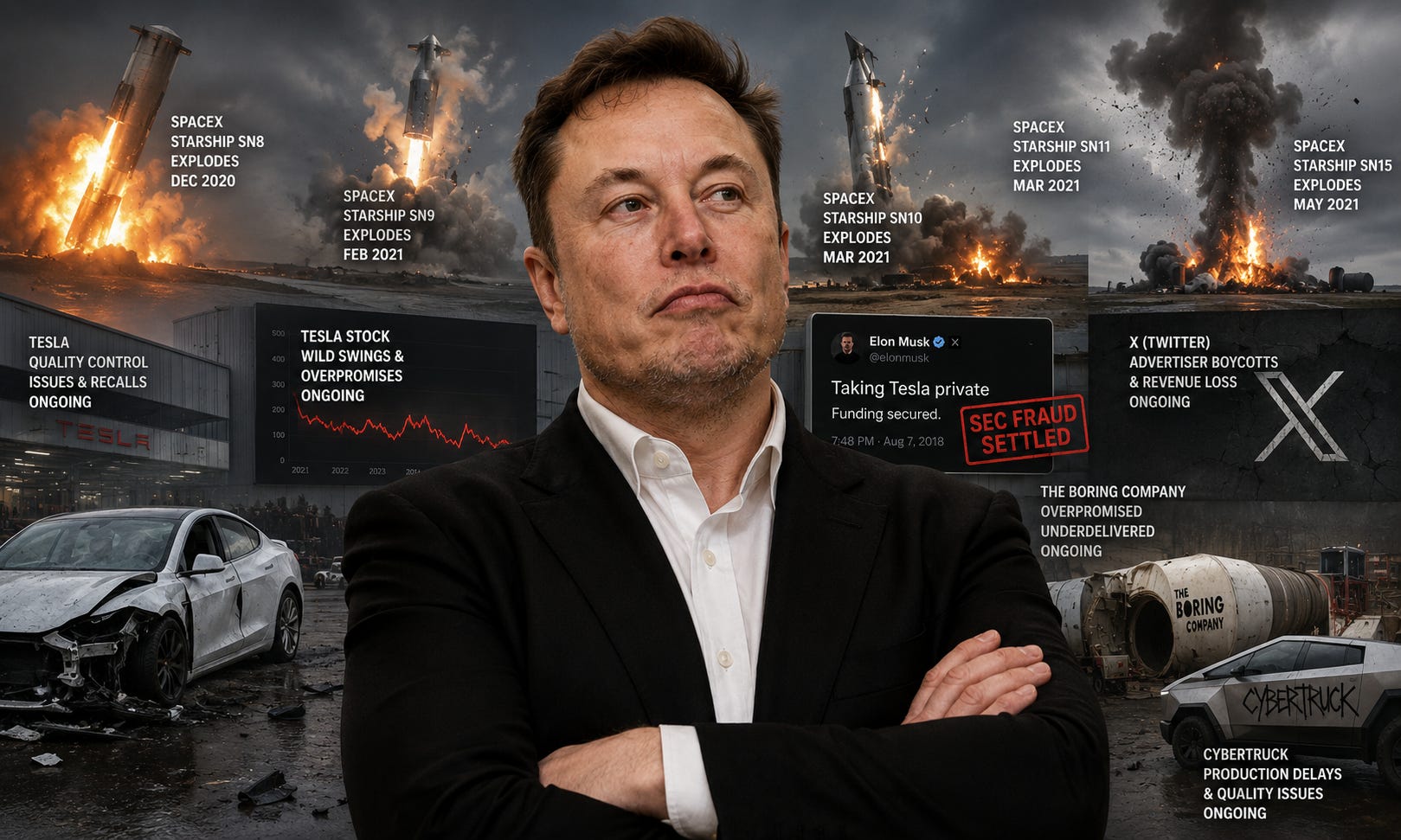
Apparently, the way to become the richest man in the world is to fail bigly and piss everyone off.
Here’s the top-ten (actually, only nine) list of continuing failures, and the most interesting aspect of his life as an immigrant is that he always seemed to fail upward. I’ve done my own share of failures but, somehow, they never worked out that way.
And, awaaay we go…
Zip2: Musk co-founded this intriguingly named company as an early online city-guide software company. Shoulda been a slam-dunk, as many have succeeded since, but investors didn’t understand his kinship with Haley’s Comet, and were unwilling to wait another 75 years, eventually removing him as CEO in 1966. They considered him inexperienced and difficult to manage (an understatement of iconic proportion). Being kicked out is tough for most people to choke down, but Elon used his payout to start over.
X.com / PayPal was his next shot out of the gun and introduced him to Peter Theil, the force behind many internet startups and cheerleader for “move fast and break things,” as well as the admonition to ‘never lose control through going public.’
Musk was again removed as CEO during an internal food-fight over management style and technical direction. Engineers are said to have revolted against his insistence on moving systems to Microsoft servers.The relationship between Musk and Thiel was one of the most important (and strangest) alliances in Silicon Valley history.
Never close friends in the ordinary sense, they were rivals. Allies when it suited, ideological twins until separated, and powerful men who used each other only when it mattered financially.
Ironically, the name “X” survived in Musk’s imagination for decades and eventually became his new name for Twitter which (along with its stockholders), absolutely abhorred the new name).
The PayPal civil war:
Musk founded X.com in 1999 as an online banking startup, a kind of logical extension of the PayPal idea. Peter Thiel had co-founded Confinity, whose payment product eventually became PayPal.
The two companies merged in 2000, and immediately descended into internal warfare, a knife fight instead of a harmonious merger.
Mergers are not always what they hope to be, and very few pay off.
Musk saw himself as a grand visionary, expansionist, wanting a financial super-app, and aggressive expansion. His go-to style was chaotic management and engineering impulsiveness.
Theil was a political strategist, who favored controlled execution, and expected to build a focused payments company with a disciplined legal/structural hierarchy.
If that sounds familiar for Musk, it’s almost exactly the logic behind his purchase of Twitter.
The critical moment came in 2000.
While Musk was on his honeymoon in Australia, to one of his varied baby-making co-pilots, Thiel pulled off what was effectively a boardroom coup and removed Musk as CEO.
Removal had struck yet again, and Musk was personally devastated (if such a thing can be attributed to such a supreme ego). He retained ownership and influence, but Peter Thiel became CEO of PayPal.
That event is said to have permanently shaped Musk psychologically.
Musk never forgot it, never fully forgave it, and became obsessed from that time forward with maintaining absolute control over his companies. At both Tesla and SpaceX, he later constructed stock structures (ala Theil) designed to make removal far harder.
But removal of the incompetent is a strength, not a weakness, of business. And the protective wall he built around himself did not always serve his companies well.
Weirdly, in the cutthroat sense of ‘it’s not personal, buddy, it’s business,’ they remained connected.
After eBay bought PayPal in 2002, both men became enormously wealthy, as well as leaders of what became known as the ‘PayPal Mafia.’
Despite winning the knife fight, Thiel invested in SpaceX during its most dangerous early years.
At a time when many considered SpaceX insane, Thiel backed Musk financially. He may have distrusted Elon operationally, but stood somewhat in awe of his ambition and willingness to attempt civilization-scale projects.
SpaceX: Three rocket explosions and near bankruptcy.
This was probably Musk’s most spectacular technical failure period. The first three Falcon 1 launches failed between 2006 and 2008. SpaceX was nearly out of money. Musk later described the stress as physically overwhelming, but he’s known (for at least the reputation) of sleeping almost not at all, while driving engineers to breaking points.
Most aerospace startups can’t survive a single catastrophic launch failure. SpaceX survived because of Theil’s financial support. The fourth launch succeeded and NASA awarded a contract shortly afterward.
This is a pattern that defines Musk’s career: overpromise, crash, improvise, survive, then rewrite the public narrative around the survival.
SpaceX astonished the world with a stunt no rocketry had ever accomplished, probably because it was beyond any space organization’s ability to conceive of, much less try.
Talk about rewiting the narrative, they landed an initial launch rocket back on a platform not much larger than its base…not once, not twice, but continually. That being one of the most expensive components of space shots, SpaceX became enormously profitable, and no company could approach it in a bidding war.
Telecommunication satellites came next and, unless the government chooses to nationalize SpaceX, it will remain a key to his enormous wealth.
Then, there’s TESLA: Tesla went through ‘production hell,’ nearly imploding during the Model 3 ramp up. Yet TESLA has, since its inception, been a dirty-laundry basket of failed expectations customer wise.
It began with ‘hyper-automation,’ which turned out to be a great idea initiated way too early. It initially assembled cars partly in giant tents, with intense manual labor, under chaotic conditions. Employees described brutal delivery expectations, sudden management reversals, unpredictable firings, and a frantic deadline culture.
In other words, typical Musk management, with Elon sleeping on the floor and most engineers not sleeping at all. Turnover and burnout were the order of the day.
The company largely survived because investors kept believing in Musk. EV demand exploded, traditional automakers moved more slowly and the government offered rebates. Without those factors, Tesla could easily have died around 2018, but it would go on to cripple itself, while China hovered in the background.
Promises made, promises endlessly delayed. The endless broken promises are, perhaps, Musk’s greatest long-term failure pattern. He repeatedly announces impossible timelines, unfinished technologies, and exaggerated capabilities.
He’s promised “Full Self Driving” every year since 2016, unfulfilled robotaxi delivery promises for a ridiculous design, Cybertruck release dates (and a mechanical disaster when it finally came, as well as Tesla Roadster 2 timelines for a car that’s not even scheduled).
But, the icing on a collapsed cake, is his scheduled delivery of branded ‘signature Model X and Model 3’ $156,000 (prepaid) delivery with great fanfare...cancelled without notice…three days before their delivery celebration. Not even an apology or explanation.
Meanwhile (a favored Stephen Colbert segment) he closed a production gigafactory to concentrate on humanoid robots, which he claims will be his ticket to becoming the world’s first $trillionaire.
Wow…Elon…Really? Got a delivery date in mind? Checked out what’s going on in China, have you?
“Funding secured,” Elon’s SEC humiliation.
In 2018, the Musketeer tweeted that he had “funding secured” to take Tesla private at $420/share. In actuality he had no such deal in hand, and the SEC concluded the statement was misleading and fined both Musk and Tesla $20 million each. Pocket-change perhaps, but Musk was temporarily forced to step down as Tesla chairman, an action that may have sent chills down his spine as ghosts of earlier corporate disasters.
This was one of the first moments Wall Street openly questioned whether Musk’s public statements were reckless rather than visionary, although anyone with eyes to see and ears to hear might have gotten an earlier clue.
The purchase of Twitter/X Perhaps his biggest self-inflicted wound.
The purchase of what would cast aside a major brand (Twitter) in favor of X, may become Musk’s most significant example of shooting himself in the foot.
He paid multiples above market value, simply to stand by and watch advertiser flight, chaotic layoffs, verification confusion, moderation controversies, falling brand value, a confusing “X” rebrand, and either firings or departure of most engineers and marketing pros.
It was classic Elon Ego and something few other than he could afford.
Perhaps that’s why he makes so many absolutely unprovoked and poorly thought through public utterances…because he (and only he) can afford them.
Critics argue Musk fundamentally misunderstood what Twitter actually was: not a tech platform alone, but a delicate political-media ecosystem. The rebranding from “Twitter” to “X” destroyed one of the most recognizable brands on Earth, and that decision still astonishes branding experts.
Destroying (in four months) a great deal of the functions of American government that we will soon celebrate on the nation’s 250th birthday.
This piece is already too long and I cannot bear the personal pain of what this (now increasingly unwelcome) immigrant has done to my country, and the vital machinery of government.
The remarkable thing is not that he misses deadlines, or should be (forcibly if necessary) disarmed before shooting himself once again in the foot.
It’s that investors and fans continue believing the next projection.