
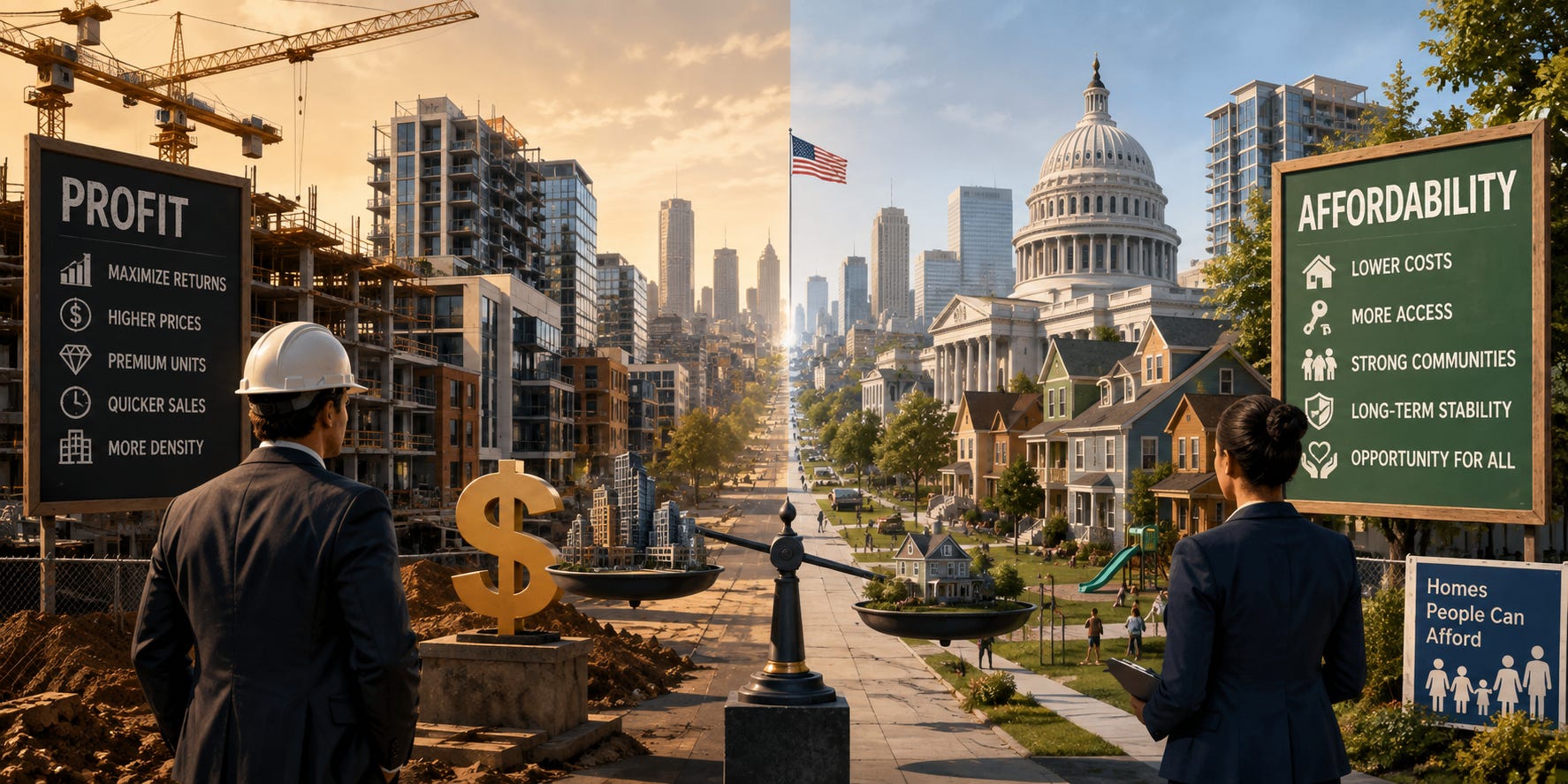
If ever there was a definition of ‘cross purposes,’ that would serve as well as any.
Is “We’re full. We like it the way it is. You can go somewhere else,” a logical path forward, tied as it is to litigation and zoning constraints?
Just to keep my credibility clear on this issue, my home for a major part of my earlier life was Lake Forest, Illinois, and you can’t find a better illustration of that circumstance. Additionally, as a retired landscape architect, I have in my day sat through more Chicago-area meetings on the subject than I care to remember.
Because there is no single American housing-development approval system, a project may encounter municipal, county/regional, state, federal, and quasi-public utility approvals, and the exact combinations vary enormously by location and project. But they will likely include,
zoning compliance; rezoning or zoning-map amendment;
comprehensive/master-plan consistency;
subdivision approval; preliminary plat; final plat; site-plan review;
conditional/special-use permit; variances; density/height/FAR approvals;
design/architectural reviews; a historic-preservation review;
demolition permits; tree-removal/landscape approvals;
grading/earthwork permits; erosion-control plans and a stormwater/drainage plan;
street/access approval; curb-cut/driveway permit; parking approval;
water connection; sewer connection/capacity; fire-department review; and
building-plan review; building permit; electrical permit; plumbing permit; mechanical/HVAC permit; elevator permit; construction inspections; fire inspection, and certificate of occupancy.
But hold on, that’s only the beginning. A spadeful of earth will not be turned until,
Planning commission approval; zoning board/board of adjustment; design-review board; historic commission; sometimes city council/county commission approvals;
public hearings; neighborhood notifications; sometimes development agreements or negotiated community benefits,
county subdivision reviews; county roads/access; health department approvals; septic systems; wells; drainage/flood control; regional transportation review; school-impact review; regional water/sewer authorities; regional planning agencies; sometimes separate environmental or open-space reviews (whew),
State environmental reviews in states having NEPA-like laws; state highway access/traffic permits; state water-quality certification; wetlands permits; stream-crossing permits; dam/reservoir approvals; groundwater/water-withdrawal permits; sewage-treatment approvals; air-quality permits where applicable; endangered-species review; historic-resource review; coastal-zone permits; state fire/building-code requirements; utility/public-service commission approvals in some circumstances, and possibly
Federal Clean Water Act 404 wetlands/waters permit; 401 water-quality certifications connected to federal permits; NPDES construction-stormwater permit; Rivers and Harbors Act permits where navigable waters are involved; FEMA/floodplain requirements; Endangered Species Act reviews where federal action is involved; National Historic Preservation Act review; NEPA environmental review when federal funding, land, approval or other federal action triggers it; HUD environmental review for HUD-assisted projects; various EPA, Army Corps, Fish & Wildlife, highway and other agency requirements depending upon the project.
And those are (most) of the requirements meant to be acted upon.
If you ever had a hankering to develop some low-cost housing, bear in mind that such terms as ‘review’ and the ever-present ‘permits’ have various waiting times, and almost endless meetings (with paid experts in tow).
Two additional federal requirements are particularly common on large sites.
Construction disturbing one acre or more—or a smaller parcel that is part of a larger development ultimately disturbing an acre—generally requires construction-stormwater coverage under the Clean Water Act.
If development involves filling federally regulated waters or wetlands, a Clean Water Act 404 permit may be required, generally administered by the Army Corps of Engineers or, in some places, an approved state or tribal program.
Oh shit, let’s just fold our tent and get the hell out of here.
There will be a half-dozen nearby residents who will show up at each of the above meetings, because they have nothing else to do in their retirement years, and at least one of them will take you to court.
These ‘not in my back yard’ groups have in common the fact that they are both relentless and vicious.
If you wonder why it costs so damn much to build housing in America, this is a major part of the answer. The relevant burden isn’t simply the number of permits, it’s the accumulated cost of land held idle, lawyers, architects, engineers, consultants, financing, redesigns, hearings, studies, fees, uncertainty, further redesigns, and years of carrying costs while those approvals are obtained.
There can be (and at some point, will be), ways to fix the seemingly unfixable.
We need a National Building Code, which would undo much of what hinders approvals, and allows manufactured housing at the same time, as well as,
a national Right to Purchase obsolete shopping centers, dead malls, underused parking lots, abandoned industrial land, surplus government property, underutilized military property, aging office parks, commercial strips, municipal land, and low-density parcels around existing cities.
Many of those properties already have something extraordinarily valuable: roads, electricity, water and sewer nearby. A dead shopping mall surrounded by 80 acres acres of asphalt may actually be far more valuable as a housing resource than 80 acres of untouched farmland.
Here’s what may be an interesting twist on the problem.
Cities and states are already bidding against each other to offer tax breaks for businesses and individuals moving elsewhere for tax purposes. Some of these incentives are extremely generous.
Suppose, just suppose, we encouraged small-town America to bid for mixed-use housing projects that would repair the misery the interstate highway system caused them. Small-town America is, and has been suffering for decades from boarded-up Main Streets, as well as populations that abandoned them.
Local restaurants, barber and hardware shops, jewelers and grocery stores fell victim to the Wal-Mart five miles out of town, or the fast-food joints at their nearby interstate interchange. Small-town America is our heritage, an asset left swinging in the wind.
That asset can be recovered, instead of dying off with its aging residents.
A combination of businesses-looking-for-workers, and workers looking for a peaceful place to live, educate, and bring up their kids, could quite logically feed off one another.
Levittown, in an upgraded version, might easily rise again and support the building of the 5 million homes we need over ten years, and another 5 million the following ten.
We built Levittown for returning WWII veterans. Are our underhoused, and youngsters today who can’t afford a starter-home, any less important?
I think not.
But what we have isn’t working.
It may be time to try something new…