
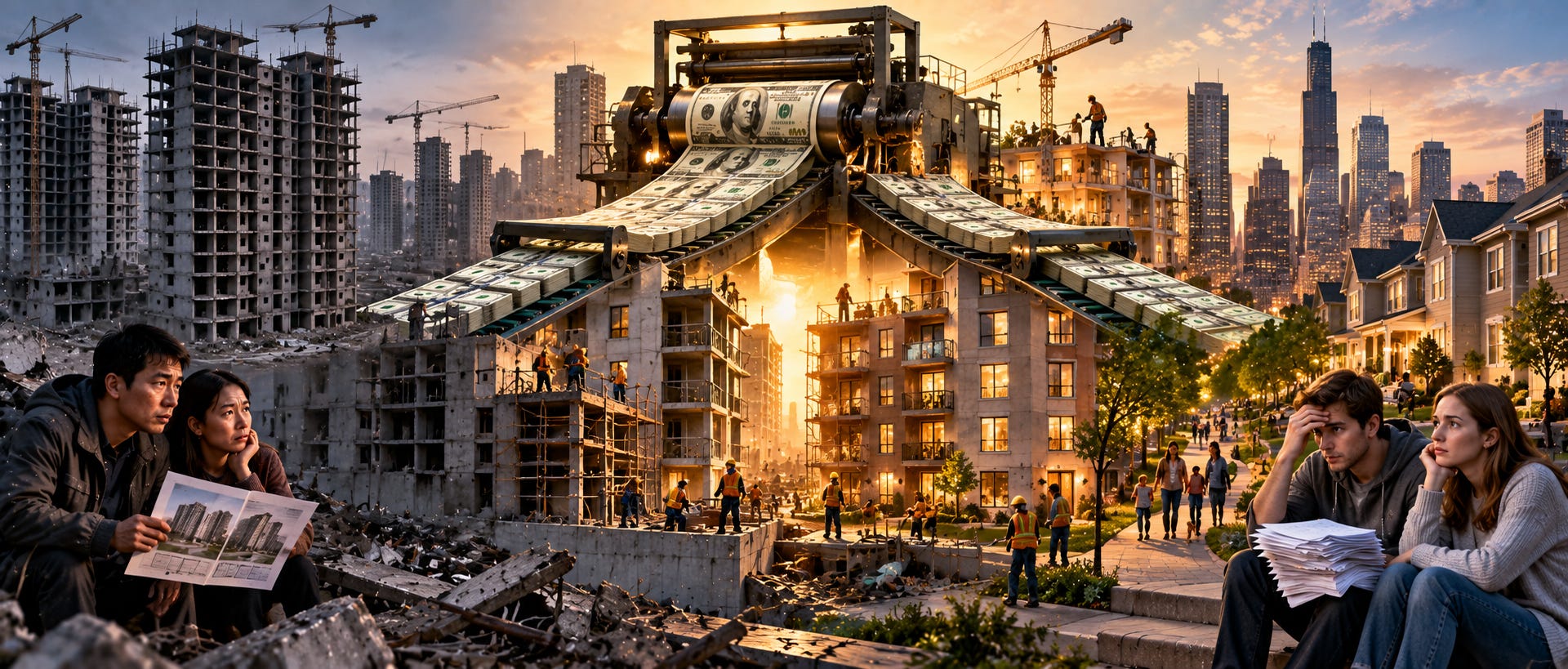
It’s non-partisan, internationally applicable, and easy to achieve. It works on housing shortages for the young, the homeless, and those removed from the markets by exorbitant college debt. In the case of China, the problem has been caused by developers who used down-payments to expand their businesses, rather than complete the units promised.
One size fits all. Deliver houses and apartments.
Now, before you rant at me for ignoring the truths of 2008, or mindlessly bowing to uncontrolled inflation, let me make the case:
matter where you live in the world, if private housing is available, it represents life’s largest and most secure investment.
Home ownership supports government, because it invests the population in ‘staying put’ and building a solid life.
In countries where saving rates are low, it encourages saving and asset growth.
It provides an asset to be handed down to the next generation.
So, all things considered, it’s a good thing, right?
Conveniently to my argument, China and the United States share housing crises that destabilize their governments, but for different reasons.
And, just to get the argument on somewhat level ground, let’s agree that having the two major nations in world government sharing a similar instability, is generally a bad thing.
Artificial intelligence may be the juicy-headline race, but internal security is the long game. Both nations are spending enormous sums on AI, while housing problems occupy a very, very back seat.
And you no doubt remember the parable of the tortoise and the hare.
Excuse me for a moment, while I discuss my opinions on assets and liabilities, and why they matter.
Liabilities are, by definition, ‘debts or financial obligations owed to others, whether that’s an individual, a business, or a country.
Governmentally, that generally means social benefits such as unemployment insurance, housing and food subsidies (but not Social Security because it’s self-generating),
The National Debt is included, now $40 trillion,
At least half of all military spending, including the Pentagon, because it purports to give us the security to maintain our assets,
The costs of maintaining the Executive Branch, a Congress and Supreme Court, all three of which purport to maintain our freedoms.
The questionable adjective here is ‘purport,’ which means “having the often specious appearance of being, intending, or claiming.” But, without those three pillars, there essentially is no government, so I guess we accept what we have, purportations and all.
Assets, you will be pleased to find, are defined as “anything of material value or usefulness that is owned by a person, company, or government” (government, in this case, being a collection of persons). They include;
Schools,
roads,
industries
electric grids,
and other public media,
housing (both public and private),
the other half of the military (which actually does protect our rights to ownership),
infrastructure such as bridges, sewers and waste disposal plants,
small towns,
cities,
airports and railways
There are other liabilities and assets within government, but the acid test is whether or not there is something left at the end of the spending that is worth more than what was spent.
If yes, an investment is considered a good thing and, in general, assets are said to return between two and four dollars for every dollar spent.
If no, much of the money spent returns nothing but the survival of a given portion of society and, although that’s important, such expenditures must be watched closely, but maintained.
My complaint is that, in current conservative American governments, fiscal solutions invariably include cutting back those liabilities that support society.
If you don’t yet see my solution for both the United States and China, I’ve not written well.
Print the money to solve both nation’s housing problems, AND you will be rewarded somewhere between 2 and 4 to 1.
The acquisition of housing assets in both nations will avoid those feared inflationary pressures and leave in their trail
a grateful public, with
increased faith in their government,
the future of their kids and
their personal well-being.
Assets delivered (and housing is such an asset), means
increased personal saving and the
positive influence of affording the small expenditures that keep mercantile wheels turning.
In both China and America today, those are very big wheels.
Thus two great nations suffer similar road-blocks, both related to housing.
In China, estimates point to an overhang of roughly 90 million empty or unfinished pre-sold apartments nationwide. Chinese citizens have lost an estimated $1 trillion in unrecoverable deposits, due to developer defaults. Over 540,000 properties faced court-ordered auctions, in early 2026 alone, as distressed assets flooded the market.
None of those auctions returned money to the individuals who had made downpayments in good faith. Instead, they paid off
secured lenders (Banks),
local financial institutions, and
state-owned asset managers, as well as
bankruptcy liquidators and contractors.
These losses, in many cases, equal the life savings of innocent Chinese citizens, due to circumstances allowed by their government. Chasing criminal developers does nothing to compensate the innocent.
Putting them back in those half-million apartments would
revitalize dead neighborhoods,
reinstate renters as owners,
save nearly completed buildings from deterioration, and
rescue new owners from financial disaster.
Local businesses would bloom,
take off, and
social life begin to swing once again, Chinese style.
Without that, every single building is a dead loss. As the Chinese government seeks to punish the developers, the real losses are in a half-million potential assets turned into unrecoverable liabilities. Even the cost of tearing down what has been built is beyond knowing.
There is no alternative, and not a week needs go by in a communist dictatorship that moves like lightning when it serves them.
The alternative is social disaster in a nation only beginning to thrive.
In America, the problems are more complicated, but the solutions are similar.
American student loan debt stands at $1.86 trillion, representing one of the largest categories of consumer debt in the United States, second only to mortgages.
91% is held by the federal government, impacting 42.6 million individual American borrowers.
The average balance is $40,000 per borrower, owed by those in their 30s and 40s,
exactly the same people hoping, but unable, to buy a starter home.
According to the latest U.S. Department of Housing and Urban Development (HUD) annual data,
745,652 people were officially counted as experiencing homelessness in the United States. Because they have no address, these are people who
cannot vote,
cannot hold jobs, and
cannot pay taxes
Essentially, they are a dead weight on the economy, usually through no fault of their own.
Building houses and alleviating student debt would go a long way toward solving those issues, turning liabilities in the private sector into assets.
Admittedly, solutions in America are political, while they are dictatorial in China. Thus China can solve them more easily.
In America, we can wait for an economic collapse to force solutions
It’s a choice…