
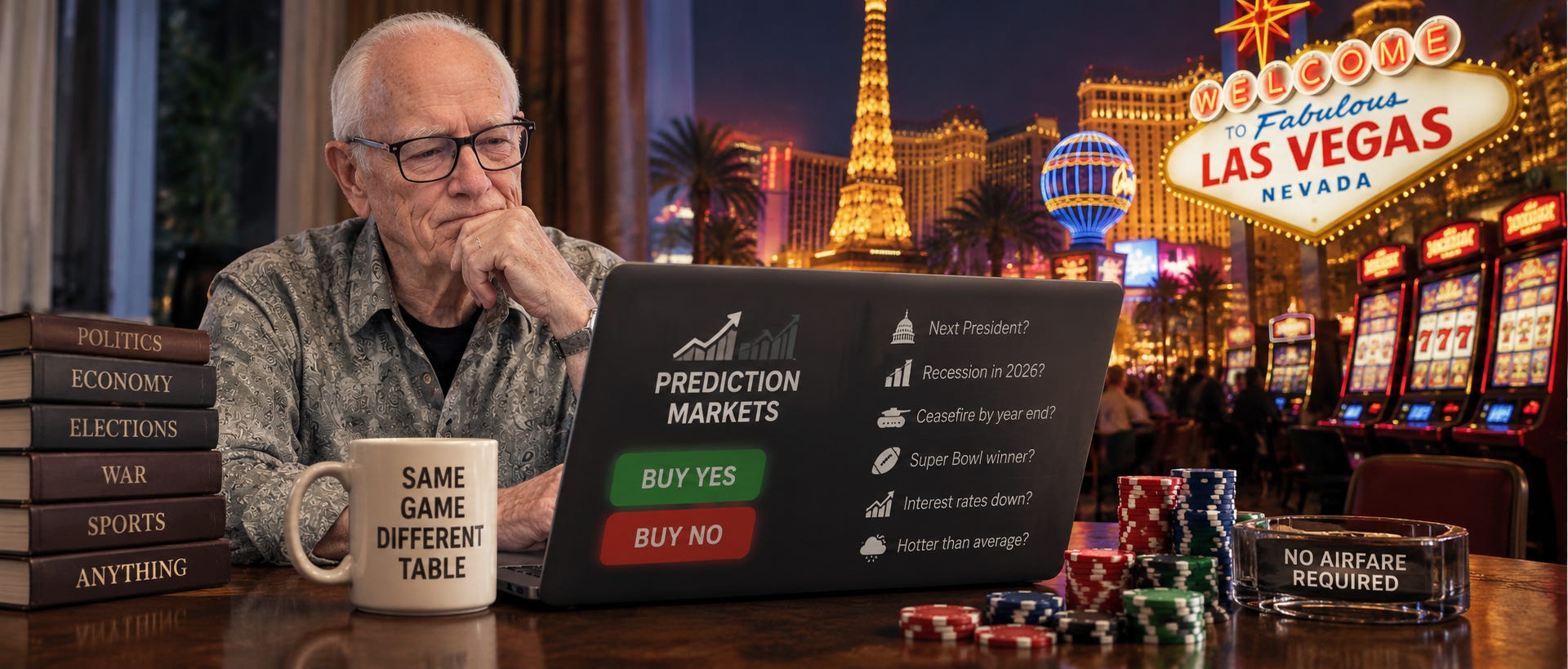
Americans, one must admit, are largely addicted to gambling. It’s the ‘something for nothing’ attraction, even though we’ve conveniently set aside the ‘nothing’ side of the equation. Simply look at the $5 water-cooler bets on Sunday’s game.
It seems to me, and I am not a gambler at heart, that Prediction markets are worth taking seriously, because they’re yet another way to lose the family farm without your family having a clue. And you don’t have to take time off to go to the track or Las Vegas, because it’s all available at your fingertips online (so long as nobody looks over your shoulder).
Prediction markets sit at the intersection of forecasting, financial markets, gambling, politics, journalism, and increasingly, public policy. That’s six points of information most of us know nothing about, so it’s easier to worry, betiing wise, about whether Patrick Mahomes gets injured in the first quarter.
What is in the way between us and a win, is
if the Dow Jones makes a sudden jump,
what Trump may tweet,
what the guy we’re betting to win a primary says at a public meeting, and
if he has a heart attack.
Mahomes is simple, compared to that.
So’s a slot-machine, and at least you can try to time a slot-machine for payoff. It’s easier to simply bet the farm on black or red, spin the wheel and blow your brains out or go home.
But, if you’re addicted to smoking, any brand will do. Where the government comes in, is usually not on the side of a gambler’s family.
When Prohibition made booze illegal, Al Capone and the boys invented the speakeasy, ran illegal alcohol routes and made big dough. Legend has it that this is where John Kennedy’s father made the family fortune. So, government threw in the towel, quit the deal, and repealed the 18th Amendment, because prohibition wasn’t working, everyone was drinking bad booze, while Capone made dough and the government looked foolish (which is a bad look for any government).
Similar, but hardly exacy, story with gambling.
America spent much of the twentieth century severely restricting gambling, and governments subsequently discovered that legalized gambling could also produce tax revenue. Lots of it, at a time when politicians were eager to turn on any faucet available.
It wasn’t that guys lost the rent money or farms changed hands, it’s that state and national governments weren’t holding the cards. When Trump told Zelenskyy he wasn’t holding enough cards, where do you think the expression came from, and why do you think everyone instantly knew what he meant?
And so, we come at last to Prediction Markets.
They have existed experimentally for decades, but since the 2024 election they’re qualitatively different: they have become a very large commercial industry. Suppose the question is: Will Democrats win the presidential election?
A YES contract (yep, these things are contracts) might trade for $0.63 and a NO contract for roughly $0.37. Buyers and sellers create those odds through trading, saying the probability is 63%. If YES happens, the contract settles at $1. If not, it becomes worthless. Before the event occurs, traders can buy and sell their positions as expectations change. To the fellow losing his money, the distinction between “market price” and “betting odds” may seem wonderfully academic.
That produces something ordinary opinion polling does not.
People are not merely telling a pollster what they think, they’re putting money down. The economic theory is that thousands of participants possess fragments of information. Trading causes those fragments to become incorporated into a single price. The Commodity Futures Trading Commission (CFTC) describes prediction markets as “information aggregation vehicles.”
As I’ve explained so many times in judging Banks and Wall Street, a ‘vehicle’ is what robbers take off in, after the robbery. That was true in the 2008 housing bubble, has been true in other bubbles such as dotcoms, and is likely in prediction markets as well.
Those who agree or disagree will ether make money or lose the farm.
So, the defensible statement isn’t that prediction markets always predict elections better than polls, it’s that there’s considerable empirical evidence that properly functioning prediction markets can aggregate dispersed information extremely effectively and sometimes outperform conventional polling, particularly farther down the pike from Election Day.
And, that’s a mouthful, so if you understand it, let me know.
The keywords are ‘properly functioning,’ ‘extremely effectively,’ and ‘sometimes outperform.’ If you’re comfortable with all those adjectives, I have a whole lot of investment opportunities for your portfolio.
What AI tells me is; Imagine 10,000 people trying to predict an election.
One knows polling,
Another knows turnout history,
Another follows fundraising,
Someone lives in Pennsylvania,
Someone else understands Hispanic voting behavior,
Someone further follows economic indicators,
Another knows something about campaign organization, and
Each possesses incomplete information.
A prediction market provides an incentive for people who believe the market is wrong to put money behind their information. If knowledgeable traders believe a 40¢ contract actually has a 60% chance of occurring, they buy it.
A prediction market works beautifully, in theory, when you have
lots of independent participants,
sufficient liquidity,
informed traders,
no manipulation,
reliable settlement rules and
nobody with privileged information affecting the outcome.
I know damn well I ever saw Wall Street work that ‘beautifully.’ Greed trumps theory in both Vegas and Wall Street.
In my experience, reality more often gives you thin markets, whales, political partisans, insiders, people betting on events they themselves influence, journalists reporting the market price as news, and traders potentially trying to manipulate that price.
We’ve taken gambling out of Las Vegas, removed the travel, removed the closing time, put the casino in everyone’s pocket, and renamed the bets “contracts.”
And that, rather than any rational and thought-through process, is how I expect boatloads of investors, who don’t live within 500 miles of tillable acreage, to lose the farm.