
The short answer is that humanity has not yet been invited into the debate.
Is there a God? Perhaps so, but He (or She) is busy at the moment, and not taking my calls. Dial 9 for more information, when and if He or She decides to give it out.
I have coffee most every week with a dear British friend who is current on world events, and one of the few points of agreement we share is that so many facts that would (and perhaps should) be available to the argument are simply shielded behind governmental curtains. Those Wizards of OZ (and there are many of them) shift, and manipulate, pull levers, and fiddle dials with humanity’s future without any proper observation or outside control.
That may sound a bit hysterical, but we simply don’t damn well know.
On the few occasions we are inadvertently allowed to peek under the rug, it seems that those who ‘do know’ pretty much have their knickers in a twist about whether AI will become sentient and run off with humanity in its back pocket, destination unknown.
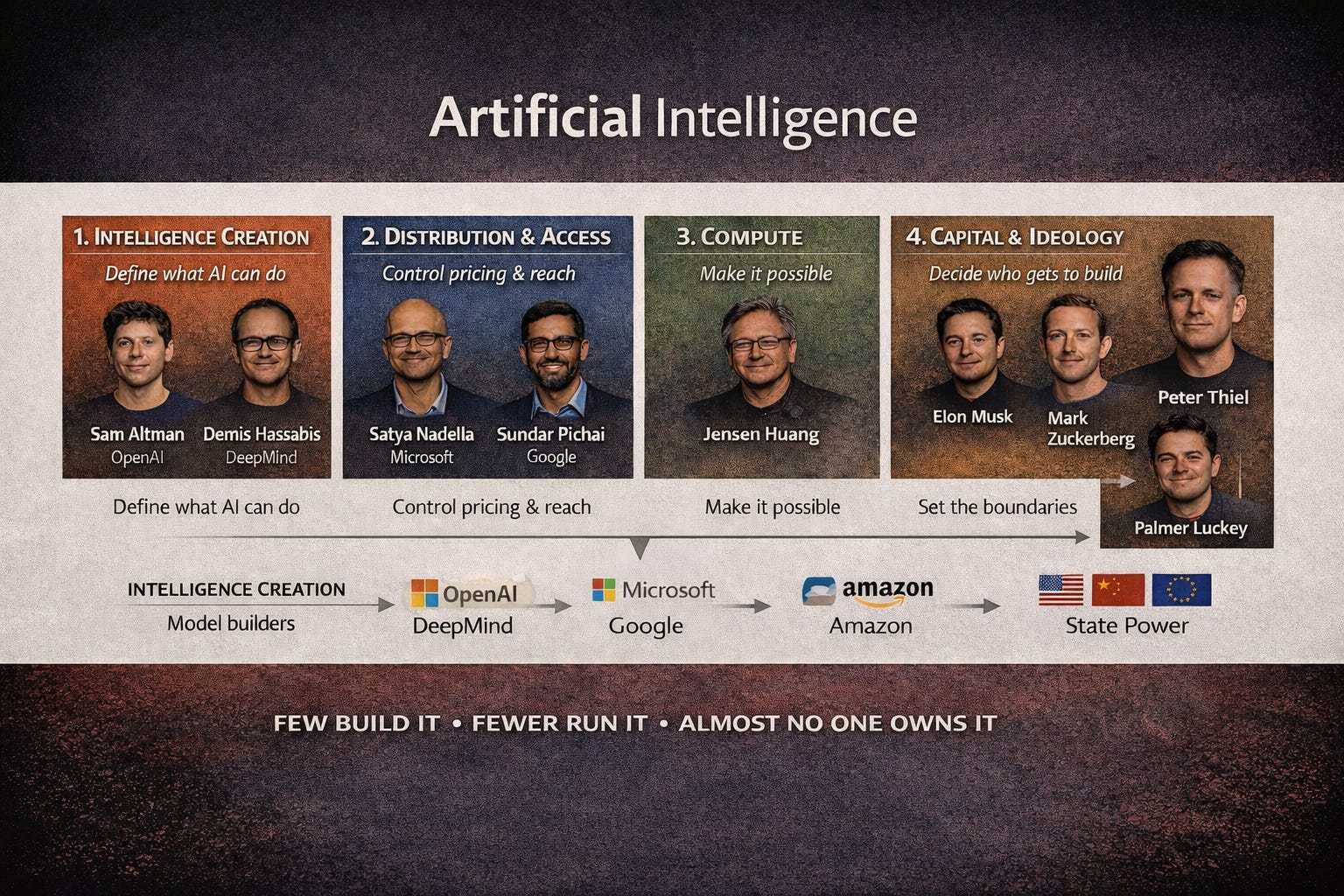
You and I, one would hope, have a shared interest in that destination, along with the ethics and intentions of whoever might be the winner and what, in fact, they might have in mind once they have won. So far, the main contenders appear to include OpenAI, Google DeepMind, Anthropic, Meta, xAI, Mistral AI and Cohere, although that list may be out of date by the time you read this.
The Cloud & Platform Giants who control the infrastructure, and provide the computing power and distribution, are the usual suspects.
Microsoft, Amazon, Google and Oracle, all of who’s representatives stood proudly front and center (even in front of family) at President Trump’s inauguration. That was likely a wrongheaded marketing move, as it all too clearly identified them versus us in the political world.
Gotta keep all that secretive stuff apolitical. Big money is supposed to do what it does both quietly and in the background.
The United States is not alone in this international footrace. China, the United Kingdom, France, and the European Union all, have their own competitive runners in the starting blocks, so the stakes are high and information is low. Once you strip away all the marketing gibberish, the ‘who’s winning’ question comes down to three aspects: models, infrastructure, and geopolitics. As you might expect, and different players compete in each.
In models, OpenAI and Google DeepMind are thrashing it out in reasoning, multimodality, and scale. Anthropic is a strong third, especially in what they call reliability and enterprise trust (however anyone chooses to define those). Infrastructure, I’m told is the quiet winner.
Microsoft, by backing OpenAI early, turned itself into the default AI platform for business.
So, they’re winning this part of the game for now. But again, from what I understand, the real choke point for everyone in the game is chips, and NVIDIA is the only source that supplies the GPUs that OpenAI, Google, Meta, and governments all depend upon. Because demand still outstrips supply, NVIDIA is the single biggest winner in the entire AI boom at the moment and, because chips are short worldwide in all sorts of other operations, they’re likely to stay there.
The real story isn’t who wins AI, at least in America, it’s who controls access to it.
The uncomfortable reality is that we’re moving toward a system where a handful of firms own the intelligence, rent the infrastructure, and our government sets the boundaries.
That’s not the open internet model we were promised, but closer to broadcast television in the 1950s, where just a few channels had enormous influence. But this is not the 1950s (don’t we wish it was) and control of AI access will determine which ideas get amplified, which businesses survive, how expensive intelligence becomes, and whether individuals remain independent thinkers, or become subscribers.
I don’t know about you, but my cost of various paywalls is getting out of hand. So, the future isn’t so much about who builds AI, it’s about who you have to pay to use it.
It’s likely to be Peter Thiel, Elon Musk, Zuckerberg, or some other individual I would rather indict than make wealthier. Whataya bet I simply sigh deeply, grumble under my breath, and pay up anyway?
Sleep well, your country and its richest component is working day and night to make your life as decisionless as possible. There is wheat in the world and there is chaff. You and I, the voting public, are definitely chaff.