
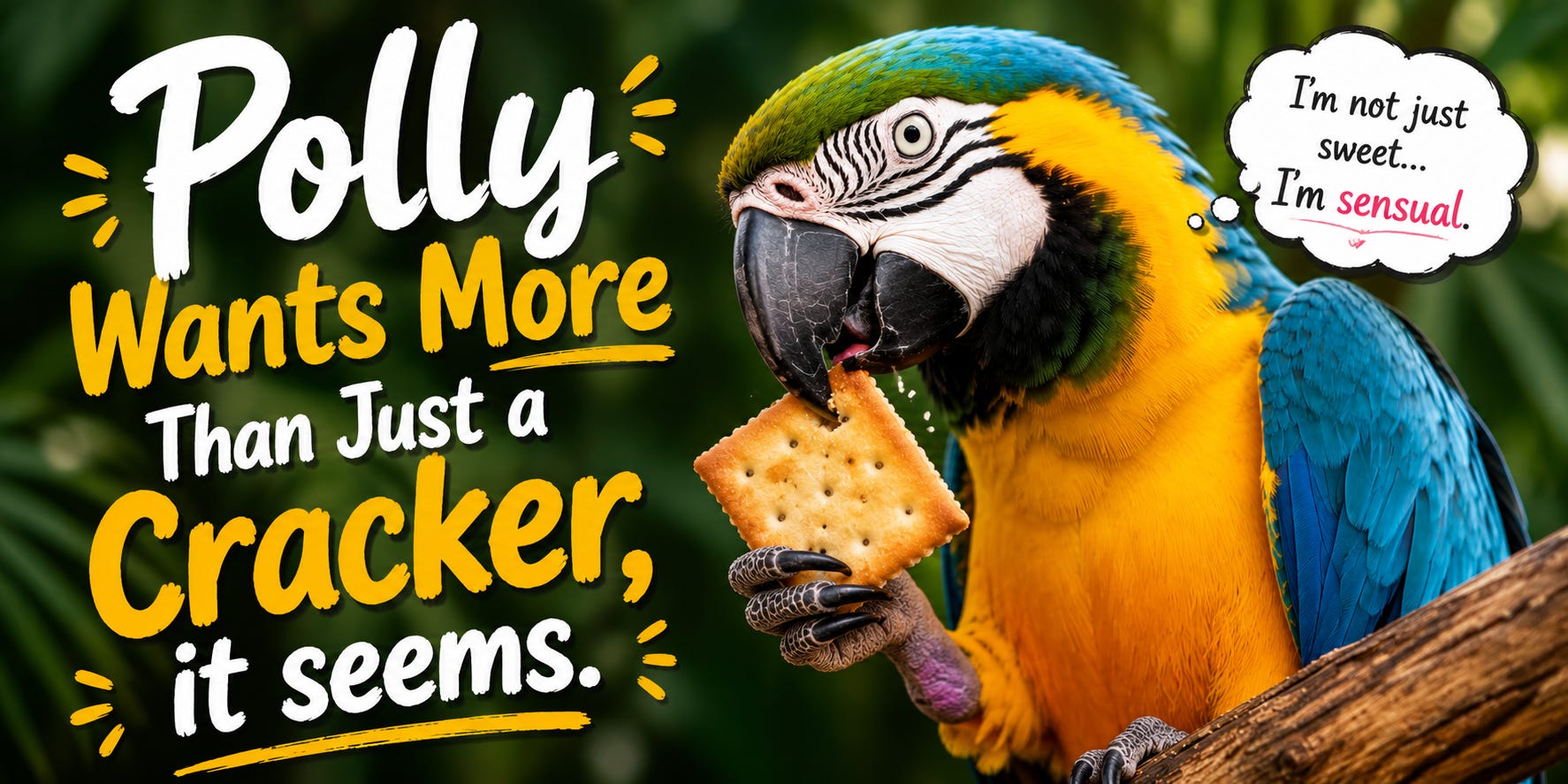
So help me, that is a Guardian UK headline.
Bear with me, as I share the opening paragraphs of the article: “An investigation into acts of self-pleasure among parrots and other birds has reached a climax, with the results providing welcome relief for vets and researchers, not to mention the birds themselves.
“Bird keepers are often advised to discourage and even punish birds for masturbating, but the study found the activity was more common in the wild than in captivity, with researchers concluding it is part of a bird’s natural behaviour.
“The report’s authors urged vets to reassure worried owners that the antics are not harmful and warned that efforts to intervene, which range from removing perches to hormone treatment and surgery, could be far more damaging.
“Our big finding is that masturbation is not a negative response to captivity,” said Dr Chloe Heys, an evolutionary ecologist at the University of Lancashire in Preston. “This is widespread in birds and we found it’s a perfectly natural and healthy behaviour that’s part of their repertoire of sexual behaviours.”
Bird keepers ‘are often advised,’ are they?
That’s news to me. I was raised as a kid with a parrot, a somewhat nasty bird that drank coffee and bit my finger if I offered to shake hands-feet with it. But I had never observed Abner trying to pleasure himself. I had just only recently gotten around to that discovery myself.
And, what does that say for the wild bird world outside our windows? Is that low hum sometimes heard at night, not the neighbor’s car left idling in his driveway, but the collective moan from the trees, announcing community orgasm among our perched bird world?
And, is it nocturnal, or only likely to assault our ears at that specific time for ‘easy listening’?
Further, what has it to say of our wider, un-feathered natural world?
Whales, I’m told, can communicate across hundreds of miles. Are the oceans abuzz with self-manipulated sexual activity? These are serious questions, that may affect radar, sonar, and other man-made instruments of destruction.
One can but wonder.
The singing of mosquitoes, chirping of crickets, even (as yet, unstudied) moaning of trees as they bend in the wind. What of these things, I ask? Is the veretative world left out, or merely unstudied? A vet surely cannot answer, but perhaps a horticulturist might apply for a grant to see what your houseplants are up to when you’re not looking.
Dr Ana Basto, a vet at the University of Lancashire who was not involved in the study, said the report would help vets give better advice to bird owners.
“This research is pivotal and will be a step towards achieving a more holistic understanding of why and how birds behave the way they do.”
What about our kids, Ana, locked in their bedrooms upstairs, loud music playing, and not answering the door?
Are they to be ignored, while we fret over a parakeet with a smile on its beak? What are vets contributing to the understanding and support of our sexually misunderstood children?
Down with birds and up with children, I say.
It’s a mantra for today’s over-stressed parents.
Our kids do not (yet) shit on newspaper in cages.
Free the whales, save them snails, take a deep breath and allow the animals, vegetables and humans to get along as they always have…badly, but with an outlet for their misery…