
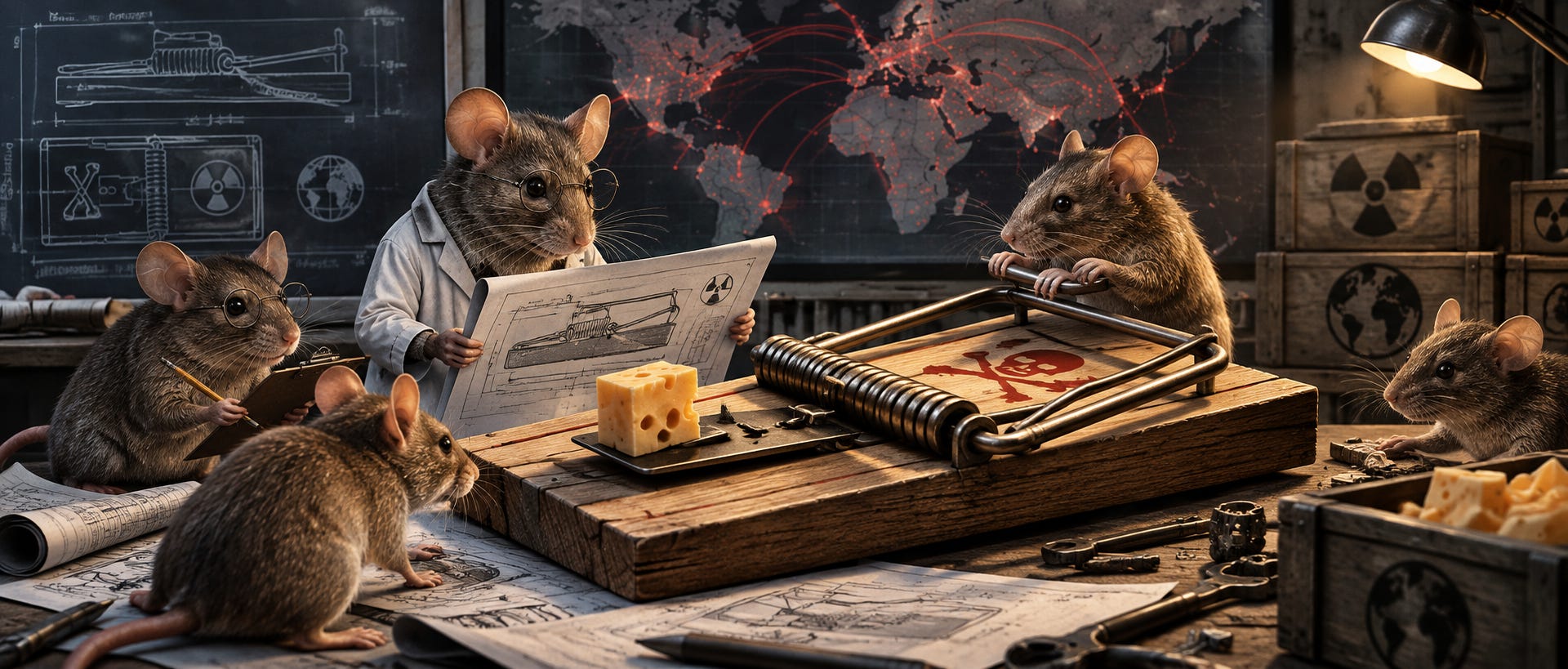
Such are the AI world and collapsing environments at the moment
So, which mousetrap is it, artificial intelligence or environmental chaos? Humankind rolls the dice and they come up snake-eyes on either choice.
But being human, and having sole access to that ‘big brain’ we’re so proud of, we’ve chosen to kick both cans down the road for the foreseeable future. Indeed, we are mice, and mice are more attracted to cheese than the possibility of a sprung trap.
But one mouse, one sprung trap and one dead mouse does not rid humanity’s house of mice.
But hold on, you mouse trappers. Physicists were stumped for nearly a hundred years on something called the Navier-Stokes Existence and Smoothness Problem.
I’ll bet you didn’t know that.
A couple weeks ago, OpenAI announced that it successfully solved the problem ( one of the seven historic Millennium Prize Problems). The job was done in 88 hours by 10,000 autonomous AI agents working concurrently. Physicists and mathematicians are now asking themselves (and each other) if the profession they chose is no longer viable and if, in mid-career, they have become redundant.
AI, as I have insisted in a number of articles, is only a tool. I may be wrong, and much is no doubt at risk, but break-though tools have both thrilled and threatened humankind for its entire history.
The invention of the longbow, prior to Europe’s Hundred Years War, was thought to be so deadly as probably the end of warfare. And yet here we are, six centuries later, killing one another with drones and hypersonic missiles.
The invention of the steam engine sparked the First Industrial Revolution, powering factories, steamships, and locomotives It fundamentally reshaping labor (at their horror), global trade, and urbanization.
Electricity became a universal utility. Powering the Second Industrial Revolution, it lit up cities, prolonged productive hours, and reinvented nearly every subsequent modern technology.
Antibiotics revolutionized medicine and doubled the average human life expectancy in the 20th century.
The Internet and World Wide Web reorganized global information access, interconnected humanity in real-time, and restructured the global economy, each of them (as we have seen) for both good and bad.
America’s wealthy trundled off its industrial power to China, in return for profit, and the former middle class lay wounded and bleeding by the side of the road. A billionaire class emerged to replace it.
And now it’s Artificial Intelligence’s turn so, hang on to your hats, but don’t despair (yet).
Other risks are now hanging off the landing-gear of this wobbly AI helicopter. Mathematicians are worried, but what of physics and medicine? Might Einstein’s theory of relativity have been proven in days, rather than decades? Might the cure for cancer have already arrived?
When trying to evaluate the risk/benefit values, it becomes obvious that the value of a new tool depends upon the uses to which it is put. And that’s a very scary and unknown element.
An AK-47 is a benign piece of hardware, unless in the hands of a school-shooter. AI, which may open all sorts of roads to medical progress, might also be used for evil purposes. A madman might design a widespread outbreak of a deadly infectious disease, such as the Spanish Flu tThat killed 18 million people early in the 20th century. That was under relatively isolated circumstances. But the world is an open space these days.
So, rather than opening Pandora’s Box, it’s mostly a matter of who is allowed to peek inside, and under what circumstances.
That’s a very large and currently unanswered question. It has been said that “when the cat’s away, the mice will play.”
Perhaps a ‘resident cat’ is the solution.
Or smellier cheese.