
At 91, and living in the comparative luxury of Prague, I dare to call myself a journalist, which demands a definition of the term. Mirriam Webster defines that as “a person engaged in journalism, especially a writer or editor for a news medium, or B) a writer who aims at a mass audience.”
The first of those definitions irritates me, when dictionaries use the word to define the word: Thereby, ‘a journalist is a person engaged in journalism’…what trash.
Beyond that, ‘a writer or editor for a news medium’ only applies if one defines Substack as ‘a news medium.’
You can already see me reaching, sweat dribbling down my side, and yet salvation may be found in ‘a writer who aims at a mass audience.’ Does it count, if one aims, but does not hit? I have 184 Substack followers and still ‘aim’ at a mass audience, on Facebook, LinkedIn, Substack and Threads. I aim, but have yet to attract the several hundred thousand targets out there.
I am not there on the world’s frontlines. I am observing there, but from the comfort of here.
I’ve written over 3,500 essays (you might honorably call them columns) since the turn of this century, all of them featured on The Dark Side of the Moon. And even that carries its own minor controversy: I had no idea at the time that the name was that of a Pink Floyd album. I had named it for a Mark Twain quote:
“Every man is a moon and has a dark side which he turns toward nobody; you have to slip around behind if you want to see it…”
That’s a long way ‘round to ‘a comparative life in journalism,’ but it was inspired by an article a week ago today in Britain’s Guardian UK.
“In Israel’s Prisons, Torture and Death Have Become a Norm That It Barely Tries to Hide” was the headline, and Nesrine Malik the author.
“This is the end. I don’t see myself surviving. They brought me here to kill me.”
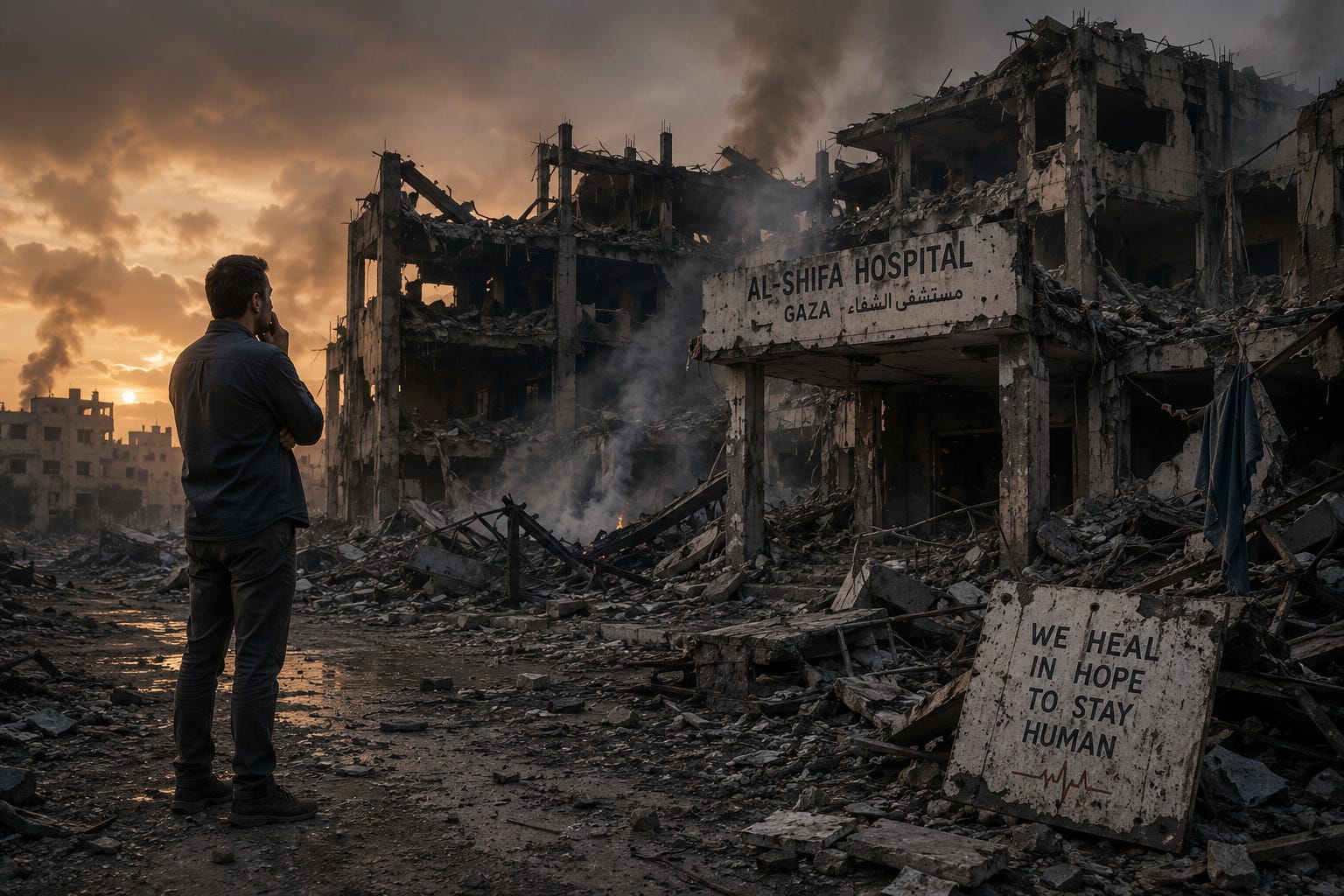
These were the words of Dr Hussam Abu Safiya to his lawyer earlier this month. Abu Safiya was the director of the Kamal Adwan hospital in northern Gaza.
Eighteen months ago, he was seized by Israeli forces and has since been held without charge or trial. He reports being struck with hammers and batons, daily beatings and loss of consciousness. The latest images of him show a much gaunter man than the one who had been the voice of besieged healthcare workers in Gaza, doing their jobs in impossible circumstances.
Being the Director of a Palestinian hospital, appears to have been his crime.
(Further in the article)
“Abu Safiya and the other Palestinian prisoners there never see daylight, a violation of the Geneva conventions. Across the Palestinian territories and Israel, about 3,500 prisoners like him are held under “administrative detention” that can be renewed every six months, indefinitely. Nearly 200 of them are children. Once a Palestinian is detained under these rules, they are essentially abducted by the state.
“Real hell” is what is experienced once detained, says Ali al-Samoudi, a Palestinian journalist, who was released earlier this year, unrecognisable. He had lost 60kg, about half of his body weight. “Prison today is hell in every sense of the word,” he told CNN. “Everything they practised with us was punishment and revenge.”
“The scale of abuse, torture and death in Israeli prisons is well documented but, every once in a while, an image appears that is Abu Ghraib-like in its relish and abandon.
Earlier this month, a photo taken by an Israeli soldier was posted on social media. It shows a Palestinian man from Gaza face down, stripped to his underwear, bound with ropes to a plank and an iron rod. The caption said “good morning” in Hebrew. The echoes of Abu Ghraib were all there, the sinister gloating, the sexualised humiliation of stripped prisoners, the taking of photos as some sort of trophy.”
I remember, and have written many articles about, the American criminal acts at Guantanamo and Abu Ghraib.
Except for the 200 children, the horrors are the same.
Before his detention, Safiya repeatedly declined opportunities to leave, even after his hospital came under repeated attack, he himself was wounded, his 15-year-old son was killed in an airstrike, other colleagues were killed or detained, and medical resources had nearly collapsed.
Abu Safiya shrugged his shoulder at the risk of being re-arrested, saying it was worth the work he would continue to do.
And there lies the difference between journalism and journalists, at least for me.
The answer is not to be found within a dictionary, and I can find no comfort there. It lies within the character of those who consider it not a calling, but a profession and social construct worth prison, torture, and even death.
The Committee to Protect Journalists (CPJ) reported that at least 259 journalists and media workers had been killed in the conflict by early April 2026. Most were Palestinian, with additional Lebanese and Israeli journalists also killed.
If you have the stomach for it, here is more from an Associated Press article. By every major international monitoring organization’s assessment, the Gaza conflict since October 2023 has become the deadliest conflict for journalists since modern record-keeping began, exceeding the toll of previous wars such as those in Iraq, Syria, the Balkans, and Vietnam.
So, here I am, old, broke and yet within the confines of what is a comfortable life, although my boat rides economically lower and lower in the water.
But a journalist?
I would like to think so…
…but the world outside my door says no.