
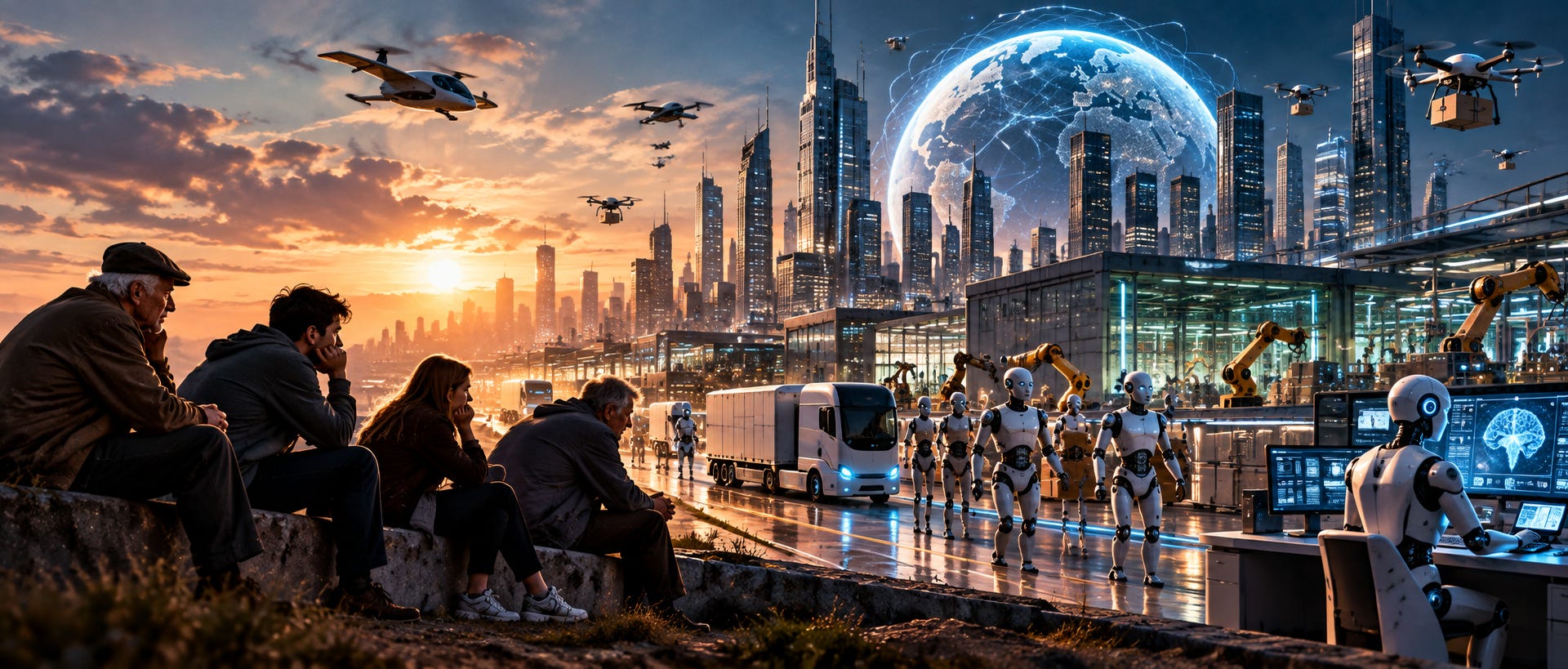
I got to thinking about this, and my mind wouldn’t let it alone, because I come from a slower time, a time when we thought more deeply and probably looked for solutions. It’s an interesting question, particularly with AI staring down our futures.
Over most of human history, slowly but steadily, tools could replace our muscles but needed us to swing the hammer or wheel the wheelbarrow. Becoming more inventive, the tractor displaced the plow-horse, and the computer pretty much made filing cabinets optional. These days a machine can draft the instructions, prepare the contract, write the letter, draw the picture, summarize the evidence, and offer us two or three opinions on how well ‘we’ did it.
While that’s fascinating, it runs a chill down the back of many of us in the professional trades.
Who really needs a doctor, lawyer, or accountant anymore. I’m a retired landscape architect, and remember thirty-five years ago when computer aided design (CAD) first came on the market. Landscape drawings fit the requirements, but all evidence of human touch disappeared. I knew it was time to move on, but if I hadn’t known it, the market would have told me.
55,000 mid-level architects lost their jobs, the guys and gals who drafted details for 25 years and had become expensive because of annual wage increases. The only skill they had was draftsmanship, so they drove cabs or became store clerks, and their wives got jobs.
No one saw what was coming.
If I look at an architectural proposal these days, it walks me through a completed (furnished and landscaped) building as if it was already built. Stunningly presented, costed out and ready. Already positioned on the client’s property, showing neighborhood context.
Well, you ain’t seen nothin’ yet.
The International Labour Organization estimates that one in four jobs worldwide is exposed to generative AI. It expects most of those jobs to change rather than disappear. The International Monetary Fund puts the share of jobs exposed to AI more broadly at nearly 40 percent. Neither figure means 40 percent of workers will be fired.
Both tell us that change has reached well beyond the architect’s office.
The threatened jobs include work we once considered distinctly human. A young lawyer learns by researching cases. A junior programmer learns by writing code. An aspiring writer learns by wrestling with a sentence until it says what was intended. If a company gives those first attempts to software, where do the experienced lawyers, programmers, and writers of tomorrow come from?
Good question, that researchers fail to address. “Distinctly human” is all that disappears? “Thank God, Edna. There will be something left for us.”
Employers, understandably, see the attraction. A machine does not ask for a raise, health insurance, or Friday afternoon off. It can produce ten versions of a report while its human colleague is still considering the first. Whether any of the ten is correct remains a human problem, but speed has a way of arriving at the boardroom before accuracy.
There is evidence of a more useful arrangement. Anthropic’s analysis of how people used its AI assistant found more instances of collaboration with a person than of the system directly performing a task. That distinction matters (for the moment, anyway).
A tool that helps a nurse understand a patient’s records can improve care. A hospital that treats the same tool as a reason to spend less time listening to the patient has misunderstood the job.
But hospitals (and prisons, and homes for the elderly) are increasingly owned by Private Equity, and the one thing that remains sure in this fractured world is that Private Equity never gives a shit for anything but profit.
Keep that cash-box full, and beds unmade…
Nor are predictions of universal unemployment supported by the available evidence. In a survey of employers, the World Economic Forum (people I wouldn’t trust with my future, considering their past economic stupidity) projected 92 million jobs displaced and 170 million created by 2030.
“Across several forces of change,” they advise us, including technology and demographic shifts (each of which they know nothing). Words to soothe the increasingly fidigetty people in the streets, looking for work.
“Those are forecasts, not promises,” they say, hastily covering their asses. A new job somewhere does damn little for the person whose old job vanished elsewhere.
I’ve lived long enough to watch many inventions advertised as the end of work.
Work survived.
The people who had to change occupations did not always come out ahead, but that’s the history of labor. What makes this AI moment different is the speed with which it can enter an office, a classroom, or a home. It needs neither a railway laid across the continent nor a new machine installed in every factory or office.
The question then is, who decides what the machine is for. We can use it to relieve drudgery and give people more time to teach, investigate, care, and create. Or, we can also use it to shrink payrolls while concentrating the rewards among those who own the systems.
Guess which choice the people with the investment are going to select.
Human beings may not have become irrelevant.
But the market has never been especially good at measuring what makes us relevant, or have judgment, responsibility, affection, curiosity, and the ability to recognize another person’s distress, because that doesn’t serve the purposes of the market.
The godlike market, to which we all bend a knee, promises butter and jam on our bread and then takes away the bread. Except for those at the top, and they eat cake.
Research tells us we had better insist on those values while the rules are being written. Think for a moment about how much the ‘we’ those researchers we depend upon have had, allowing us to insist upon getting gun control and viable healthcare.
Then, consider our actual control over what Elon Musk, Jeff Bezos, Zuckerberg, Altman, Donald Trump and Jesus Christ himself brings to the table.
The machines will be very quick at following whatever rules those dudes (not including Christ) leave them.
Sleep well.