
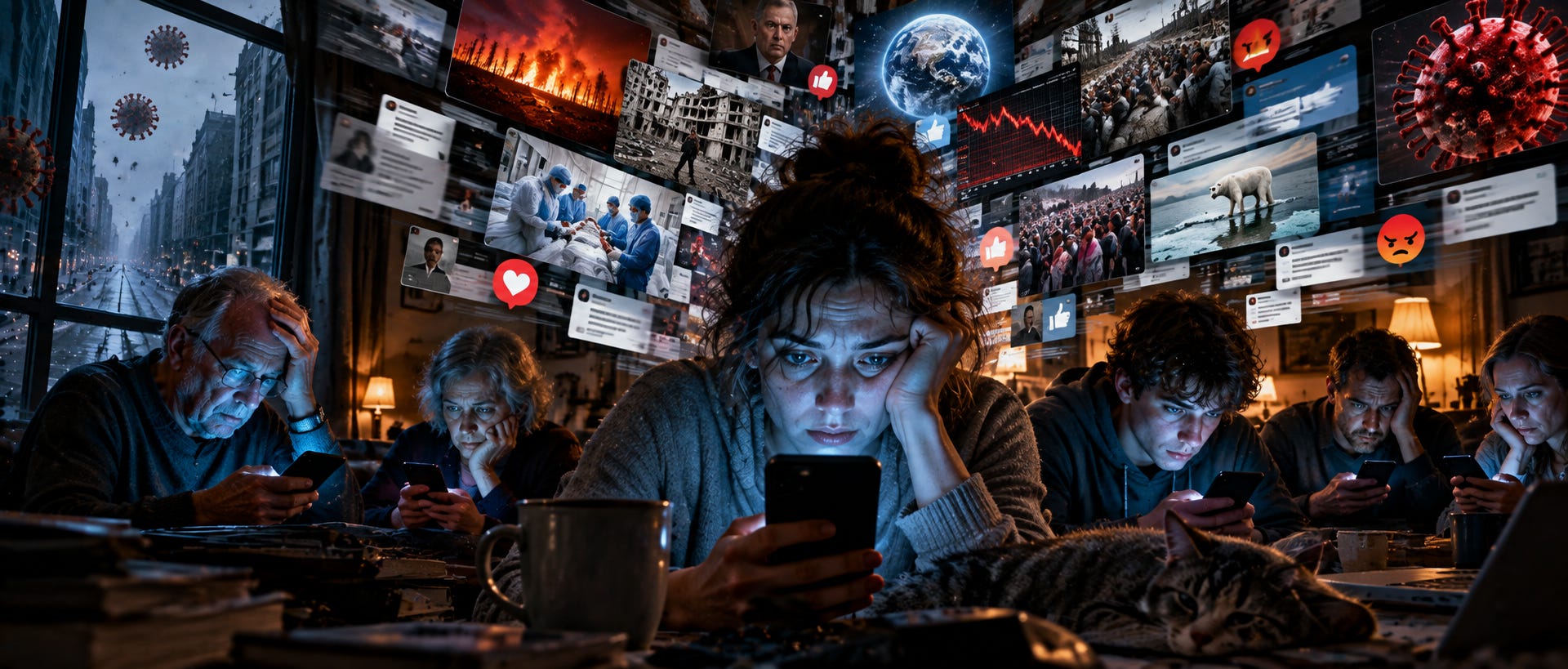
Which is, in itself, an interesting comment on language and how we communicate. Doomscrolling didn’t even exist in the English language until those isolated days of the pandemic.
Those days turned us inward, and inward is often a dangerous place to spend our time.
For some reason or another, my wife and I escaped most of that trauma, and merely found it inconvenient. Most likely it seems, in retrospect, because we have always both worked from home, our offices a room away from each other, but plenty of time for conversation over coffee.
Here in Prague, where we live, public transport was not closed down, but anyone who stepped outside wore the required mask. We also are lucky enough to own a very modest summer-house, inherited from her parents, that gave us the comfort and isolation of the countryside, without restriction.
But our clients mostly disappeared, many of them never to return.
Language is our business, both translation between Czech and English and editing in those languages. Thus our main sources of clients were the universities, which were closed.
Then, like an additional small but painful stab-in-the-back, artificial intelligence (AI) came along with language applications to further muddy our economic waters.
The worldwide impact was job dislocation and that, combined with social separation, drove we comfort-seeking human animals into rabbit-holes.
Those companies able to do so, sent their employees home, to work remotely, laptops on laps. But those who had small children were already cramped for space, and a Zoom call interrupted by a crying or shushed child brought its own problems.
Suddenly, there were no shared lunches or conversations around the coffee pot.
What we did have, was disruption, isolation, discomfort and a surrounding world that appeared very much to be melting down. Nine-to-five became any time a boss had his computer turned on, and a 10pm email was expected to be answered.
Privacy was all but gone.
As an adjunct to that, we now had computers-at-home, which many of us hadn’t had before. Suddenly, the disappeared office coffee-klatch turned itself into the relief of the internet.
Doomscrolling was born, crying from the birth-swat of its technical father, and wailing at us from the middle of our living rooms.
Wives, many of whom had jobs as well, now had the added pressures of keeping some degree of order in a ‘business home.’ Marriage, which is a difficult enough negotiation anyway, was now a boat taking on serious water.
Many (not all, but many) turned to the internet as a last hope of contacting the outside world, and what they found there was political, economic, and societal chaos…plus pornography and old movies.
It has been said that “when all the choices are bad, people will make bad choices.”
Yet, returning to the subject of this argument, let me return to the menu of American news on offer;
An upcoming mid-term election with huge political consequences, and an electorate in suspended animation.
Cost of Living & Inflation: Stubbornly high prices for basic necessities remain a top voter concern.
U.S. national debt crossed $40 trillion, driving a massive structural fiscal deficit, forcing the federal government’s net interest outlays to surpass $1 trillion annually.
30-year fixed mortgage rates hovered above 7%, effectively locked out first-time buyers and severely restricted new housing supply.
Hiring has dramatically decelerated, and overall unemployment has crept up toward 4.5%.
Partisan rifts exist, a majority of voters expressing deep distrust toward opposing political parties.
Asylum suspensions, status checks, and heavy military presence continuously divides the electorate.
Healthcare & Medicaid Cutbacks,
Anxiety over an artificial intelligence bubble and its long-term impact on employment, and
Pervasive mental health emergencies, with nearly one-third of American adults reporting chronic symptoms of anxiety or depression.
So, if doom and gloom dominates the menu, one can expect the public at large to be scrolling doom and gloom.
Never before in my living memory has that been the case, not even in the horror decade of the 1960s.
End of argument.
You’re welcome.