
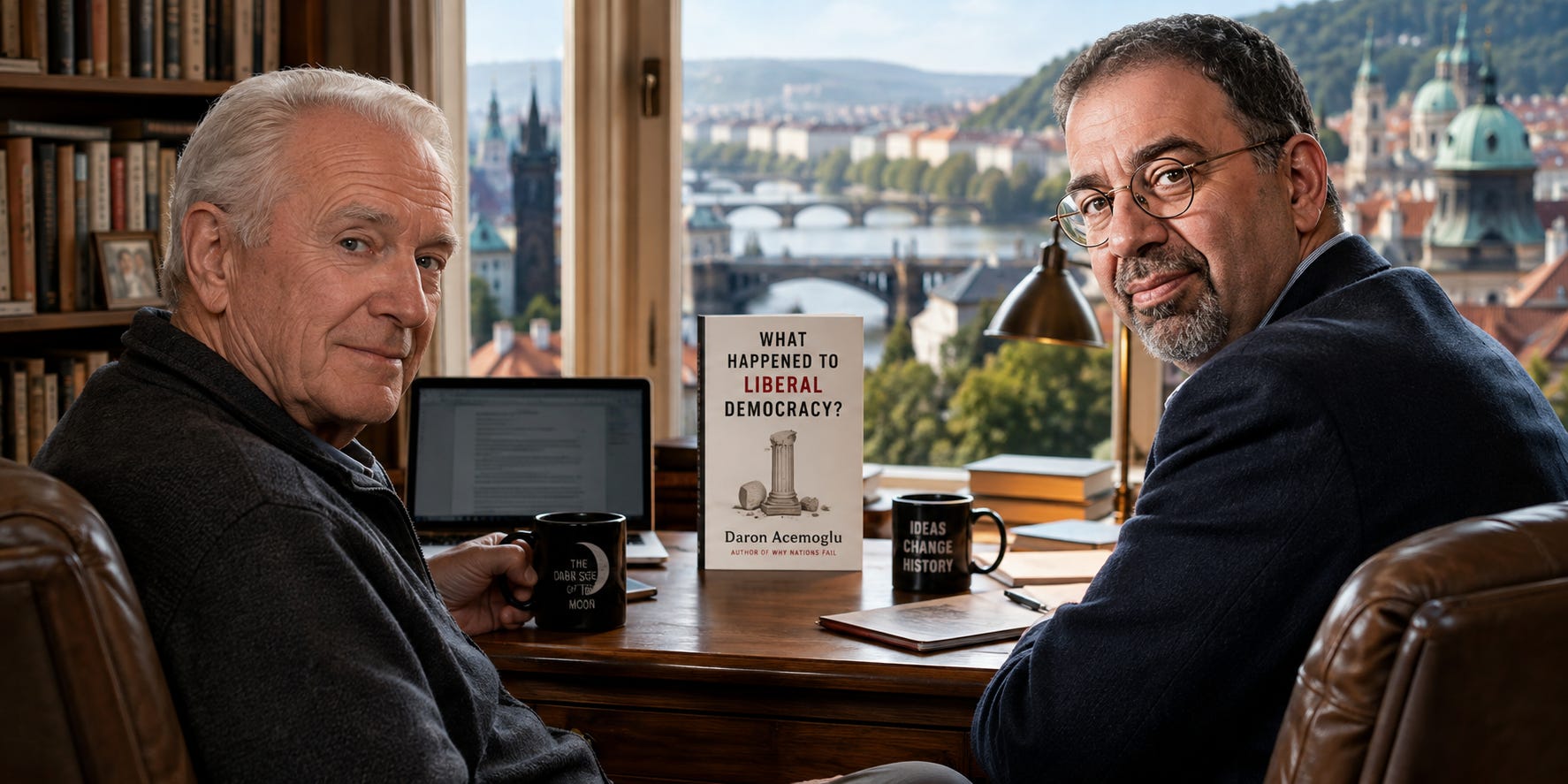
So says Nobel Prize winner Daron Acemoglu, and that’s the fourth leg of the chair that supports the argument he makes in his new book, “What Happened to Liberal Democracy?”
And if indeed his observation is correct, then the counter argument made by ‘fake news,’ and the internet’s splintering of what is and is not true, salted by billionaire influence, will give us a society “less intellectually curious, poorer, and less free.”
There is no doubt in my mind that, within my nine-decade lifetime, we have suffered precisely that fate.
Acemoglu, I’m told, is one of the world’s most influential political economists, and his work is unusually relevant to questions about why the United States and other liberal democracies have become more unequal, less trusting, and increasingly politically unstable.
That’s okay with me, as I’ve made similar arguments for decades…and don’t we all love to have our positions supported by ‘one of the world’s most influential political economist?’
Hold on, Nobel Committee, there may yet be a spot for me.
But Daron was born in 1967, and a great deal of his knowledge was gleaned from a history that I lived.
I’ll share with you a salient example, although you may laugh at the fact: Every time I shave, and every time I have shaved since it was necessary, as I apply the razor to my upper lip, I think of Hitler. It is impossible for me not to do that, since I actually heard him rage and pound a rostrum so many times during the war. Not the identical mustache on Charlie Chaplin.
Hitler!
I doubt that anyone who read about Hitler from history books, or watched old newsreel images, would have that visceral connection. It’s among the things I cannot unlearn, like counting the steps up or downstairs. I must hum or sing (much better at humming) in order not to do that. Living in a third-floor flat, it’s a constancy
There is, I am convinced, a difference between what we have read and what we have lived.
I do not put down any of Daron’s brilliant writings, nor question their authenticity, but ‘pooled and shared knowledge’ is first learned at the family table. That knowledge also has age-old tribal connections, learned in the circle around a common fire by listening to one’s elders.
I grew up at family dinners, served precisely at 6pm and eaten beneath a candle-chandelier which, metaphorically, serves as ‘learned in the circle around the common fire by listening to one’s elders.’
Those dinners were not so much instructional, as conversational. My brother and I were expected to contribute. Our shared upbringing demanded contribution to other adult conversation as well, saying a word or two when appropriate, and shutting up and paying attention when not. There was no such as ‘shutting up’ at my father’s dinner table, but the talk was of art and architecture, philosophy and why the world was what it was.
Carl and Bobby Wood were close friends of my parents, who came to play bridge on a weekly basis. Carl flew fighter planes in the First World War, when they were made of paper and glue. My father drove an ambulance in France, until they discovered he was only sixteen and sent him home.
Can you imagine the conversations?
Daron was not yet born when the Japanese attacked Pearl Harbor, or when Eisenhower took over as commander of Europe’s combined forces. He was not there as the Marshall Plan rebuilt Europe, and assassinations took John Kennedy, his brother Robert, and Martin Luther King, Jr. from us.
I do not question him for that…we have no power over our date of birth.
So, I can learn from him because of his perspective, research, writing and intellect, just as I learn from writer’s Mark Twain and Charles Dickens.
“He was conscious of a thousand odors floating in the air, each one connected with a thousand thoughts, and hopes, and joys, and cares long, long forgotten,” wrote Dickens
There are ‘odors of the times’ in which we live and breathe and take in the world around us.
And there you have it.
The difference I sought so imperfectly to define.
My lived history has a smell, much like the balls of hot tar we rolled up from the street when we were kids.
Driving past road work here in Prague, some 85 years later, that smell instantly takes me back to the curb in front of my home in Evanston, in 1941. I recognize my friends, I understand the fact that the lawn needs mowing and it is my chore to do it. But not until we have whooped our way off on three-dollar bikes to see the world, as small as that world may have been.
I know, because it is my experience, and Daron Acemoglu enjoys that smell of his lived life from when he was a kid, right up to accepting the Nobel Prize.
His is a different smell, more or less pungent than mine.
Daron and I are not acquainted.
But it’s what we share.
And that’s important to me.