
There are, of course, the billionaires infecting the economic and political world, but they never last, and will likely never even leave an asterisk on history.
And then there’s Ted.
Or at least there was, until news of his death hit today’s paper. Old as I am, I watched more of his life story than many, and the youngsters of today may not even know who he was. It’s their loss to have missed out.
Founder of CNN, Captain of an America’s Cup yacht race, who was so drunk at his yacht’s win that his face fell in the soup, restorer of huge swaths of American prairies by rewilding buffalo herds, onetime husband of Jane Fonda, the man had many friends, and enough enemies to prove he mattered.
A storied man, and here are but a few of his stories.
Ted lived a half-dozen lives in one lifetime, rebellious, ruthless, media hero before we knew what it meant, racing yachtsman, environmental cheerleader before it was chic, noisy when needed, a good friend to many and a dangerous guy to cross.
More Patrick Mahomes than Tom Brady, his skills were meteoric and failures as public as a face in the soup.
I never met him, but I’m a writer and sit a horse pretty well, so I loved his story.
in 1980 he launched CNN, the world’s first 24-hour television news network. It had to fail, everyone knows there’s not enough news to fill 24 hours. And it nearly did, hemorrhaging money early on, while he mortgaged heavily and slept little. But CNN was there for the Space Shuttle Challenger disaster, the Gulf War, the fall of the Soviet bloc, and listeners watched as continuous news mattered.
Ted was just a bit early. It was his calling card to be early.
Pretty much the first public man to not-give-a-shit; he mocked network execs, insulted competitors, and once called Rupert Murdoch ‘the Darth Vader of television.’ Funny, outrageous, and quick on the draw, the public loved him because he was so often right, and he spoke in their language.
He bought the Atlanta Braves and turned the Braves into “America’s Team” by national cable broadcasts. As earlier rural electrification had brought radio to isolated farmers, cable TV reached rural America and those who had never been to Georgia suddenly grew up watching Braves games nightly.
In 1997 Turner pledged $1 billion to support the United Nations. The largest charitable donation in history by a private individual. Conservatives attacked him for it, but he said global problems required global institutions whether anyone liked it or not.
“I didn’t want to fail my father.”
The backstory of so many driven men. In interviews, he repeatedly described living under immense pressure from a demanding parent who alternated between approval and harsh criticism. After his father’s suicide, still a young man, he inherited his father’s billboard business and drove himself relentlessly to prove himself worthy. “I spent my whole life trying to get my already dead father to love me.”
Buying CNN, he said, “the big networks looked down on us like country bumpkins,” and now we’re inundated with 24 hour news, which is maybe okay and maybe not okay. “I wanted to be the biggest in the world.” Way before he was, he openly admitted he wanted the biggest network, the biggest audience, and the biggest impact. And yet, he talked way more about ‘winning’ than ‘money. That distinction mattered to him, and he was very much like Tiger Woods in that regard. But Tiger was equally dominated by his father’s approval.
Ted Turner was widely reported for years as the largest private landowner in the United States.
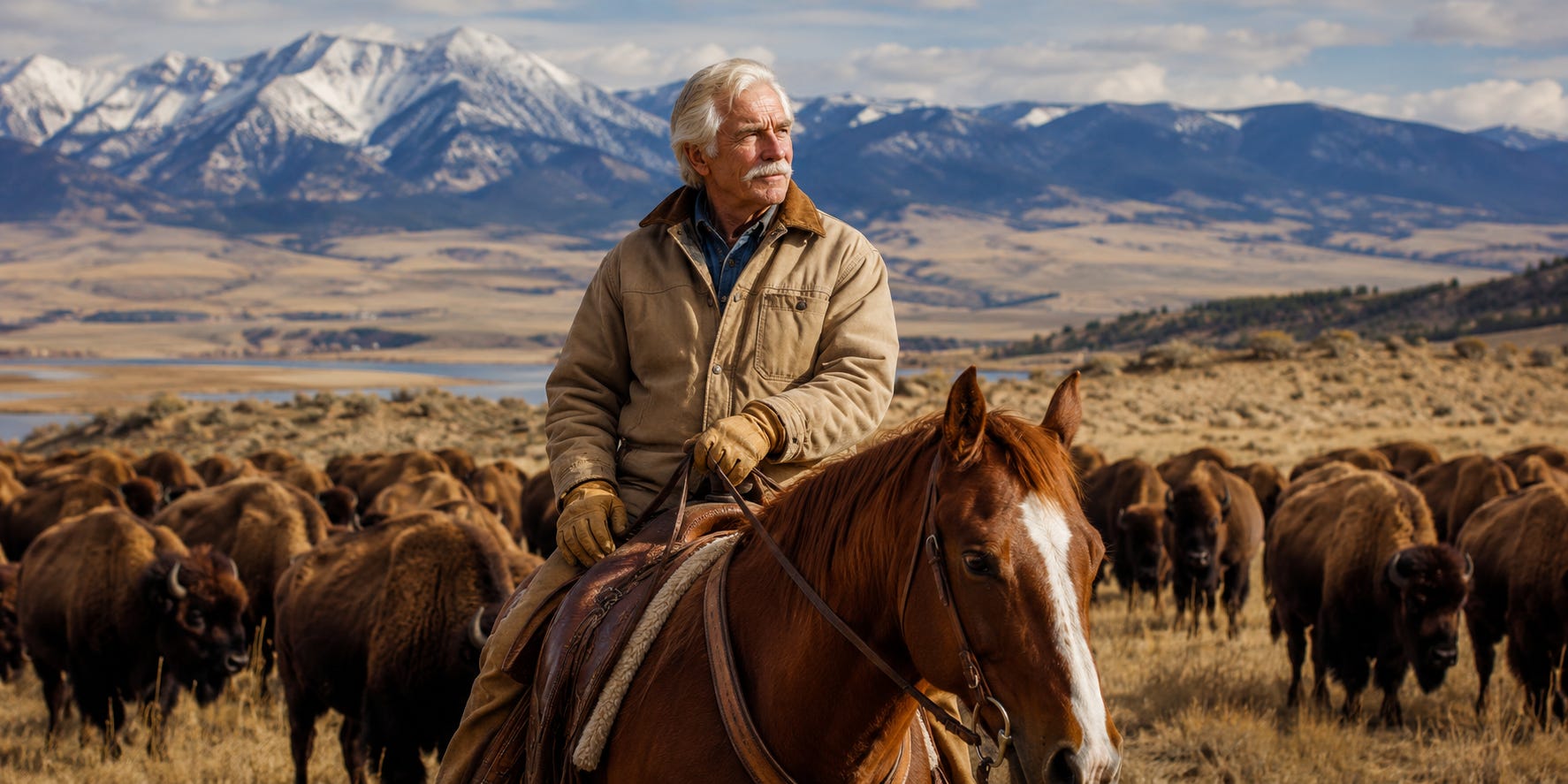
At his peak, he owned roughly 2 million acres across several states, especially Montana, New Mexico, Nebraska, and South Dakota, an area larger than some small countries. What made such wide ownership unusual was that he was not looking for speculation. He was deeply interested in wildlife conservation, ecosystem restoration, sustainable ranching, and bison restoration. He built one of the world’s largest private bison herds — reportedly tens of thousands of animals. He often said he believed bison belonged naturally on the American plains and that cattle ranching had damaged ecosystems, particularly those waving tides of western grasslands.
A renaissance man? Surely so.
There is an irony in Turner’s story that he himself sometimes acknowledged: a man associated with satellites, cable television, and global media ended up becoming almost a nineteenth-century western land baron.
Why not? And who better to steward such an almost lost legacy?
I will miss him. I feel he was a friend of most things I hold dear in this world, and am in fear we are losing them all too quickly.
For me, he rode very tall in the saddle.
His Bar None Ranch is about 15 miles from my Uncle Horace Morgan's ranch in Belgrade. If I remember correctly, their properties abutted each other. The Morgan Ranch is about 85,000 acres. I learned to rope and to shoot a .44 Magnum there. About took my arm off.
His Flying D Ranch is about 10 miles from my grandparents ranch in the Gallatin Gateway, where I spent a few summers of my youth. The local ranchers—my uncle owned a huge spread in nearby Belgrade—weren't so thrilled with Mr. Turner at the start, but they mostly came around with time.