
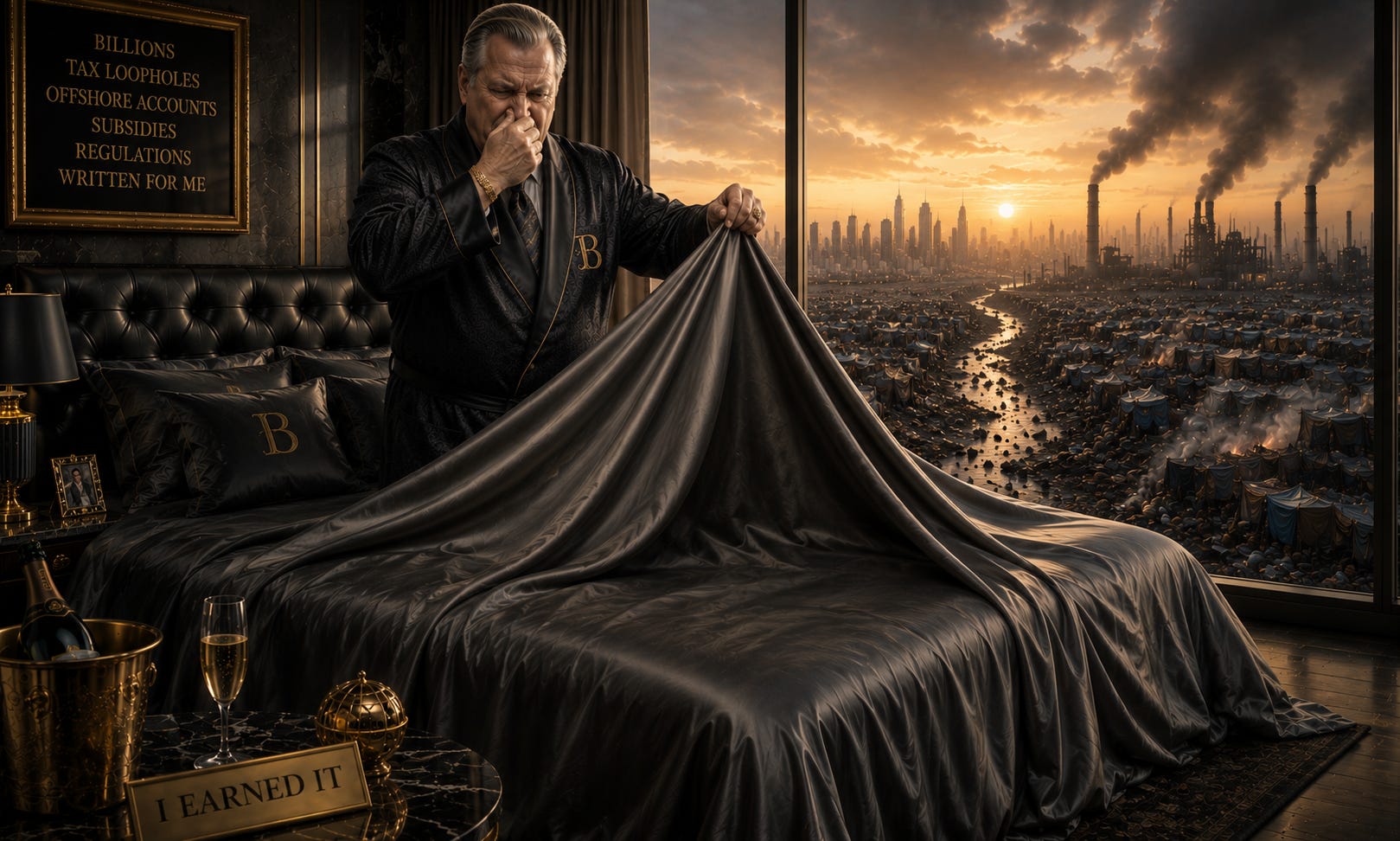
Part One, of many parts to come
This is not an accusation, it is a history that can be found in various archives, but the finding is obscured by the wealth and power of its makers. Aside from that, who really wants to dig that deep in a hole already excavated?
I am 91, and will take you there, not as a historian, but as someone who lived the experience and paid attention. It’s a free ride, a sort of Hop-On, Hop-Off bus of how and why we lost control.
Come along. You don’t even need to bring a sandwich.
In 1950 I was fifteen years old. Born in the heart of the Great Depression, having tended a Victory Garden with my family during the Second World War, and watched Truman defeat Dewey in the first political upset of my young life. During the first ten years of that life, ‘the president’ meant Franklin Roosevelt.
We were a solid middle-class family. My father was a landscape architect and contractor, who built interiors of DC3s at Douglas Aircraft because there was no landscaping to be done. All of that is foreground.
More may be salt and peppered in as we hop on and off the bus.
First stop today, 1950 America. Hop On.
We were pretty solidly out of the Great Depression by 1950, and World War Two was the main cure. Like so many wars in world history, this one was won by industrial superiority. Not a bomb was dropped on our ‘island nation,’ protected as we were by two immense oceans.
During ‘Lend Lease,’ America’s excuse for not declaring a war against Hitler, while keeping the United Kingdom from sinking below the English Channel, we were losing a great deal of shipping. Across the entire period, 1939-45, approximately 3,500 Allied merchant ships were sunk, losing over 14 million gross tons of shipping, and about 72,000 Allied merchant seamen. That was the bad news.
The good news was that, as Germany sank thousands, American shipyards eventually built ships as fast or faster than U-boats could destroy them. We built a total wartime production of about 300,000 aircraft, 264 every day, 11 every hour, one every 5½ minutes. Ships were being launched at a rate of about three per day, 50 tanks every day, more than 640,000 jeeps, 12 million rifles, 2.7 million machine guns, hundreds of millions of artillery shells, and 40 billion rounds of .30-caliber ammunition alone.
In 1950 we were industrial kings.
What else was going on when I was fifteen?
Our first class of university military veterans was graduating.
The class that graduated around 1950 occupies a unique place in American history. It was the first large generation of college graduates whose education had been made possible by the Servicemen’s Readjustment Act of 1944—better known as the G.I. Bill, which transformed American higher education.
We haven’t done the same for our veterans since, but in those days we rewarded duty. Nearly 16 million Americans served in World War II, and half of them used the G.I. Bill’s education benefits between 1944 and 1956. Unlike later generations, these veterans overwhelmingly chose practical fields that would help rebuild the postwar economy, including engineering, business, medicine, law and architecture. They stayed for advanced degrees, producing a new generation of scientists and engineers.
We built homes for them as well, starter homes in Levittown and elsewhere. Levitt built houses like automobiles, dividing construction into specialized steps, much like an automobile assembly line. The first Levittown, on Long Island, began sales in 1947. Originally intended to contain about 2,000 homes, overwhelming demand expanded the development to more than 17,000 houses by 1951. Thousands of veterans rushed to buy them, with GI Bill guaranteed low interest mortgages.
The Marshall Plan was rebuilding Europe.
The Marshall Plan was a U.S. program launched in 1948 by President Harry Truman, to rebuild the economies of Western Europe after the devastation of World War II. Proposed by then Secretary of State George C. Marshall in a June 1947 speech, it provided roughly $170–190 billion in today’s dollars in grants, loans, food, fuel, machinery, and raw materials to 16 European countries over four years. That included Germany and other adversaries, as well as allies.
It was the first time in history that a victor had rebuilt conquered nations, but there was a more serious purpose. Marshall understood that the 1918 armistice with Germany was so punitive that it both sowed the seeds of World War Two, and then watered them with crushing payments. The Marshall Plan and later European Union made possible what Marshall hoped would be the end of 2,000 years of wars in Europe.
It’s popular to say that America was debt-free in 2050.
Actually, almost debt free.
The debt barely declined in dollar terms between 1945 and 1950, because the government had not yet paid off much of its wartime borrowing. But, the debt-to-GDP ratio had fallen sharply, because the economy was on fire after the war. Factories shifted to civilian production, millions of veterans entered the workforce, and consumer spending surged. The good times were rolling for the entire country.
While we didn’t eliminate our wartime debt, we effectively grew out of it. Statistically, $257 billion remained, about 150 times less than what we owe today.
And you know how I feel about statistics, confessing to anything, if they are tortured sufficiently.
So, exactly how did America grow out of its national debt?
It had wealthy owners of businesses and corporate executives who agreeably (and even eagerly) paid their taxes.
Oh, c’mon, really?
Yeah, really.
You see they had a living memory of what life was like after 1929, when nearly everyone, including ordinary people like my father, lost everything they had built, or hoped to build. Living memory is different than hearing, or reading, or being told about a tragedy. It’s why I’m writing what I’ve lived through, because only 1% of those born in 1935 are alive today, and I am among them.
We’re checking out pretty quickly, so pay attention.
The graduated income tax kept us solvent, and it kept the rich rich, without letting national debt get out of control, as it is today.
Back in 1950, the tax brackets worked like this: The top marginal rate was 91%. That rate applied only to taxable income over $400,000 for a married couple (roughly $5.3 million in today’s dollars after inflation).
The key word is marginal. That did not mean someone earning $500,000 paid 91% of their entire income.
It meant all of the first portions of income were taxed at the lower rates. Only the last $100,000 (the amount above $400,000) was taxed at 91%. For example, if someone had $500,000 of taxable income in 1950, the first $400,000 would pass through the lower tax brackets and only the final $100,000 would be subject to the 91% rate.
One final point, because the tax code of the 1950s (like today) contained a bunch of deductions, exclusions, and preferences. Very few taxpayers actually paid anything close to 91%. The top 1% (unlike today) typically paid effective federal income tax rates in the range of about 40–45%.
Today, many pay none at all (more on that later).
(Sidenote from Jim) This is a series, that will quite likely become a book. So, further thoughts on my life, and American politics as I lived it, will appear now and then between my regular meanderings. The clue will be the title remains the same, only the Part numbers will change.
Stay tuned… comments both pro and con are solicited, as this is a work-in-progress…
For years Jim has been threatening not to write his autobiography. Now it looks like he's changed his mind, and I can hardly wait for the next 76 chapters! (Mind you, given the title. I'm not sure I'll be able to bear the stench...)