
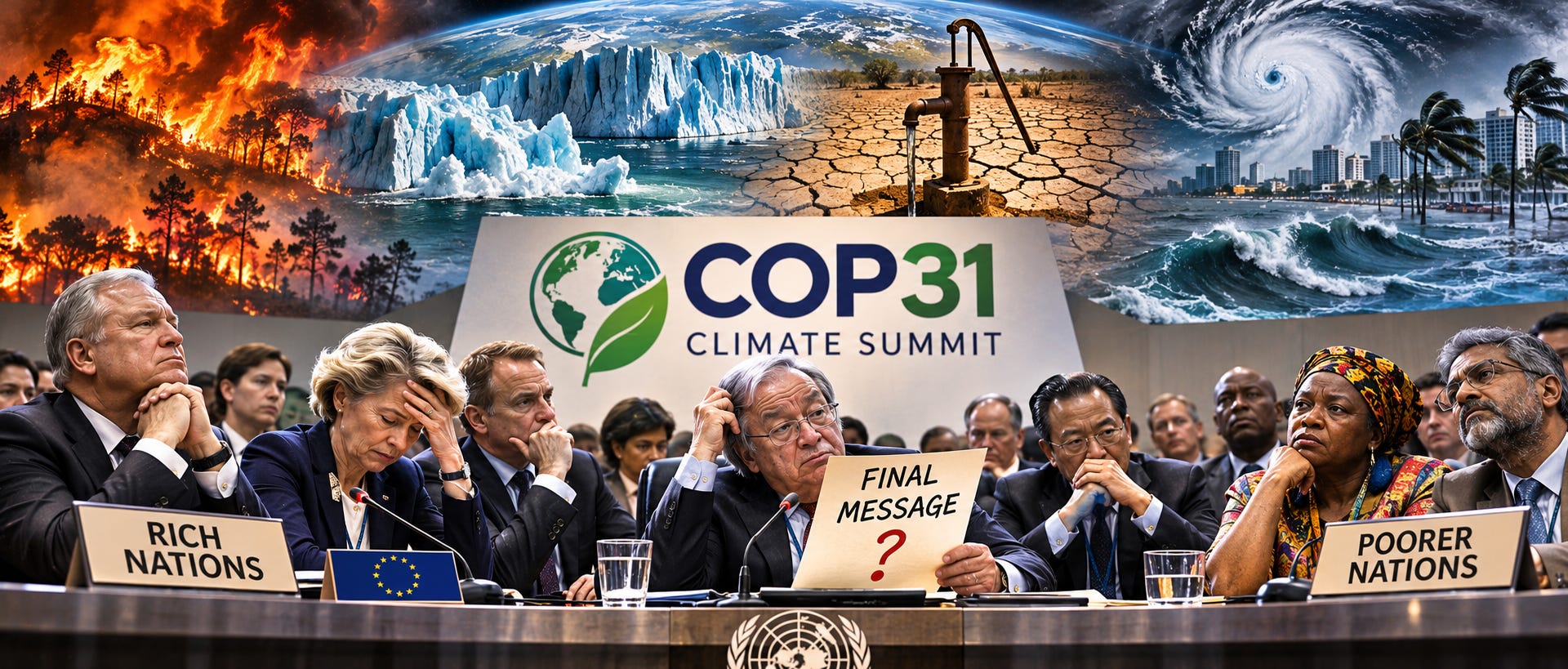
While the planet burns, glaciers melt, freshwater aquifers dry up, seas warm and rise, storm patterns intensify, and rich countries ignore their poorer neighbors, Cop 31 struggles to produce a positive closing message.
Maybe that’s because, for the 31st year, they’ve done nothing.
Turkey is the site of this year’s embarrassment.
Quoting an attendee from the current meeting, Mohamed Adow, director of the Power Shift Africa thinktank, said, “Frontline communities will look on with despair. If this version of the text remains, it will be a ghost Cop. The summit will have nothing to show for what happened here.”
A pretty good case can be made that the entirety of Cop history is little more than a ghost ship sailing away from any kind of meaningful action.
Adow’s verdict, that the talks had been ‘muzzled’ by the refusal of some fossil fuel producing countries to allow the commitment to ‘transition away from fossil fuels’ to stand, was echoed by campaigners around the world.
In the two decades since the Paris Accords, there has been no accord.
Rachitaa Gupta, who is the global coordinator of the Global Campaign to Demand Climate Justice, said: “The cause of the climate crisis is clear, as well as who should pay for it. What’s remaining is the global north’s political resolve to provide this finance. The moral bankruptcy of the global north is very visible to all of us in the global south.”
Adow and Gupta may as well pack their bags and catch the first plane home.
“Doing the same thing over and over and expecting a different result
is a definition of insanity.”
That’s a quote widely attributed to Albert Einstein, who did not say it. Its attribution is unclear, but that does not make it any less true.
Truth is falling out of favor.
I find that particularly unsettling, because humans are the first animal species in world history to know and understand the reasons contributing to their demise, and simply not give a damn.
The failure of our species is not in question. We are headed for the same junkpile that many other species before us visited, and all the evidence has been laid out before us. As Kurt Vonnegus so elegantly reminded, “Our big brain is killing us.”
Welcome to the end game which, by he way, need not happen.
We have the tools. The hammers and saws, technology and money, are all available to us. Perhaps not all of us, but enough of us to make it happen across this beautiful blue-green globe we are lucky enough to inhabit.
Turning the energy page from fossil fuels to renewables is an economic cinch.
Stanford University’s 2017 Study provides “100% Clean and Renewable Wind, Water, and Sunlight All-Sector Energy Roadmaps for 139 Countries of the World.” So far as I know, Stanford did not attend or contribute to Cop31.
Their entry credentials must have been lost among the Fossil Fuel nametags at the front desk.
But, to summarize: “Researchers mapped out full energy transitions for 139 countries (accounting for over 99% of global emissions) across electricity, transportation, heating/cooling, and industry. Because electric machines (like heat pumps and electric vehicles) are far more efficient than combustion engines, total end-use energy demand drops by roughly 42.5%. The study calculates that transitioning strictly to wind, water, and solar by 2050 stabilizes energy prices, creates over 24 million net permanent jobs, and saves trillions of dollars annually in health and climate damages.”
Aside from that, can you imagine the economic impact of no energy costs other than sun, wind, tides, and Earth core’s heat (except harnessing and distribution) for
Powering industries,
Lighting cities and homes,
Heating and cooling those cities and homes,
Powering private automobiles and public transportation,
Providing potable (and agricultural) water across deserts, as well as
Greening our cities, and transporting our goods?
24 million net jobs and trillions of dollars saved sounds pretty nifty.
According to Stanford professor Mark Jacobson’s updated global roadmap (145-Country Study, 2022), the upfront capital cost to transition 145 countries (representing 99.7% of global CO₂ emissions) to 100% wind, water, and solar energy is $61.5 trillion.
Compare that $61.5 trillion price tag to the financial costs of war and global military spending. My sources tell me that a major distinction stands out in that the Stanford Plan is an investment that pays for itself, whereas war is a sunk economic loss.
I remind you once again that investments are assets, and economic losses are liabilities.
Consider the fact that the $40 trillion (and growing) American deficit is, substantially all liability, so we dare not print the money. But we can easily print the bucks, if need be, to finance the asset of a worldwide energy Marshall Plan.
Comparing costs to payback.
The post war Marshall Plan rebuilt a mostly destroyed Europe and held off its tendency to continue endless wars. Not a bad bargain at any cost.
What the $61.5 trillion to take the planet renewable buys, covers the construction of
all new wind turbines,
solar farms,
hydroelectric upgrades,
battery/thermal/hydrogen storage systems,
heat pumps, and
transmission grids worldwide,
including the labor costs involved.
The payback period.
That $11 trillion in annual energy savings means the $61.5 trillion upfront investment pays for itself in under 6 years through electricity and energy sales. Six years may possibly be quickly enough to dodge the environmental bullet that threatens to destroy humanity.
So, at least it seems we have a political choice on whether to save ourselves, or suffer our way through to Cop 200, which is about my estimate of when humanity goes the way of all previously failed species.
To ponder that decision is a decision within itself.
Understanding that it is a worldwide political choice, and we ordinary humans have not been invited to the table…
…what do you think our chances are?