
“We all exist in dreams and live the actual. It’s the actual we can’t get over, the dreams never stop.”
If you’re looking for attribution for that quote, it is mine, gleaned from a long past book of my poetry.
Poetry?
Indeed, there was a time when I labored in the barren fields of that profession. Mercifully, it produced only three collected volumes, but it’s the theme upon which my argument today is based.
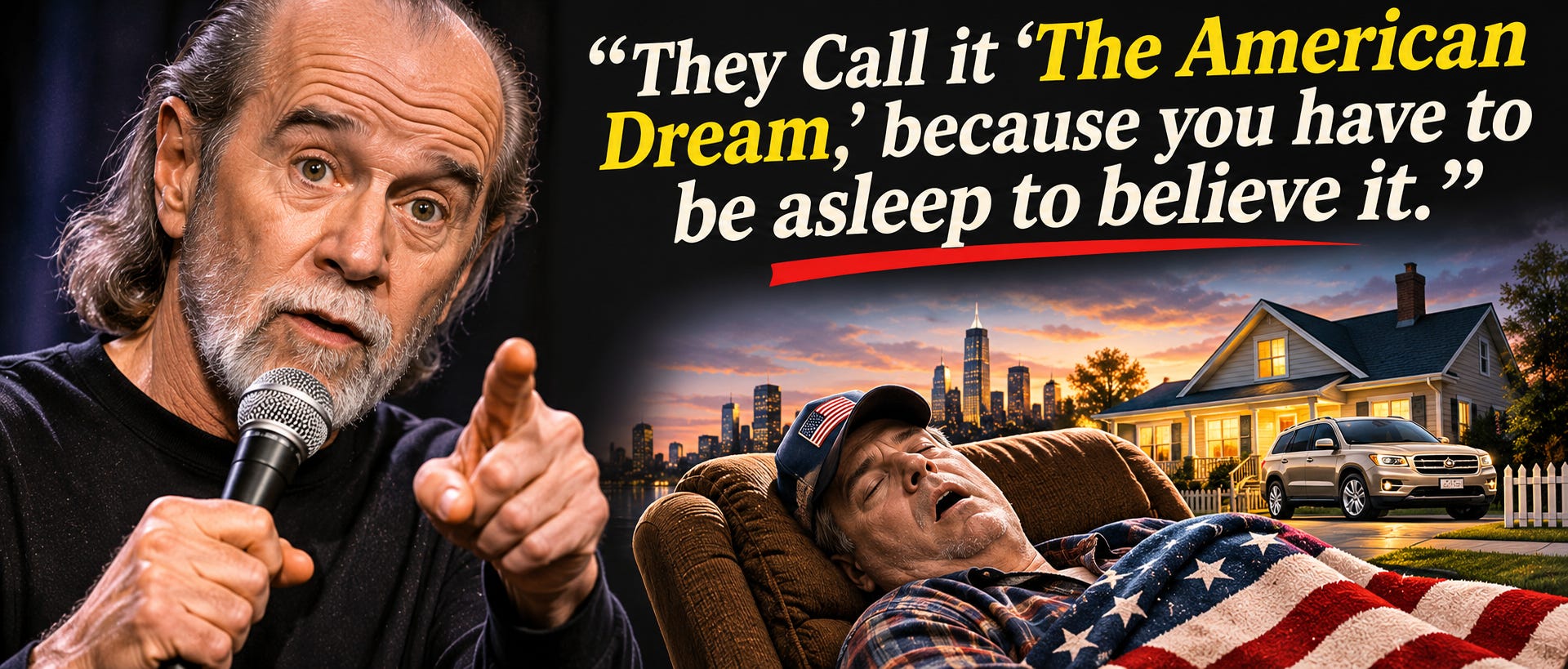
George Carlin had a word to say on that subject, and said it far better than me:
“They Call it ‘The American Dream,’
because you have to be asleep to believe it.”I grew up in the age of that thing we call discretionary income, the stuff that was left over when you’d paid all the bills, done the grocery shopping, and covered all the costs of having however many kids, and whether you owned a home or rented an apartment.
It’s the juicy part of however large a goose you have left over after dinner.
For me it was playing a bit of golf and owning a horse. But for you, if you’re old enough, it’s pretty much whatever you used to do that no longer fits the month left over at the end of the money.
In many ways, like so many factory workers in our long-gone middle class, it was a form of economic freedom. “What the hell, let’s take the kids out for dinner.” Dinner, in those days meant something other than a hamburger in a carton.
Remember restaurants?
That’s the nitty-gritty: the money left over.
Where did it go?
As you would expect me to, if you read me with some regularity, it wasn’t voluntary. It was connected to the millionaires we comfortably lived with, and a relatively small portion of them who saw an opportunity to become a thousand time richer.
Who would possibly pass that up?
Glad you asked that, because it’s a question we’re all struggling with right now. Been several hundred years since ‘pitchforks and barricades’ touched off a French Revolution, but the recent mid-term elections had the hint of the guillotine.
And, as far as passing up great wealth is concerned, it seems those who jumped on that train had no idea what station it was headed for. There were consequences—unintended consequences, perhaps—but the billions in the bank clouded them over.
Their high-speed rail pulled into the station with a vargo that included,
Shipping our industrial strength off to China, along with millions of high-wage workers jobs
Housing, that became an investment instead of a place to live (remember 2008?)
Wages that stopped keeping up with inflation as the union movement stalled
Healthcare, college, childcare, and insurance, each of which mostly became personal expenses.
Without industry, we became a service economy. Hello Deliveroo, goodbye single wage-earner families, and
As income dropped, Americans (who had become used to discretionary spending) loaded up on credit cards, auto loans, student loans, and home-equity borrowing.
It became cappitalism for the rich and consumerism for us other folks.
Looking back no further than 2025
My sources tell me, a place to live, a way to get to work, groceries and healthcare alone, soaked up over 70% of what average households had on hand in 2025. In that same year, housing costs went up 11% and health insurance over 6%.
That’s before our president’s ‘Big Beautiful Bill’ lost 4 to 5 million of us our healthcare. Cheer up, though, it’ll get more Bigly by 2034, taking another 10 to 12 million of us with it. In the longer run, Congress estimates as many as 15 million to 17 million of we bottom-feeders will have lost our coverage over the next decade.
Which, by the bye, is why Americans (particularly young voters) are so furious about billionaires not paying taxes.
“What about us,” sayeth our company workers. “Our taxes are withheld. We’re running the show and, because Musk and Bezos and Zukerberg pay no taxes, our national debt is close to $40 trillion.
My grandpa tells me that back in 1955 we had no debt. He says we rebuilt a destroyed Europe, sent all our veterans to college and financed homes for them.”
For an answer to that, look first in the mirror, and then at the mid-term elections just past.
Or don’t.
But, if you don’t, you’re likely to really misread what’s coming…