
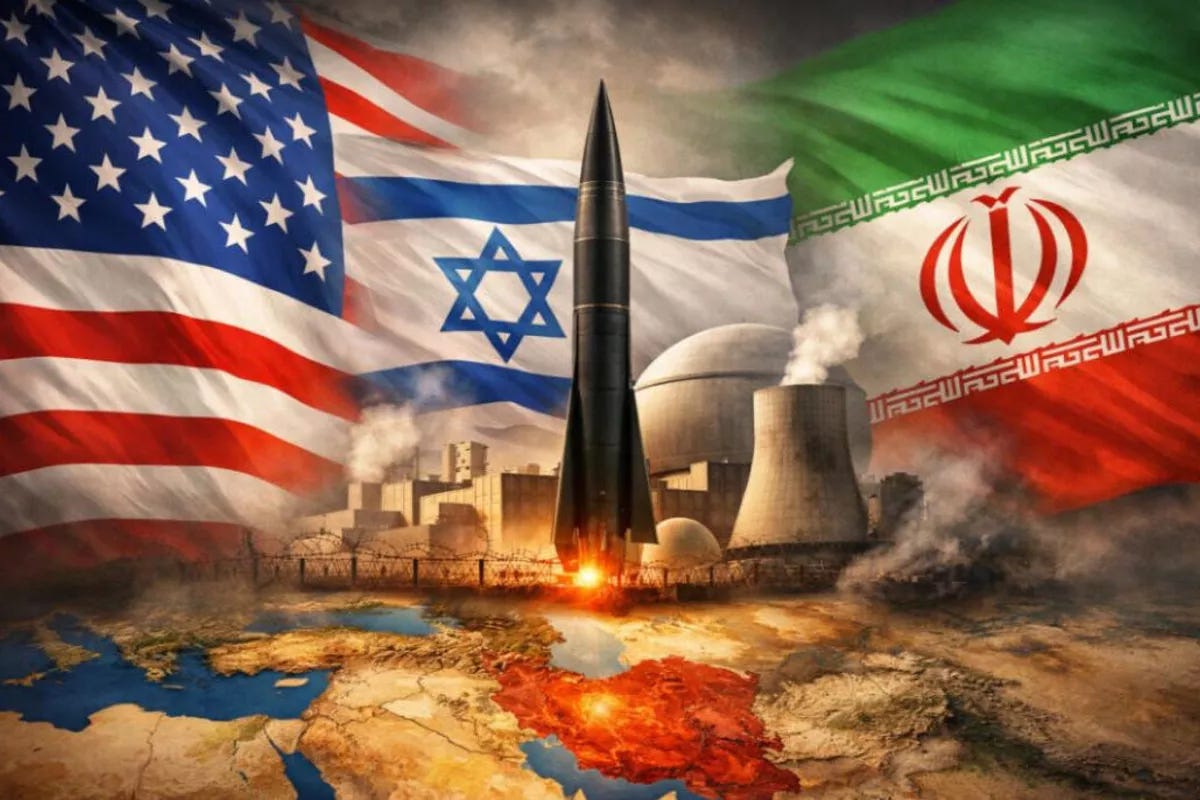
But statistics, as you know, ‘will confess to anything if they are tortured sufficiently.’ And our current administration is expert in waterboarding.
(Wikipedia) The US and Israeli surprise attacks on Iran were supported, at least in part, by Ukraine, Albania, Argentina, Australia, Canada, Czech Republic, Finland, Germany, Kosovo, Latvia, Lithuania, New Zealand, Papua New Guinea, Romania, and Trinidad and Tobago. More recently Germany, France and the United Kingdom piled in as critics of Iran.
Interestingly, (my take on it) what opposition there was, came from Afghanistan, Armenia, Brazil, Chile, China, Kazakhstan, Oman, North Korea, Norway, Malaysia, Pakistan, Russia, Spain, and Vietnam. The US-Israeli attack was further condemned by a number of progressive and left-wing parties, as well as trade unions, anti-war organizations, and some far-right parties.
Someone must have whispered in Trump‘s ear about the Japanese attack on Pearl Harbor, prior to WWII, having occurred during peace negotiations in Washington. He copied that subterfuge in both his Iranian attacks.
That’s a criminal act, by international standards, to say the least. But criminality is foretold in his book, The Art of the Deal.
The question that comes to my mind, is why so many nations would blame Iran, for being the victim of an attack by Israel and America.
I don’t recall anyone blaming America for Pearl Harbor…and I was there to recall. But there is a difference, and the difference is absolutely critical to understanding why so many American allies are blaming the canary for being eaten by the cat.
Ninety-seven nations, 50% of the U.N. membership, are not actually all that willing to be on friendly terms with the United States.
Excuse me?
They are, in very real terms, pseudo-colonies, in an undeclared American empire. In lieu of more recognized colonializations, such as those the Persians, Romans and Brits imposed, we Americans were (and are) somewhat sneaky about how we’ve managed ours.
It might come as a surprise to you (as it certainly did to me), that we have 877 military bases and CIA presences in 97 nations of the world, over 40 in Germany alone. You and I, along with ordinary American citizens, were not intended to find offense in that, because it was quietly done. That policy has actually been the American way since the end of World War Two.
First, we gave our defeated enemies the Marshall Plan to rebuild themselves. Secretary of State and former four-star general, George Marshall was not going to repeat the 1918 Armistace that so crippled Germany, it brought the world to war again in only twenty years. Europe and a large part of Asis accepted this with gratitude, aand Europe has remained peaceful.
Then the skies turned cloudy, as America followed up that amazing act of largesse with military bases, for your protection. Along with that, but not so well advertised, we added CIA intelligence, to maintain our satisfaction that all 97 would remain grateful.
Donald Trump talks a good deal about gratitude.
Not his, but others, always others.
Those on the receiving end know the Trump version of gratitude always comes at a heavy price, and is delivered in public, quite often from the Oval Office, the prelude to further requirements. Those usually include formal military bases, access agreements, and CIA intelligence facilities, although the latter are unwritten and seldom acknowledged.
All this is broadly consistent with how analysts describe the global U.S. footprint, although none dare call it empire.
But I refer you to former President Harry Truman’s comment, made shortly after he retired from office: “I would never have allowed the CIA to be founded, had I recognized the fact that we were creating an American Gestapo.”
In the context of the recent end of World War Two, ‘Gestapo’ was a term Truman didn’t take lightly. Never a man to mince words, he meant it for exactly what it was. Both America and the world at large have paid a heavy price ever since, mostly without recognizing the source.
The political effects were profound, as you might imagine. But not uniform, cutting in several directions at once.
A global network (call it what you will) allows the United States to act quickly almost anywhere, and the ramifications of that are evident in its most recent and uniformly unlawful consequences.
Those include enabling and, worse yet, providing munitions and encouragement for Israel’s genocide in Gaza, kidnapping the sitting president of Venezuela, attacking Iran without warning, threatening Greenland, and openly discussing the takeover of Cuba.
Our military and CIA footprint claims to reassure ‘partner governments,’ that America is stabilizing regions that might otherwise tip into conflict. Even so, conflict seems to be the present administration’s flavor-of-the-month internationally.
As the lopsided response blaming Iran for being attacked would indicate, American military bases are never politically neutral inside the countries that host them.
Take the Japanese, South Korean and Middle Eastern bases as an example. Those countries have each experienced nationalist political backlash that destabilized their governments, along with an awkward reputation at home, finding themselves politically aligned with the present Washington administration. This has become increasingly uncomfortable as our current president is publicly dismissive before the world to their emissaries, cameras running in the Oval Office, and including Prime Ministers and presidents.
Victims have lately included Ukraine, Japan, Canada, and the UK, as well as a host of others seeking smooth waters and finding only turbulence.
As Churchill once said, “you can always depend upon America to do the right thing, once it has considered all the alternatives.” The alternatives in this administration have been bleak at best.
And yet, as Iran is the subject here, it was Winston Churchill and the CIA that pulled the rug out from under Iran’s first democratically elected president, Mohammad Mosaddegh.
Ah yes, as Mark Twain said, over a hundred years ago, “history may not repeat, but it rhymes.”
When Mosaddegh, included among his groundbreaking social reforms, nationalizing the Iranian oil industry (it was only realizing a 16% return on its own oil), it threatened British Petroleum. That was enough for Sir Winston. After the Mosaddegh coup, America and Britain brought in the Shah, and Iran would never see democracy rise again.
The U.S. does not administer its colonies in the usual sense.
But it exerts an influence, similar in all aspects to an imperial system. It keeps a lid on whatever it might consider global conflict, while steadily raising the pressures underneath to reflect its own benefit.
Forgive me another quotation, but history demands voices from the past, lest we forget. It was Henry Kissinger who said, “It may be dangerous to be America’s enemy, but to be America’s friend is fatal.”
America did not always have imperial goals, nor can they possibly be in our long-term national interest.
A multi-polar world would seem to be in the best political interests of small nations, and the United Nations was founded with that goal in mind. Yet 877 military bases and a CIA presence in 97 nations of the world, would indicate an unbalanced foreign policy, offered with a false smile and a hidden agenda, at the end of a gun.
We Americans, and the world at large, are the poorer for it.
Sleep well…