
Who knows? In the extraordinary circumstances of this presidency, anything is possible. We’ve never seen masked ICE agents on our streets, kidnapping random targets without legal cause. Nor have we seen universities, law firms, Hollywood studios, and media sites paying extortion to a president simply to be left alone.
We tended, in our naivety, to think of an election as something that happens on Election Day. We vote, somebody counts the ballots, and a victor is declared. Simple, clean, American, and dependable.
But that comfortable assumption may not be enough to carry the 2026 midterms.
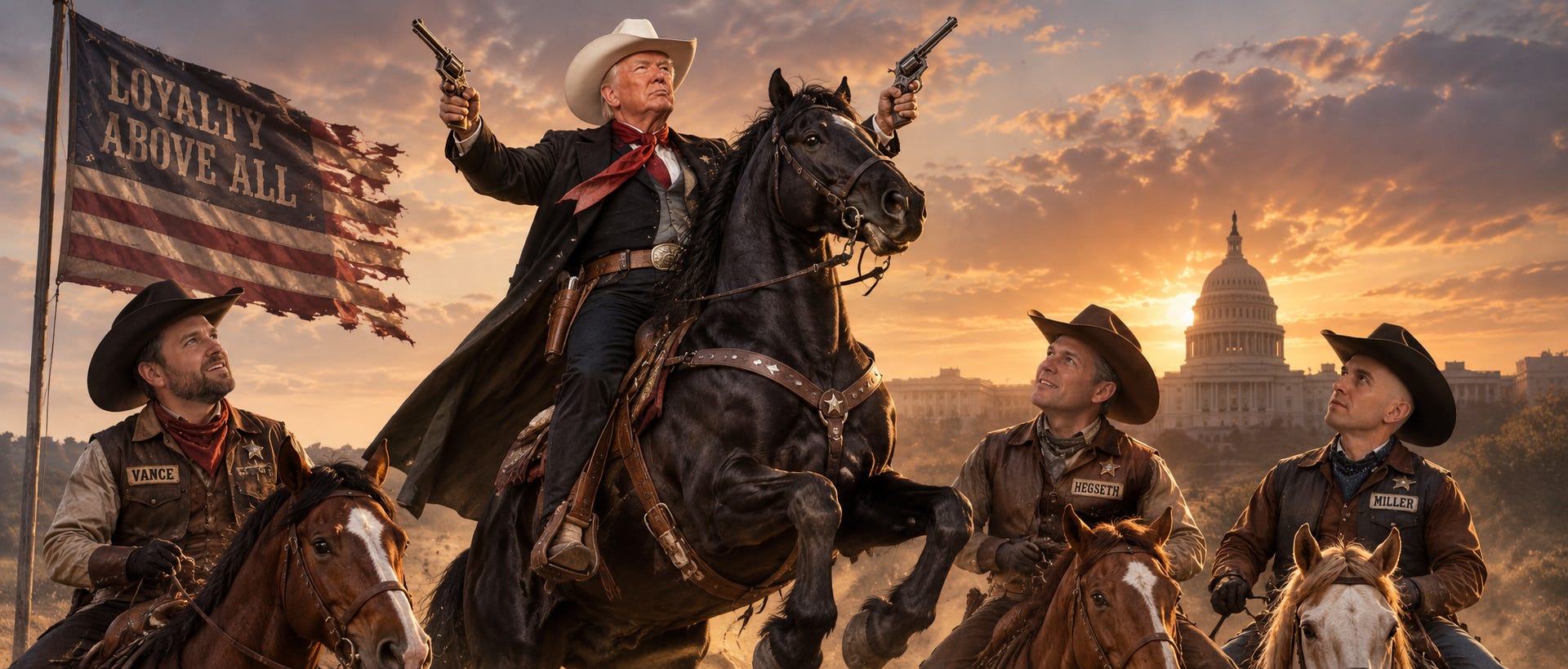
Our cowboy in the presidential saddle, both guns blazing, has already pushed the federal government further into election administration than any gunslinger before him. Arriving in a cloud of dust, horses lathered and panting, his gang of ruffians demanded state voter records, expanded federal citizenship checks, imposed or attempted to impose election-related conditions on federal funding, and fought in court for access to databases it says can identify potentially ineligible voters.
Back in May, when asked about sending the National Guard or ICE to voting locations, he brushed the dust off his chaps and said he would “do anything necessary to make sure we have honest elections.”
Anything, that is, except Joe Biden’s ‘stolen’ 2020 election.
Anything necessary doesn’t mean our hard-riding president intends to cancel or overturn the midterms. Nor does he have the constitutional authority simply to do so, although the constitution has merely been a burr under the saddle for him.
So we might be asking the wrong question. It’s not necessarily that he’ll announce one morning that the election has been cancelled. The danger is that the crowd he rides with could create confusion, disputed ballots, federal investigations and delayed certifications, all the time knocking down white lightning at the saloon—while the courts lumber along behind them, deciding what was legal.
That conversation’s already been had, sittin’ round the Oval Office campfire.
Start with voter eligibility. Who are all those dudes, wringin’ their hands and lookin’ to grab a ballot. “Noncitizens is what they look like, an’ we need greater federal involvement in elections.” Our saddle-tramp ordered DHS and the Social Security Administration to create state citizenship lists, and his boys have gone riding hard to the Supreme Court, raisin’ up a cloud of dust, demandin’ to use an immigration database to check them state voter rolls.
Whether those systems accurately identify ineligible voters is being litigated. Litigation takes a while, especially when the defendant keeps haulin’ logs into the road, and the election is a mere 42 days away. Our high-riding hero doesn’t need a decision, he needs a complaint to hang his ten-gallon hat on.
More important for November, is what happens when Washington tells a state that its voter list contains people the federal government considers questionable?
Who gets the final word?
Traditionally, the 50 states do. Elections in America are extraordinarily decentralized. Thousands of state and local officials actually conduct them. That apparent inefficiency has always stood us well when the alternative is presidential control. The Constitution set it up that way for just this purpose.
Then there is money. Always an interesting factor in a country that lost its democracy down the sofa cushions to a plutocracy.
Riding high in the saddle, the administration attempted to condition federal homeland-security funding on states’ compliance with election-related requirements. including use of federal citizenship-verification systems.
States challenged those conditions in court, which creates an interesting form of federal persuasion, call it blackmail if you wish, but comply with our cowboy in chief’s election-security requirements or risk losing Washington’s security money.
You don’t even have to be quick-on-the-draw, just lay it out there. Wheel your horse around, stare down the local sheriff, and wait for the penny to drop.
Whether it ultimately survives judicial review may be less important in October than whether a governor or election official can afford to wait until February to find out. Every single elected official is on a different timeline, and the only thing they have in common is re-election or a dunce’s chair in the corner. Their entire life is one long climb, with different asses to kiss every step of the way.
Then come the people with badges.
State and local officials around the country are preparing for the possibility of federal agents appearing at or around polling places. Reuters interviewed more than 50 election officials from both parties and found preparations underway for federal demands for voting equipment, ballot seizures, investigations and agents at election locations.
Be Prepared, that’s the Boy Scouts marching song.
The chairman of the Joint Chiefs, Gen. Dan Caine, has provided an important reassurance: he says the military has no plans to deploy troops to polling places or seize ballots or voting machines, and he does not anticipate receiving an unlawful order concerning the election.
Good.
But the military isn’t the only federal force available.
ICE, the FBI, DHS and the Justice Department all possess legitimate law-enforcement responsibilities. DHS has said immigration agents might appear at a polling location to execute a particular warrant or respond to a specific threat. DOJ reportedly plans a substantially enlarged election-monitoring operation.
Again, none of this proves an election conspiracy.
But imagine the possibilities created by combining otherwise separate authorities.
Federal databases identify alleged noncitizen voters. Federal investigators open cases. A warrant is issued. Agents appear.
Voting equipment or records become evidence.
Local officials object.
Demonstrations follow.
Social media announces that massive election fraud has been discovered before anybody has established that it has.
Now the government isn’t creating an emergency, it’s responding to one. That distinction may prove enormously important.
A president declaring a national emergency before anything has happened, looks like a president interfering with an election. A president declaring one after arrests, demonstrations, disputed ballots and allegations of foreign or noncitizen interference, can claim he is restoring order.
The most vulnerable period may actually come after Election Day.
Let’s just suppose federal investigations or litigations prevent certification in several closely contested congressional races. Nobody needs to cancel the national election. A relatively small number of unresolved House races could matter if congressional control is close.
The argument then becomes not “We lost, therefore the election doesn’t count,” but something superficially more respectable: “These results cannot be certified until allegations of fraud have been investigated.”
Ouch. Never saw that one coming.
Which brings us to January 3rd.
The Twentieth Amendment provides a formidable obstacle. Congressional terms end at noon that day. A president, no matter what size horse he’s astride, cannot extend defeated members’ terms merely by declaring an emergency.
But, have you noticed, constitutional law and political reality are not always synchronized?
The question Americans should be asking before November is not simply whether the man on the black horse possesses the legal authority to cancel an election.
He doesn’t.
The question is whether presidential power, horse or no horse, can create enough disruption, investigation, litigation and uncertainty that the country reaches January 3 still arguing with each other about what happened on November 3.
My bet is that he damn well can.
If we wait for a ‘declaration of emergency’ before paying proper attention, we may have taken our seats way too late, and find ourselves watching the play somewhere around the third act.
That may set the stage, and write the strategy, for the upcoming 2028 national election.