
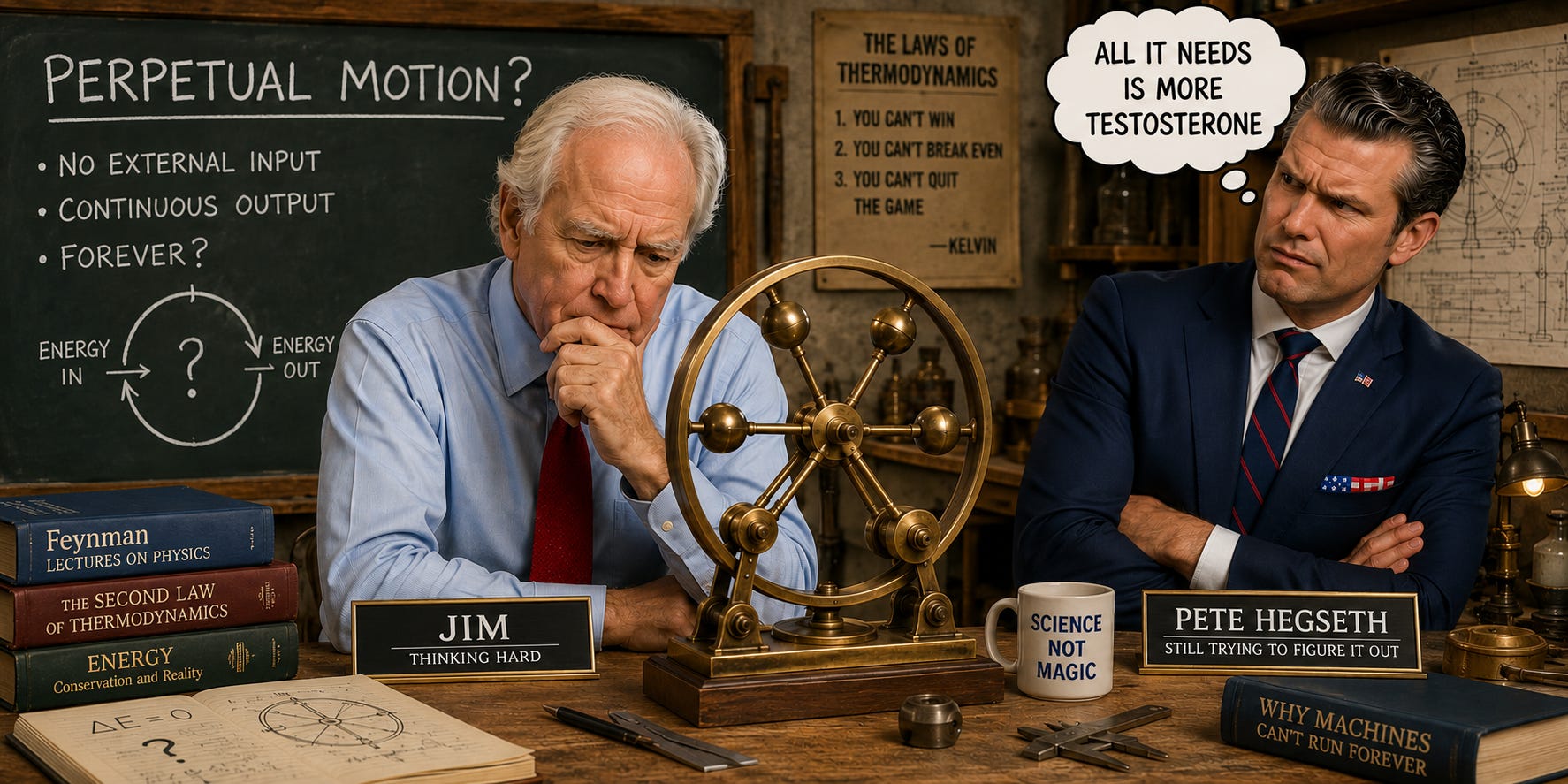
I’m told that the impossibility of perpetual motion is considered one of the strongest conclusions in physics because it follows from laws that have survived every experimental test we’ve ever devised. More importantly, it isn’t just a single law—there are multiple independent reasons why perpetual motion cannot work.
I was taught that decades ago in high school physics classes and have believed it ever since, because I trust in scholarship, and my professors were nice people who would not lie to me.
But that was well before Eisenhower’s warning about what those military-industrial guys were up to.
They had a scheme, and that scheme was quietly passed around from boardroom to boardroom at corporations like Lockheed, Boeing, General Dynamics, Raytheon and McDonnell. Back in the day, these firms received billions of dollars in Cold War contracts for bombers, missiles, submarines, radar, and nuclear weapons.
Part One of the Perpetual Motion Machine (PMM) was a permanent peacetime arms industry of unprecedented size.
Well, golly gee, we’d never had one of those before, but why not? These companies all existed, but had been seriously reconfigured to produce all the weaponry of World War Two.
Profits were off-the-wall, because who counts nickels and dimes when a war was under way? And here, all this nuclear fright, along with politicians needing to ride that fear to their next election, handed us a perfectly good Cold War.
Cold or hot, they chuckled around their polished boardroom tables, we can keep these profits coming as long as fear is a common human trait.
Part Two of the Perpetual Motion Machine being built was keeping fear alive.
Not a problem at all, most people live in a constant state of fear. Will their marriage survive constant argument, the kids avoid drugs, they keep their jobs, be able to make enough money to move up the ladder and, (for god’s sake) keep anyone from knowing about my secret bank account?
With Russia rattling its nuclear saber, and all the grief of colonialism having fallen apart, the prospect of wars-to-come is perpetual all by itself.
Part Three is, there’s no use in keeping this damn PPM thing running if we can’t make a buck.
Not only make a buck, but become insanely rich.
This deal has gotta work whether or not there actually is a war. Bingo! If there actually is no war at the moment, the fear of war will do nicely.
Europe worried about Russia as well, and there were a bunch of nations in Europe that needed bullets and guns. All the nations of South America hated each other…good market there. Saudi and the Middle East.
What the hell, this is not a lack of customers, it’s simply a marketing opportunity. Scare the shit out of everyone, and they’ll weapon up. There is no one but us left in the world to both produce and sell.
Hoo-ha!!!
Part Four, how do we keep the money flowing?
Simple. We model the weapons industry after the fashion business. New and improved is the mantra. Better bombs, missiles probably have a future as well. Fighter aircraft will be like automobiles, everyone eager to get the most chrome and upgraded power.
Fashion has Paris shows, so we’ll put on International Weapons Conferences, airshows that use commercial aircraft to work as cover for the real stuff…military jets doing loop-the-loops.
There is no end to where fear will take us.
In 2025, global military spending reached approximately $2.6–2.9 trillion, the highest level ever recorded.
While that has been proven to be true, the main scientific reason perpetual motion isn’t the perpetual part, it’s the friction.
Friction can be avoided by greasing the machinery, and so the American government greased the big boy’s wheels.
I have continually grumbled about America’s military-industrial complex taking up 42% of our national budget.
My sources tell me The Pentagon’s budget is roughly $850 billion annually. But when veterans’ care, nuclear weapons, intelligence, homeland security, military pensions, and a proportional share of interest on the national debt are included, the United States spends on the order of $1.5 to $1.7 trillion per year just to maintain its national security establishment.
The grease comes from the fact that these corporations and services are largely private, listed companies on the stock exchanges. These companies, and their stockholders, make money either by dividends, or (far more commonly) by increases in their share values.
Thus, the government pays for the product at wholesale, but the producers bank it at retail to Saudi Arabia, Israel, South Korea, Qatar, the United Arab Emirates, and others.
And there, my friends, is the modern American Perpetual Motion Machine at work, courtesy of your U.S. Government.
“In the councils of government, we must guard against the acquisition of unwarranted influence, whether sought or unsought, by the military-industrial complex.”
-Dwight Eisenhower, 34th president of 5he United States
An interesting historical note is that an earlier draft of Eisenhower’s speech reportedly used the phrase “military-industrial-congressional complex.”
He ultimately removed the word “congressional,” likely to avoid directly criticizing the legislative branch in his farewell address. Even so, many historians believe he intended Congress to be understood as part of the system he was describing.
Money may make the world go around, but in the American political and economic systems, the military-industrial crowd are among the only ones who sing and dance.
Sleep well.
The best government money can buy is working for you in Washington, D.C. this very moment.