
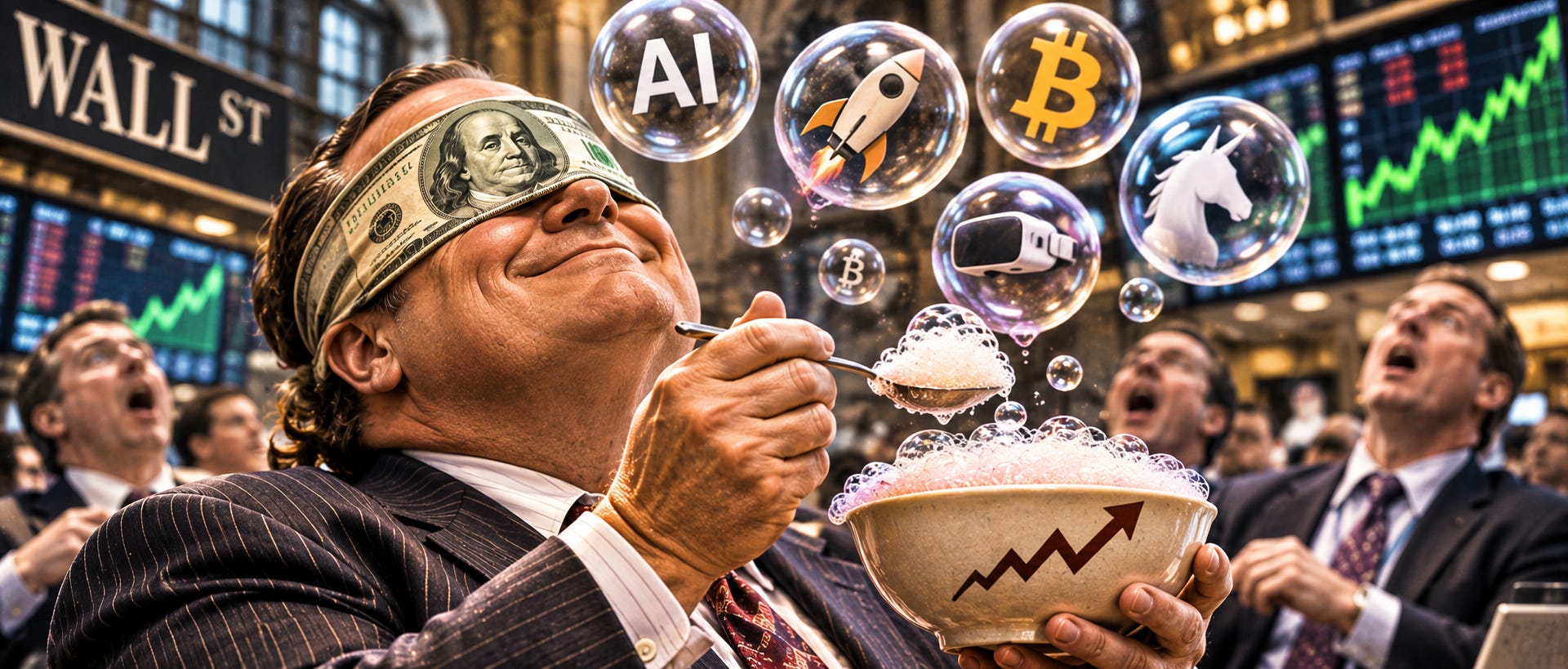
In olden times, way back before many of us were born, stocks were valued on their ‘return on investment.’ That seems pretty logical when you think about it, valuing something for what it gives you back.
But that was back before the current fashion for bubbles.
Not the sort of bubbles that float up in your kid’s bath, or are blown through a ‘bubble stick,’ but a whole fashionable invention in valuing new businesses. I’m told that many economists argue a bubble can only be confirmed with certainty after it bursts, which is precious little help to those who lost a bundle.
But I have what I feel is a more reliable test, which I have chosen to call The Freeman Factor: “When the price of a stock depends more on finding someone willing to pay even more tomorrow than on what the business can reasonably earn, you’re being taken for a ride that may not end well.”
You are free to use The Freeman Factor without attribution.
Living in Europe during the heady post-communist years of the 90s, I was shocked as so many of my young friends scurried back to the US to catch a bus, train or plane to take part in something called ‘the dotcom era,’ before they got left behind. Their friends were all (or mostly all) coining big bucks by inventing or participating in businesses trailing a dotcom behind their name.
Those years heralded a period of unparalleled technological innovation, and corresponding speculative investment, hyped by the early adoption of the World Wide Web…www.letsgetrich.com…all aboard before the train leaves the station.
Unfortunately, the train did leave the station, most of my good friends lost their luggage and, those who were able, toddled off to university to get an MBA.
It may be that I’m actually writing about something more important than stock-market bubbles.
I may be writing about an American economy in which the financial value of owning things has become increasingly detached from the economic value of making things. At what point did America decide that making money was more important than making anything useful?
Decide on your own, but that was either a good thing or bad, enhancing that bunch that have since become more widely known as Silicon Valley.
But it is the nature of investment to abhor a vacuum and, even with slightly singed wings, speculators need a place to get back in the game.
Now may be an appropriate time to define a few terms:
‘investors’ are those with capital, who engage with various stock markets, to increase their wealth over the long term. Warren Buffett is an excellent example.
‘Speculators’ are in and out of the game for a quick buck, and have very little allegiance to long term values. Warren is a long-term investor and holder of stocks with that in mind.
Let me revisit those ‘olden times’ I tempted you with earlier in this article.
In the 50s, those ancient times when America carried far less debt relative to its economy, and the wealthy paid considerably higher tax rates, stocks were valued largely on their earnings and the dividends they paid to shareholders.
A decent blue-chip stock was expected to earn a profit, share some of it with its owners, and provide a reasonable return ti investors over the years.
Simple enough.
A decent investment for little old ladies and recent widows, who weren’t particularly interested in becoming millionaires by Thursday.
There was even a convenient way of measuring the relationship between a stock’s price and what the company earned. It was called the price-to-earnings ratio, or P/E. A stock selling at 10 times earnings meant an investor was paying $10 for every dollar the company earned annually. The higher the ratio, the more investors were willing to pay for those earnings, generally in the expectation of greater profits in the future.
We had recessions in those days, of course. But the stock market was still widely understood as a place to invest in businesses, rather than a casino in which the object was to find someone willing to pay more for your chips tomorrow. Today, we see some speculative stocks selling at hundreds of times their annual earnings (check out SpaceX).
These are not waters for little old ladies to swim in, and full of sharks for speculators as well.
But speculators are holding up a record high Dow Jones Average that meanwhile leaps in times when wages are dropping in real terms and inflation is rampant.
Who do you suppose they are?
Well, I apologize for ringing the same old bell, but they’re the billionaire class that we have allowed to take over government.
Through an extended period of selling off America’s industrial assets, paying off congress for tax cuts, removing most of the regulative tools from the banking and capital toolboxes, and thereby becoming ‘renters’ instead of ‘providers,’ our super-rich have managed to push stock prices to heights only they can afford.
And, it’s not solely an American game.
Billionaires are spread around the world these days, and the most reliable ‘sucker market’ in currency remains the all-American-buck. Thus, Wall Street continues to huff and puff until it blows your house down. That is, if you are fortunate enough to live in such a house.
Elon Musk’s SpaceX isn’t 10 to one these days, it’s 556 to one. Over the last twelve months, through September 30, 2026, SpaceX shows a cumulative net loss of roughly $2.76 billion, due to earlier losses in 2025 and the first half of 2026.
Is that, by any possible financial metric, an investment rather than a speculative scenario?
I think not.
But then, I am both too wise and too broke to engage in such activities of the rich and famous…