
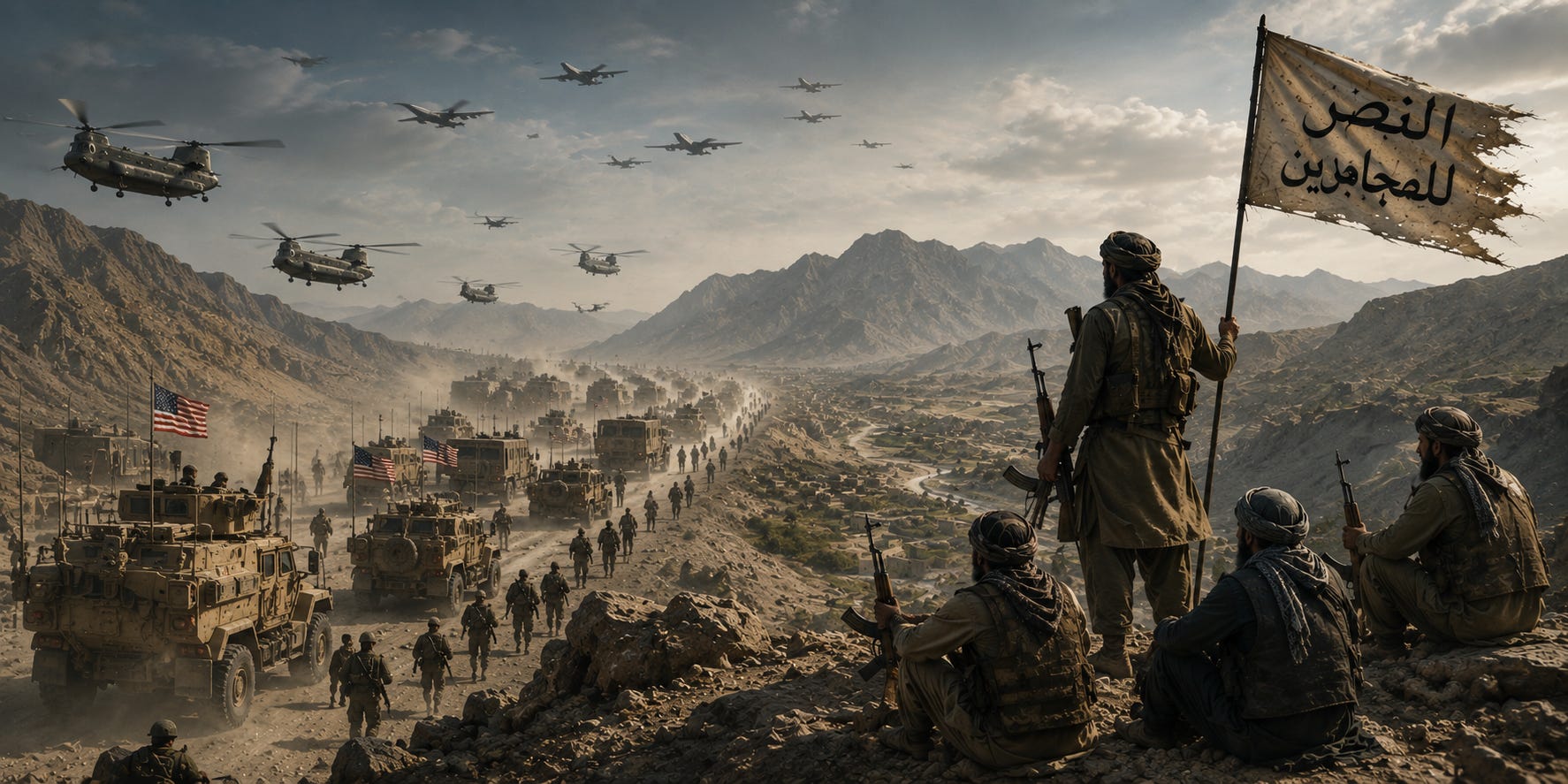
What does ‘military superiority’ even mean, when the largest military on the face of the earth can’t win a war?
Korea was simply a north-south split, no win there but for a divided nation. A dangerous and erratic North Korea is the price we still pay today for that.
Learning nothing from that, Vietnam (which was a problem the French were unable to solve), cost us the lives of 56,000 young Americans, PTSD disabling an entire generation, and an exit with desperate Vietnamese dripping unceremoniously from the landing gear of military helicopters. Who can ever forget those images?
Having learned nothing from that, we barged in to Iraq, a country we new nothing about, and whose leadership we didn’t much like. We hanged their leader, Saddam Hussein, threw out the Sunnis (who had largely run the Iraqi state), and transferred political power a know-nothing Shiite majority, leaving them military equipment as well. We left Iraq a smoking ruin, deeply corrupt, and with a poorly trained (by us) military. More than two decades later, it has rebuilt much of the rubble, but is still living with the political, institutional and human wreckage of invasion.
Having, once again, learned nothing from that, President Bush decided Afghanistan was an easier target, even though it had held off invaders across the history of the world. Before Bush invaded Afghanistan, declaring victory from the deck of an aircraft carrier, the Afghans had already defeated Alexander the Great, three invasions by the British Empire, and a fourth by a very determined Soviet Union.
Bush apparently decided we needed a fifth defeat for the record books, encouraged by his Vice President, Dick Cheney, that this time it would be a cakewalk. Georgie Boy sallied forth, into the longest war Americans had ever fought, including a Civil, First, Vietnamese, and Second World War.
An astonishing twenty years later, the United States withdrew, having spent roughly $2.3 trillion, killing 2,461 service members, and departing again with helicopters awash with hangers-on, and essentially the same governing organization it had overthrown in 2001.
The Taliban was back in control of Kabul.
Our military left behind in Afghanistan about $7.1 billion in U.S.-funded military equipment, amounting to more than 300,000 weapons, 40,000 military vehicles, 78 aircraft, 9,524 air-to-ground munitions, large quantities of night-vision equipment, communications gear, surveillance equipment and biometric systems.
More hauntingly, we left behind tens of thousands of Afghan interpreters and other employees who had served the United States. Counting their families, well over 100,000 people were potentially exposed to Taliban retaliation
As Henry Kissinger once said, “It may be dangerous to be America’s enemy, but to be America’s friend is fatal.”
The axe falls equally on both Democrat and Republican Presidents; Truman and Johnson for Korea and Vietnam, George Bush for Iraq and Afghanistan.
You decide whether or not Trump upsets that balance by supporting an Israeli genocide in Gaza and a Republican supported war in Iran.
Which is really not the point.
The point is that, in all of those lost and costly wars, we never faced opposing amies. There were no military bases to wipe out, no uniformed armies, tanks, aircraft, battleships, cruisers, or aircraft carriers. Wars are no longer fought on those terms. The enemy today is insurgent, and difficult (if not impossible) to sort out from civilian populations.
Rommel is no longer up against Patton in North Africa
It’s an Israeli Army and Airforce up against Palestinian insurgents, and we’re witnessing the frustrations and inhumanities of that. Winning, if you can even call it that, requires a genocide.
The weaponry has changed as well. Car bombs and (as we’re seeing in Ukraine) drone strikes by both sea and air. We recognized our enemies in WWII, and that was the last time in history we will probably ever have that advantage.
Another, and far more devastating, advantage we have lost is keeping these attacks away from our shores.
Because the weapon of choice is a drone, and because Amazon and your local pizzeria plan to deliver by drone, who can possibly know exactly what is being delivered to whom?
War may be hell.
And war may be fought differently.
But only Amazon and the delivery systems will be keeping score…