
We’re good at that, we Americans. The unhoused rather than homeless is but another example. George Carlin has a wonderful video on that subject, dating our dehumanization all the way back to the First World War. There’s a link at the bottom of this article, in case you’re interested.
Those who have caused all this societal grief are so ashamed of themselves, they eagerly climb on board the Precariat Express.
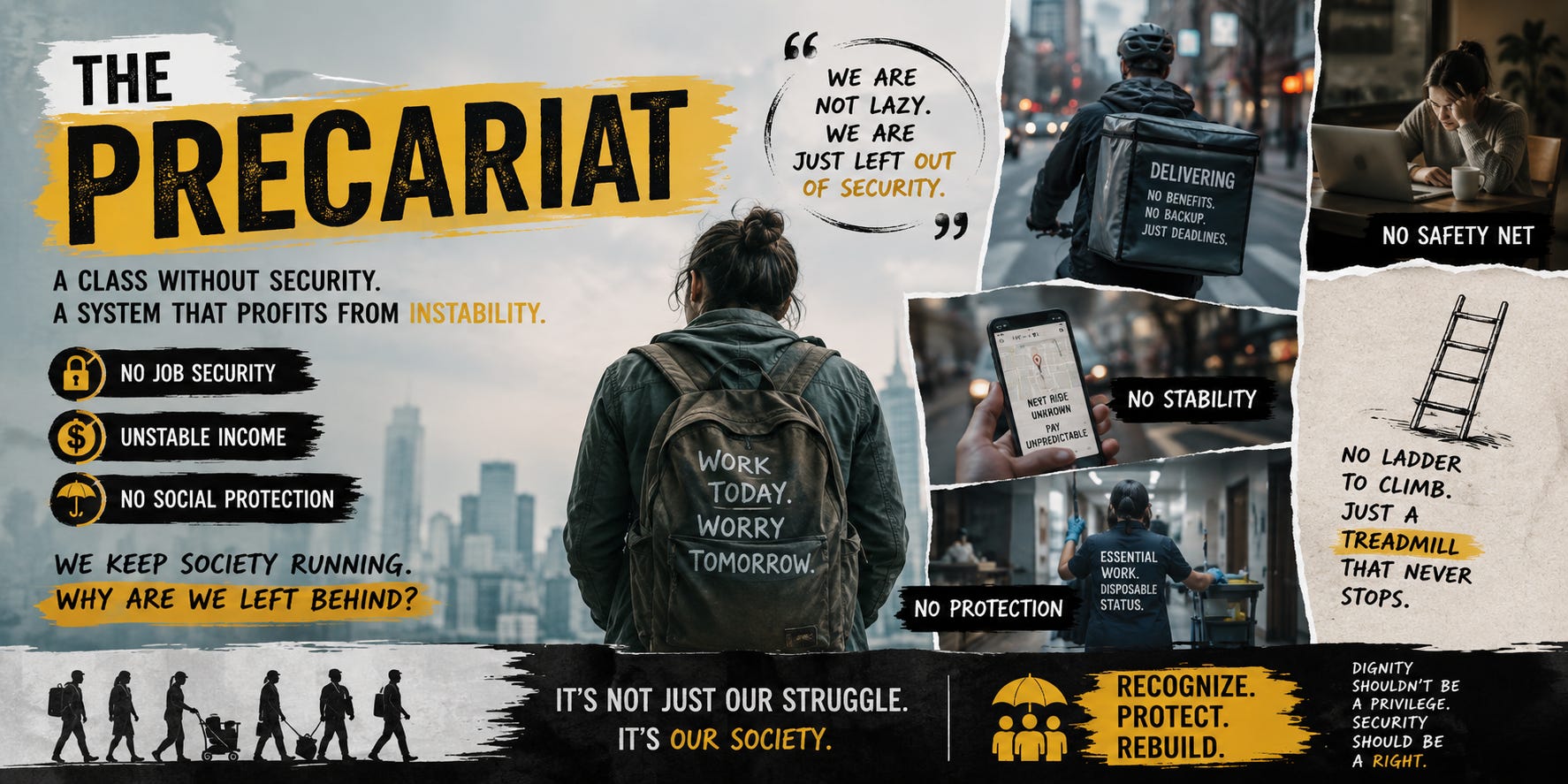
Reaching for a definition, my dictionary comes up with “word not found.” It suggests precariat is “a portmanteau of ‘precarious’ and ‘proletariat,’ referring to a social class of people whose lives are characterized by a lack of job security, stable income, and social protection.”
A portmanteau, should you be unfamiliar with that word, is a new word formed by joining two others and combining their meanings. Motel fits that usage, being made by combining ‘motor’ and ‘hotel.’
So, my dictionary disallows a word, by defining it.
As Carlin informs us, ‘shell-shock,’ a perfectly reliable word for the horrors of war, has become ‘post-traumatic stress disorder,’ a word entirely devoid of any human feeling.
But it did gain two extra words, so I guess that counts for something.
Yet, the ‘precariat’ is more than simply a few people that deliver your pizza. They’re an entire class, eating away what once was our middle class, formerly supported by labor unions.
Temporary contracts, gig work, no benefits, unpredictable schedules, little legal protection, and few paths to stability. all flies in the face of the family life we once knew, when a single wage-earner could support a family.
In the United States, it has expanded dramatically through app-based labor, subcontracting, and the erosion of traditional employment protections.
Some of the most easily recognized American examples include:
Uber Technologies — drivers classified as independent contractors rather than employees, typically without healthcare, pensions, paid vacation, or job security.
DoorDash — where drivers pay fuel, vehicle, and insurance costs themselves.
Amazon Flex drivers — technically contractors using personal vehicles to make deliveries.
Bicycle courier services in cities like New York, Chicago, and Los Angeles — many riders work through subcontractors or apps, often paid per delivery with no insurance or injury coverage despite dangerous conditions.
Warehouse temp agencies supplying workers to firms such as Amazon or logistics hubs — workers may wear company badges but are technically employed by staffing firms.
Home care aides and elder-care workers — frequently employed through fragmented agencies who pass along low wages and inconsistent hours.
Freelance media workers, copywriters, and designers working through platforms like Upwork or Fiverr.
Seasonal retail and fulfillment workers hired for holidays and quickly dismissed afterward. I once worked during Christmas for the post office, delivering packages with my Dad’s truck.
‘1099’ construction and trucking workers —legally dubious contractor arrangements used to avoid payroll taxes and benefits.
“It’s not us,” says Amazon’s Jeff Bezos. “We have to use subcontractors and have no control over their business arrangements.” Bullshit, Jeff. What passes for slave labor is entirely under your control.
A major distinction of what we now call the precariat, is that workers bear the risks once required by employers, such as healthcare, retirement savings, social security contributions, worker compensation between jobs, equipment costs, insurance, and even legal liability, where they can get away with it.
Add all of that together, and you can see where employers benefit.
Critics, those few whose voices are heard, argue this model creates a four tier society:
a larger share of whom are working poor,
a shrinking secure middle class,
an expanding workforce living paycheck to paycheck despite being continuously employed, and
white-collar workers.
Supporters argue that gig work offers flexibility and entry-level income opportunities.
History creates society as much as it records it.
The American precariat was enabled by the 2008 financial crisis and suffered further during the COVID era, as app-based delivery and contract labor became normalized across much of the economy.
Normalized, was it? What on earth is ‘normal’ about the combination of a bubble-based series of bank mismanagements, followed by a pandemic?
What was normal, was the super-rich responding to opportunity, as the super-rich have done throughout most of American history.
And I made no complaint over that, until they stomped all over a middle class that took 200 years to build, stole in-the-dark-of-the-night all the tools from the toolboxes that constrained the necessary limitations on capitalism, engineered a fraudulent takeover of the checks and balances that supported a democratic republic…
…and then ran off with the wealth of the nation.
This essay is getting longish, but several points have yet to be made.
In 1776, the year or America’s birth, Adam Smith wrote An Inquiry into the Nature and Causes of the Wealth of Nations. That elegant tome is usually shortened to The Wealth of Nations.
It is, according to those who know better than me, considered one of the foundational works of modern economics and classical liberalism. Smith argued that markets often function best with limited government interference, that a division of labor increases productivity, and self-interest can unintentionally benefit society through competition and trade.
He argued that national wealth comes from productive labor rather than hoarded gold or colonial mercantilism.
I argue (with far less reputation than Smith) that we find ourselves overwhelmed today by hoarded financial holdings and a grip on mercantile assets that is colonial at best, and overarchingly repressive at worst.
The wealth of our particular nation has, within my lifetime, expanded a thousandfold.
One percent of our citizenry now controls 60% of all American assets.
From the comfortable days of a wealth class made of millionaires, who paid their taxes and ran a government without debt, we have elevated ourselves a thousand floors, to a billionaire class that pays virtually no taxes, defeated the tenets of a nation of law, and engendered a forty trillion dollar indebtedness.
I was a young businessman in those times. We provided free university education for our returning soldiers after WWII, and built Levittowns to house them. We rebuilt a destroyed Europe and Asis with Marshall Plan funds.
There was nothing we could not do.
And we sold it all, became consumers instead of producers, and called that progress.
Adam Smith was also a moral philosopher. His earlier work, The Theory of Moral Sentiments, emphasized empathy, ethics, and social responsibility. Those social admonitions are often overlooked by people who reduce him to a simple defender of greed or laissez-faire capitalism.
We shared that philosophy, and traded it for Jeff Bezos and Elon Musk.
Watch George Carlin, you’ll be glad you did…