
And so it is with hope in the place of reflection.
For example, one need look no further than Tesla which, as I write this, is trading at $381 and, for those three hundred eighty-one bucks, you’ll get 13 cents back this quarter.
The Price-to-Earnings ratio of Tesla stock (TSLA) is somewhere around 360, depending upon what time of day it happens to be. For a comparison, look at Ford Motor Company with a PE ratio at 11, GM at 9 and Toyota at 8. That’s thirty times as high for every buck invested in a car company that’s missed every delivery date promised, already dropped two of its five offerings and has yet to fulfil Semi-truck orders accepted years ago.
Investors paying that multiple are effectively valuing Tesla as much more than a car company.
Really?
Betting on future growth from a Ketamine addicted founder with a trail of broken promises might seem strange, but then Ford isn’t promising autonomous driving, robotics, AI, energy storage, and robotics. For the most part, Ford delivers what it promises.
Wall Street just made Mr. Musk a $trillionaire on his latest IPO.
If the ground under valuations at Big Banks, Tech Companies and AI Startups seems a bit shaky, maybe it’s just me and my memories of persistent financial ‘adjustments’ every five years or so and major wreckages every decade or two. Born during the Great Depression, I’ve seen a lot of decades.
Large parts of Europe are on financial thin ice,
there’s a war in Ukraine in its fifth year,
Israel is hip deep in what the world calls a genocide,
the United States has joined Israel in an unprovoked attack on Iran,
oil transport has been internationally interrupted through the Straits of Hormuz as a result,
Trump’s tariff policies have business interruptions on a global level, and
income inequality in America is at an all time high…but
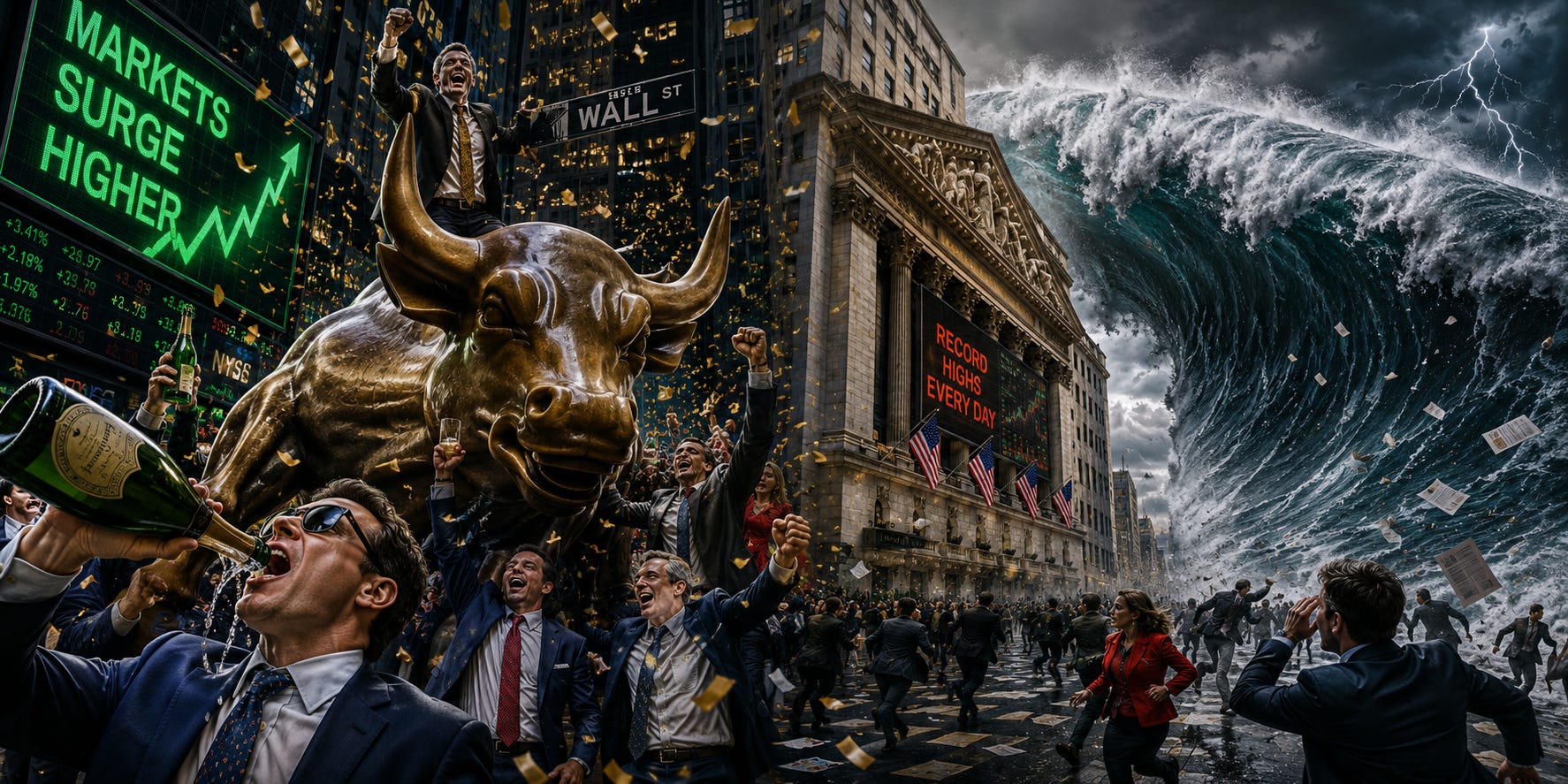
‘happy days are here again’ on Wall Street.
Does that seem just a bit risky at the moment, or is it just me?
My sources say it’s not just me. They point out that markets are not the economy, and Wall Street is not Main Street (ya think?). Markets discount the future, with investors asking ‘what’s next,’ instead of ‘what’s going on now.’
P.T. Barnum had it right, when he said, “The public appears disposed to be amused, even when they are conscious of being deceived.” Amused is one thing, a PE of 360 is quite another.
It’s a good thing to remember that Wall Street makes no money in a stagnant market. When nothing moves, no one makes a buck. Thousands of traders whispering in thousands of ears keeps the bonuses rolling, and there are always ears willing to listen.
And then, of course, there’s interest rates.
Flying in the face of rational lending, we had decades of zero (or near zero) interest rates. ‘Free money,’ and many businesses (particularly small businesses) tanked up on debt for expansion, or buying back stock, if they were listed. The current U.S. prime rate is about 6.75%, and most commercial loans are a couple of points above that.
Now those ‘adjustable’ rates are biting a lot of businesses in the ankle.
The U.S. hip-deep in debt:
Residential mortgages, $13.2 trillion,
Student loans, $1.66 trillion,
Credit card debt, $1.25 trillion,
Auto loans, $1.69 trillion,
Nonfinancial business debt, $22.2 trillion, for a chilling
total of all categories, amounting to $40.0 trillion.
Those are $trillions, folks, forty-thousand $billions…
It’s useful (but not all that helpful) that markets rose during periods during the Vietnam War, as well as the Iraq War, and during other periods of severe social unrest. They also remained buoyant in the late 1920s and before the 2008 financial crisis, right up to the moment they didn’t.
In 1929, the Drake Hotel was the tallest hotel in Chicago, and known for its fine cuisine. It was a favored place for broken investors to enjoy a fine meal and jump to their death after a cognac or two.
The argument for caution is straightforward: when valuations become elevated, debt levels are high, geopolitical risks are multiplying, and a great deal of optimism is already reflected in asset prices, the margin for error shrinks. One of my favorite economists, John Kenneth Galbraith, warned that “financial markets have a remarkable ability to ignore unpleasant realities for longer than observers think possible. But history also shows that when sentiment finally changes, it can change very quickly.”
One metric illustrates the point.
Tesla’s P/E ratio is roughly thirty times Ford’s. Investors are not paying for today’s thirteen cent return, they’re paying for a very (and I think over optimistic) future.
If I’m on track, it can be brutally repriced when it doesn’t and, in these times of international finance, the world will share the wreckage.
So, the issue isn’t risk.
The issue is underestimating, giddyness, and greed.
I think I’m not not alone, in wondering why so many warning lights are flashing as stock indexes remain near record highs.