
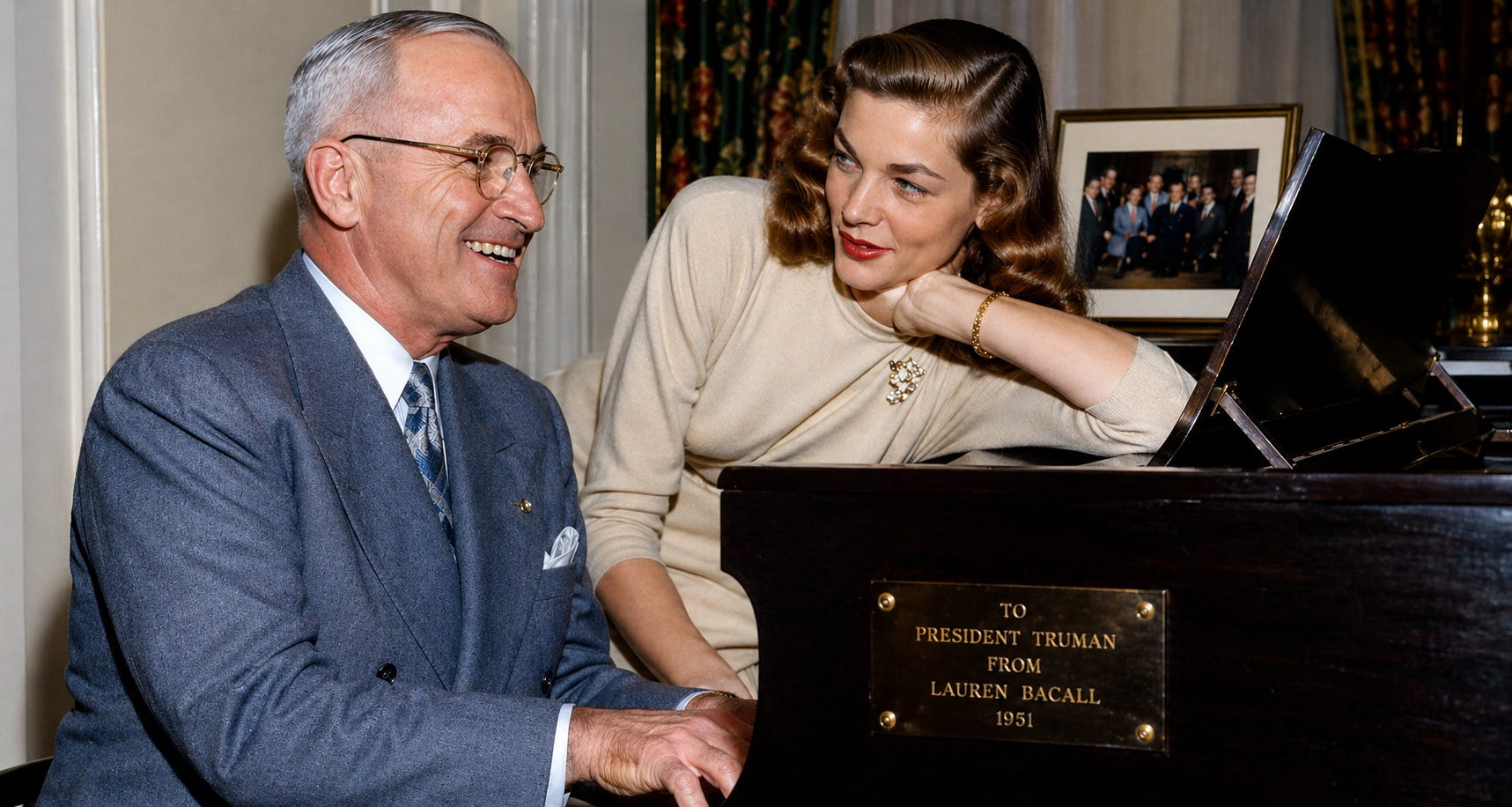
That ‘twain’ thing is an idiomatic expression, originating from a Rudyard Kipling poem, describing two people, things, or ideas that are so fundamentally different or geographically distant that they can never coexist, agree, or come together.
And so it is with my favorite president, Harry S. Truman, and the guy sitting in the Oval Office at this moment.
Presidents choose running mates for all kinds of reasons, but FDR had his hands full getting the country out of its worst depression in history, along with presiding over yet another world war. Add to that his fragile health, his age, and the political pressure of a congress not all that happy with Henry Wallace, his former VP.
By 1944, Roosevelt’s fourth consecutive win, Wallace had become too controversial for party leaders, who mostly saw him as too left-leaning and unpredictable. Democratic bosses (yes, those were the days of back-room choices during conventions), big-city machines, and Southern conservatives wanted him off the ticket. It must have been a hard blow to Wallace, because it was pretty clear that whoever was selected as vice president would succeed an aging and clearly unwell FDR. He needed a running mate who wouldn’t fracture the party, and took what was offered, busy with enough already on his plate.
It wasn’t that Roosevelt saw Harry Truman as a ‘nobody,’ but Truman was the least risky acceptable choice in a very tense political moment, and he also had real, if not widely recognized, strengths. He wasn’t identified with any extreme faction. He could satisfy both the New Deal wing and those more conservative Democrats. As a senator, he led the Truman Committee, which investigated wartime waste and saved the country billions, at a time when that was a hell of a lot of money.
Bottom line, he was acceptable.
FDR didn’t know him well and wasn’t deeply invested in him.
Roosevelt’s style had always been to avoid firm commitments and let divided factors battle it out. He allowed party leaders to coalesce around Truman and then gave him a lukewarm blessing. There’s no strong evidence that FDR saw Truman as a future architect of the postwar world.
Eighty-two days later, Roosevelt died and Truman became president, an office he was almost completely unprepared for.
Seventy-three years later, Donald Trump would become president, a job he was completely incompetent to fulfill, but that’s a contrast we will address shortly
Truman hadn’t even been briefed on the atomic bomb. His immediate reaction was pure Harry: “I felt like the moon, the stars, and all the planets had fallen on me.” He wasted no time, not because he was eager, but because there was simply no time to waste.
Within months he authorized the use of atomic weapons against Japan, a controversial decision that is still widely debated today. Not a man to shirk responsibility of point fingers elsewhere, Truman called in every available advisor, made the decision based on projected American and Japanese losses, and carried the burden of that decision publicly for the rest of his life. Harry, who retired to mow his own lawn and live simply, was never a second guesser—the buck always stopped with him.
An avid reader of history, Truman never expected to be a writer of it.
Truman had no formal academic training beyond high school, but he read history voraciously, especially biographies of leaders and accounts of war, diplomacy, and statecraft. Figures like Andrew Jackson and Abraham Lincoln mattered to him. He wasn’t interested in theory; he wanted to know how leaders made decisions under pressure.
Unencumbered by bone spurs, he was a Captain of artillery in World War One.
His stance against Soviet expansion wasn’t abstract ideology—it reflected lessons drawn from the failures of the ‘peace in our time’ appeasement in the 1930s.
Equally imbedded in that failure was his dedication to the Marshall Plan and NATO. Neither was simply policy, they were strategic decisions to avoid repeating the punitive World War I Armistice that over-punished Germany both economically and strategically, giving rise to Hitler.
A politician would have announced the Truman Plan for Rebuilding Japan and Germany. Then Secretary of State (and former U.S. Army Chief of Staff during WWII), George Marshall designed the plan, and Truman insisted it carry his name.
Harry thought in terms of “what happens if we get this wrong again?”
Distrusting intellectual overcomplication, he reduced problems to the moral and practical terms of who is responsible, what are the consequences, and what does past experience suggest will happen next? His one regret after leaving office was the creation of the CIA and, again, he made that confession public. “I would never have approved of the founding of the CIA, if I had known it would become the American Gestapo?”
In his seven years as president, he fired a single military commander. On 11 April 1951, he relieved General of the Army (5 stars) Douglas MacArthur of his commands, after MacArthur made public statements that contradicted the administration’s policies in Korea.
After leaving office, Truman did contribute to history through his memoirs (Year of Decisions, Years of Trial and Hope). Not excuses in any way, they’re justifications and explanations, written in the same direct tone he governed with, where the buck always stopped on his own desk.
Donald Trump thinks in terms of where can I exert my power, who can I embarrass in the process, and what’s in it for me?
Trump operates through a lens of personalized power. He measures decisions by how they enhance his leverage, reinforce loyalties, and use the constant threat of dismissal to sustain his public dominance.
In the first year of his second term, and up until now, he has fired or demanded the retirement of thirteen top military officers, creating a never-before-presidential-habit of firing his way down until he gets compliance.
Trump names everything he can under his personal brand and leaves no air in the room for Republican followers, because he wants none, will tolerate none.
Ignoring both the courts and international law, he governs by Executive Order, although the country is under no existential threat that would allow their use. His abandonment of US and international law includes flouting laws directed specifically toward him by the Unites States Supreme Court.
Harry Truman honored the impersonal responsibility of the common American exercising the temporary power of office.
Trump thirsts after personalized power that shows the world his strengths and makes him rich.
Take your pick