
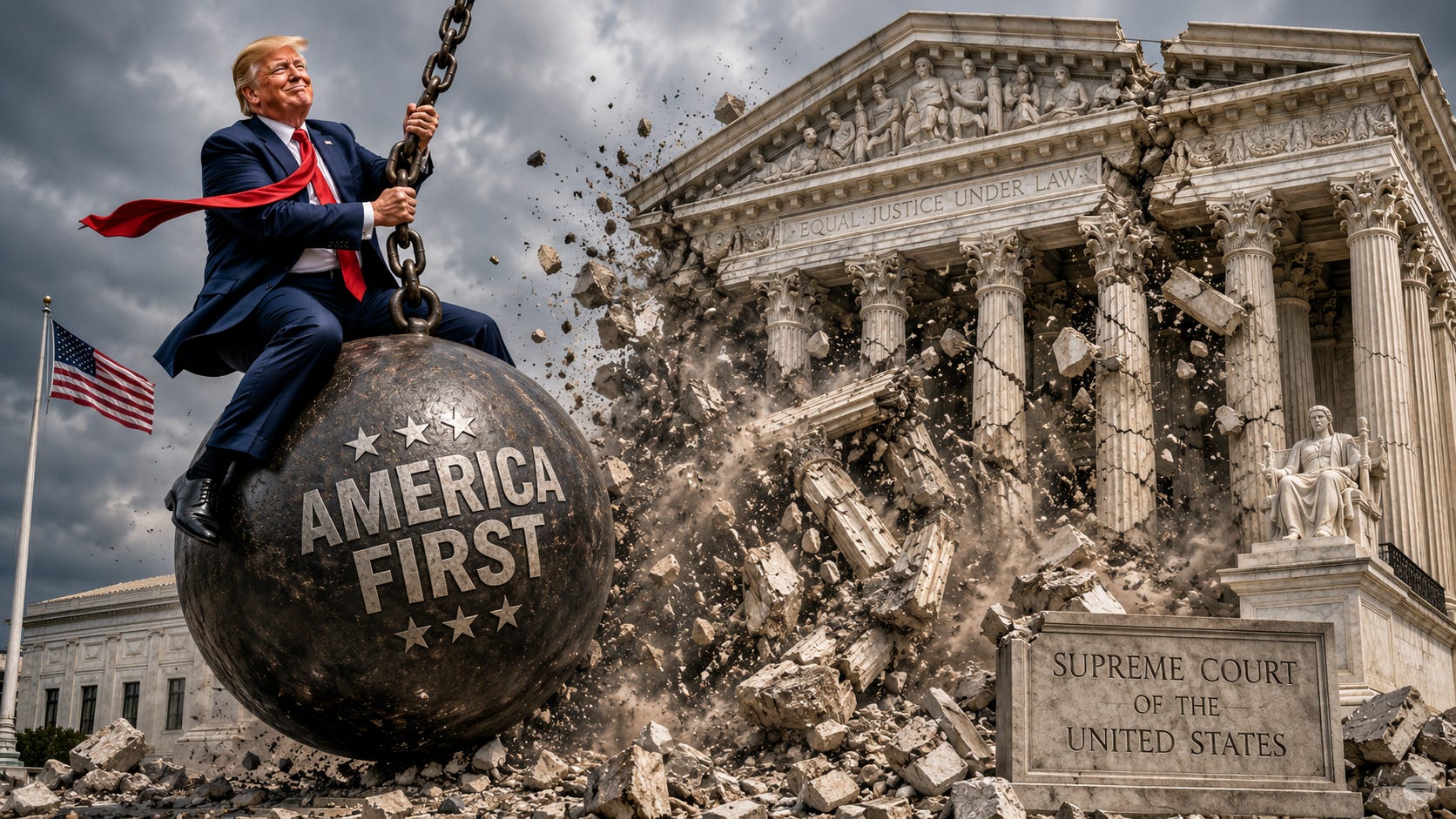
The two, obviously, are not disconnected, as our president stacked the court in its current 6-3 conservative majority.
Which might not be so bad. After all, we have survived such majorities in times past, but this one is not conservative. It is a veritable wrecking ball tearing away at the Constitution and the congressionally created laws of the land.
In my humble opinion (and my opinions are rarely humble), presidential recommendations to the high court should be aimed at convergence rather than political advantage. Five-four, in either direction, should be a constitutional stop-sign for presidential appointments.
Additionally, while I’m waving my arms around in frustration, it seems to me that retirement of Justices in ten years, or age seventy, should be the rule, whichever arrives first. This court, regardless of any feelings about our current president, is the most destructive in history and, apparently, will be with us for a long time to come.
A look at the record is dispiriting.
Trump v. United States (2024) — Presidential Immunity.
The Court ruled that presidents enjoy absolute immunity for core constitutional powers and presumptive immunity for official acts, even after leaving office. Critics argue this creates a dangerous expansion of executive power and places presidents above the law.
Corner Post v. Federal Reserve (2024)
The Court expanded opportunities to challenge long-established federal regulations, potentially exposing decades-old rules to fresh litigation. Critics say it invites endless legal challenges to government agencies, and we’ve seen that gone badly awry.
West Virginia v. EPA (2022)
The Court adopted the “major questions doctrine,” limiting the ability of agencies such as the EPA to make major policy changes without explicit congressional authorization. Goodbye EPA regulations.
Shelby County v. Holder
Predates Trump but was authored by Chief Justice John Roberts and became the foundation for much of the election-law landscape during his administrations. It struck down the formula used to determine which states and localities required federal ‘preclearance’ before changing election laws. It boldly gutted the most powerful enforcement mechanism of the Voting Rights Act and led to a wave of voter-ID laws, polling-place closures, and voting-rule changes, all aimed at disenfranchising minorities.
Rucho v. Common Cause
Arguably the biggest gerrymandering case of the Trump era. It ruled that federal courts cannot adjudicate claims of partisan gerrymandering. That gave state legislatures broad freedom to draw heavily partisan congressional maps without federal judicial review.
Equal Rights Amendment (ERA)
The Court never chose to rule on the merits of the Equal Rights Amendment because it was never certified as part of the Constitution. The practical effect has been that, despite receiving renewed state ratifications decades later, the ERA remains outside the Constitution.
Thus, the judiciary and federal officials accepted procedural barriers that prevent recognition of the amendment.
In Brnovich v. DNC, the Court upheld Arizona voting restrictions and made future Voting Rights Act challenges more difficult.
In Trump v. Hawaii, the Court upheld his travel restrictions on several predominantly Muslim countries, a flagrant abuse of international travel rights.
In Trump v. CASA, the Court substantially limited the ability of lower federal judges to issue nationwide injunctions blocking presidential policies. Many considered this one of Trump’s most important second-term procedural victories because it made it harder for a single district judge to stop administration initiatives nationwide.
Dobbs v. Jackson Women’s Health Organization, overturning a half century of abortion rights, was only possible because of his appointments of Neil Gorsuch, Brett Kavanaugh, and Amy Coney Barrett.
If you think I’m cherry-picking, I’ll accept that.
Yet, together, these decisions strengthened executive power, reduced federal oversight of elections, and made it harder to challenge government actions in court. From a historical perspective, the immunity ruling, and the restrictions on nationwide injunctions may prove to be decisions with the longest-lasting impact on how the federal government operates.
Even so, the argument that Donald Trump has acquired (or is attempting to acquire) dictatorial powers is made by a number of constitutional scholars, former judges, historians, and political scientists.
These are not generally individuals with political prejudices. As for the Supreme Court ruling that presidents enjoy broad immunity for official acts, they argue there is such a thing as too broad, and that this places any president too far beyond criminal accountability.
Trump has (possibly on purpose) made himself too hot a topic for impartial criticism, creating a presidency far more powerful than the framers intended. Some legal scholars have gone so far as to describe the ruling as making the presidency more ‘imperial’ and less accountable.
Maybe so, maybe not.
I’m in my tenth decade as a witness to American politics, and hove never seen such controversy, even when Franklin Roosevelt was simultaneously fighting both a major economic depression and a world war. It’s probably not unfair to point out that FDR was fighting for a wounded country, and Trump is fighting only for himself and a wounded image of himself.
Yet, the Founders we are all so fond of calling upon, designed a tripartite form of governance that aimed at keeping various powers in check.
If I am correct, they anticipated all the obvious grievances of their times, and did what they could to envision a nation of equals during a time of slavery. They were not perfect, because the times would not allow perfection, but they were pretty good.
Above all, Madison, Hamilton, Franklin and Washington, feared the concentration of power in any one person or institution. Having just fought a revolution against a king, they designed a government where ambition would counter ambition, forcing each branch to defend its own authority against the others.
In all such things, the Devil is in the details, and the unexpected usually strikes on its own.
What the Framers failed to foresee, was money taking over each aspect of the construction they labored to build. Wealth, in their times, was attached to land, and most of them were both landowners and slaveholders. Their wealth gave them more privilege than wealth, but they were wary of kings for good reason.
It all worked for over 200 years, but Franklin’s response to the question of “what kind of government have you given us, Mr. Franklin? persists, and may not survive our 250th anniversary as a nation.
“A republic, madam, if you can keep it.”
The United States of America was conceived as a promise. A promise of equality, over which we would fight a Civil War. A promise of opportunity as well as invention, prosperity, education, science, and agriculture. and a nation open to immigration, because we were lacking the hands to build and the imaginations to dream.
We are in danger, and the danger is not Donald Trump.
The danger is an uncontrolled, untaxed, and immoral concentration of wealth beyond what anyone would (or could) predict. Enough money in private hands to buy a Congress, infect a Supreme Court, and disable the machinery of free elections.
“We are called the nation of inventors. And we are. We could still claim that title and wear its loftiest honors if we had stopped with the first thing we ever invented, which was human liberty.” Mark Twain
If that doesn’t make you cry, you have no tears to spare…