
There seems to be a broad misunderstanding among Altman and his fellow AI enthusiasts, like Elon and even Zuckerberg (who understands the least of them all), about what they’re actually building.
Meanwhile, it’s cringe-time for both the environment and the public at risk.
Let’s get the environmental foolishness out of the way first.
A partial (and only partial) list includes,
OpenAI + Oracle + SoftBank and others. Named Stargate, it includes building an enormous nationwide computing system for training and operating increasingly powerful OpenAI models. Originally targeted at 10 GW of U.S. AI infrastructure by 2029, it has already secured more than that.
Microsoft Fairwater / AI infrastructure network promises huge, interconnected AI “factories,” in Wisconsin and Atlanta, to support Microsoft AI and OpenAI-related workloads (whatever that means). The Atlanta complex is tracked at roughly 636 MW and Wisconsin at 369 MW.
Amazon / AWS + Anthropic, Project Rainier. A gigantic Indiana computing complex principally supporting Anthropic. The current tracker puts it around 910 MW and more than one million Trainium2 chips.
Meta Prometheus & Hyperion, Meta’s infrastructure for increasingly powerful Llama-family AI and Meta products (anyone out there know what Llama-family is?). Hyperion in Louisiana is being built toward an extraordinary 5-GW scale.
xAI Colossus / Colossus 2 (before we even knew what Colossus 1 was) is Elon Musk’s Memphis supercomputer system for Grok (currently under investigation for undressing children). Colossus 2 is under construction and is being developed toward roughly 2 GW.
Google Gemini + Google AI infrastructure plans to develop Gemini and integrate AI throughout Search, Workspace, Android, Cloud and Google’s other businesses (I guess that means GPS as well). Its New Albany, Ohio frontier facility alone is tracked at about 453 MW.
Anthropic Claude is (or plans to) develop a competing frontier model with particular emphasis on reliable/safe AI and enterprise use. Although no one yet has defined ‘reliable/safe,’ Amazon is providing much of its enormous computing base through Rainier.
NVIDIA’s AI computing platform is somewhat different: Different that what, one might ask, but rather than principally competing with ChatGPT, it supplies the GPUs, networking and systems upon which much of everybody else’s AI is built. It is also directly involved in some enormous new AI campuses.
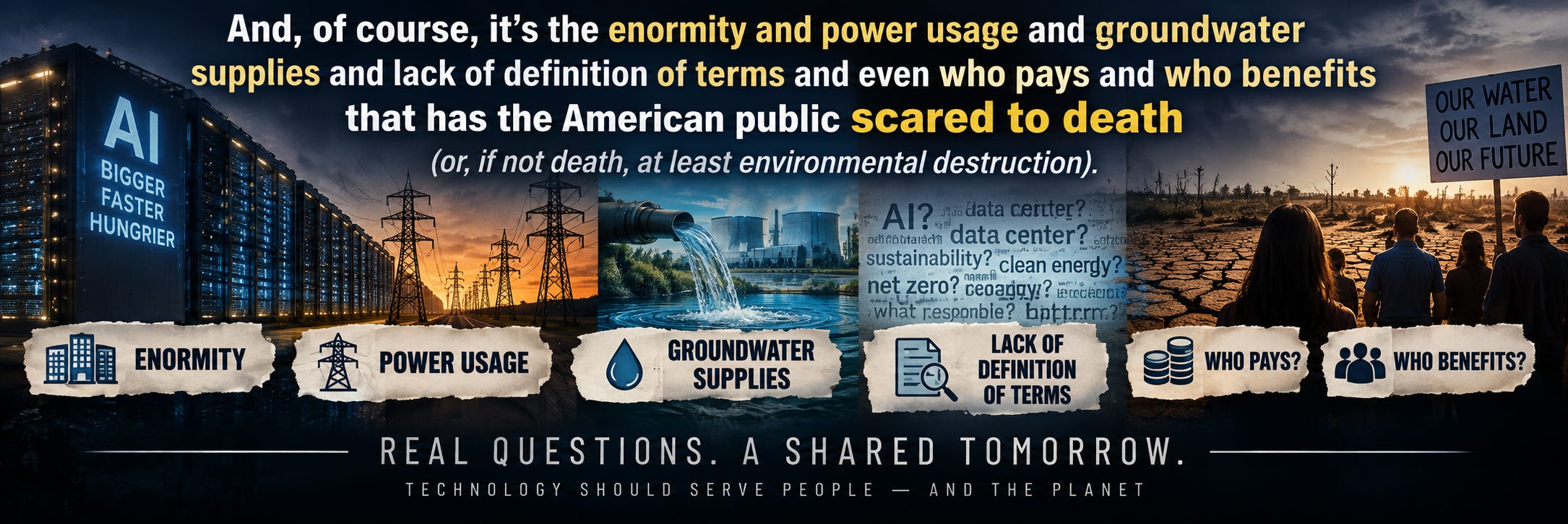
And, of course, it’s the enormity and power usage and groundwater supplies and lack of definition of terms and even who pays and who benefits that has the American public scared to death (or, if not death, at least environmental destruction).
Who provides the permitting for all these unknown knowns, and who’s in charge if the electric grid fails and the water-table disappears?
America (my sources tell me) is presently engaged in thousands of separate artificial-intelligence projects, but the race for genuinely advanced AI is concentrated in perhaps a dozen corporate and government empires—OpenAI, Google, Microsoft, Meta, Amazon, Anthropic, xAI, NVIDIA and the federal defense and scientific establishments foremost among them.
At what cost?
No one really knows, but our largest technology companies are now committing something on the order of three-quarters of a trillion dollars a year to capital investment, principally driven by the Las Vegas-style race to build AI, while other unknown quantities of individual multi-year AI infrastructure programs are being measured in hundreds of billions more.
A billion here, a trillion there, and pretty soon you’re talking about serious money.
In this private shell-game, using (apparently) some government, some investment, and some private money, who pays when some (or all) of it goes south?
No one is actually telling us in all this murky water, but the murk makes 2008 look like a day at the beach. No one told us then either.
But, there are indications,
Tech shareholders lose first through falling share prices and impaired investments.
Data-center owners and their equity investors take losses if facilities become worth less than their construction cost.
Bondholders and private-credit investors get hit if borrowers cannot service the debt. Those investors include funds ultimately containing pension (your money), retirement (your money again) and insurance money.
Banks can be exposed through loans, credit facilities and financing supplied to those private-credit structures (smacks of ‘too big to fail,’ for me).
Employees and suppliers (your money) pay through layoffs, cancelled construction and contracts.
Communities and utilities can be left with infrastructure built around demand that never materializes (your losses).
And there, at the very end, the taxpayer is already standing named as a jay-bird behind the curtain.
Federal policy (that’s you and me) explicitly permits loans, loan guarantees, grants and tax incentives for qualifying data-center and related projects. Government is also financing power infrastructure (you and me again) associated with rising AI electricity demand; for example, DOE recently approved up to $1.9 billion for restarting an Iowa nuclear plant whose output Google has contracted to buy.
No guarantor stands between you and me in those obligations. We are entirely naked, and standing by the curb in old clothes.
The other shoe to drop that fits no one’s foot.
Are these actually independent AI projects, or are we watching perhaps eight or ten organizations (think Google, Musk, Bezos, Gates and Zuckerberg) constructing a privately owned infrastructure that will dominate the American economy?
Interesting question. I suspect they are. They (and many other billionaires) already own the Congress, Supreme Court, presidency, most major corporations, as well as nearly all media organizations.
Why should we think otherwise?
Used in the best interests of the public, these labs could create a purpose-built plumber’s interface, preparing a daily schedule with tools and parts lists, keep customers up-to-date on expected arrival times, take incoming calls and schedule new appointments in open slots, and then send out all the bills.
I’ve heard no one suggest that the wreckage to communities by accommodating datacenters would lead to that.
It seems they would be more inclined toward automating everything not tied down, and sending workers home. No plumber’s interface will exist unless coders (and those who direct them) understand both the technology andthe need for time to understand the plumber.
It may turn out that Big Tech prefers to ‘move fast and break things.’
Are we the ‘things’ to be broken, or merely the ‘things to pay the bills when other things get broken?’
There are a thousand players in this shell-game, and only one or two will survive.
Even Las Vegas provides better odds than that.
Someone is going to have to pick up the lost loser-trillions.
Betcha we both know who that will be…
…and it ain’t the Tech-Bros.