
“Dow rallies 800 points, S&P 500 tops 7,100 for the first time after Iran declares Strait of Hormuz open,” is the headline.
Ah, yes indeed, let me set the stage for this conversation.
I have never been a gambler on Wall Street, and never fell for the casino belief that ‘this time I hold a hot hand.’ Those who do occasionally become billionaires and, just as often, sink below the surface never to be heard from again.
I was a landscape architect before my retirement, and satisfied that good value and a better than average sense of design was enough to make a decent living. And it did, all those three quarters of a century ago.
Those were good times.
Having said that, there is a persistent myth at the heart of modern finance that ‘markets are rational because they are efficient.’ If you look at post World War II history, the average period between recessions has been roughly 5–7 years.
I don’t see that as efficient, so much as fragile.
There is a difference.
The longest stretch between those embarrassing ‘corrections’ is the one we’re in right now…eleven years, and I find that worrisome. The political world at large, and the economic/social structures inside America have pretty much gone to hell in a handbasket since Ronald Reagan left office.
Trump one, Biden one, and Trump two (in my opinion) lit fuses that were laid down across the decades by both political parties, beginning with Reagan. The Great Communicator (Reagan) communicated his way through busting unions, encouraging the offshoring of American industry, using the CIA for foreign policy, and then riding off into the clouded sunset of Alzheimers.
Blame me if you care to. I voted for him twice, the shame of my life.
Wars then became George Bush policy in Iraq and Afghanistan, as well as encouraging Russia’s attack in Ukraine and Israel’s (with America at its side) in Palestine, Lebanon and (now) Iran. Would you believe, the war Bush lost in Afghanistan was the longest war America ever fought…twenty years…five times longer than World War Two.
A temporary ceasefire involving Iran, Israel, Lebanon, and the wildly unreliable US, is treated by Wall Street as if it were a structural shift in global stability.
It is not.
It is, at best, a pause in only one theater of a much broader geopolitical disorder—one that continues to include potential energy disaster, great-power rivalries, and unresolved supply chain tensions. Yet equity markets, led by indices like the S&P 500, behave like cheering sections at a football game, running up record highs as though a layer of uncertainty has been permanently removed.
It hasn’t. It’s merely been postponed.
Remember, Wall Street is not America, it’s the main toy in the toybox of our billionaire class. If you need confirmation of that, simply look beyond the United States and the illusion becomes even harder to sustain.
Europe remains economically constrained by high energy costs, weak industrial output, and limited fiscal flexibility, with its knickers in a twist over the threat of Trump leaving NATO. Growth is not collapsing, but neither is it robust enough to justify exuberance elsewhere, even though Orban has been knocked off his Hungarian perch. The Ukrainian impasse is emboldening Putin to threaten the Baltic states.
Meanwhile China, long the engine of global commercial expansion, faces structural headwinds with a still strained property sector, growing criticism in America (its major trading partner), and a slow, uncertain transition away from debt-fueled growth.
These realities, along with Trump tariff madness across the world, are not temporary irritations, they’re systemic adjustments.
And, while ‘adjustments’ is probably too kind a word, markets rise.
This is not new. “Nothing to see here, folks. Move along.”
Before the 2008 Global Financial Crisis, investors convinced themselves that housing prices could only move up, there was no downside. That fantasy nearly crushed the banks, which were saved by the Federal Reserve at a cost of the three million Americans who their homes.
Socialism for the banks, capitalism for the rest of us.
Yet somehow it removed the need to examine what lay beneath; poor-quality loans, excessive leverage, and financial instruments so opaque that even their creators struggled to value them.
Rising prices became proof of soundness. Optimism replaced analysis.
And here we are again, reprising the same old song.
Today’s optimism is more subtle, but way more dangerous.
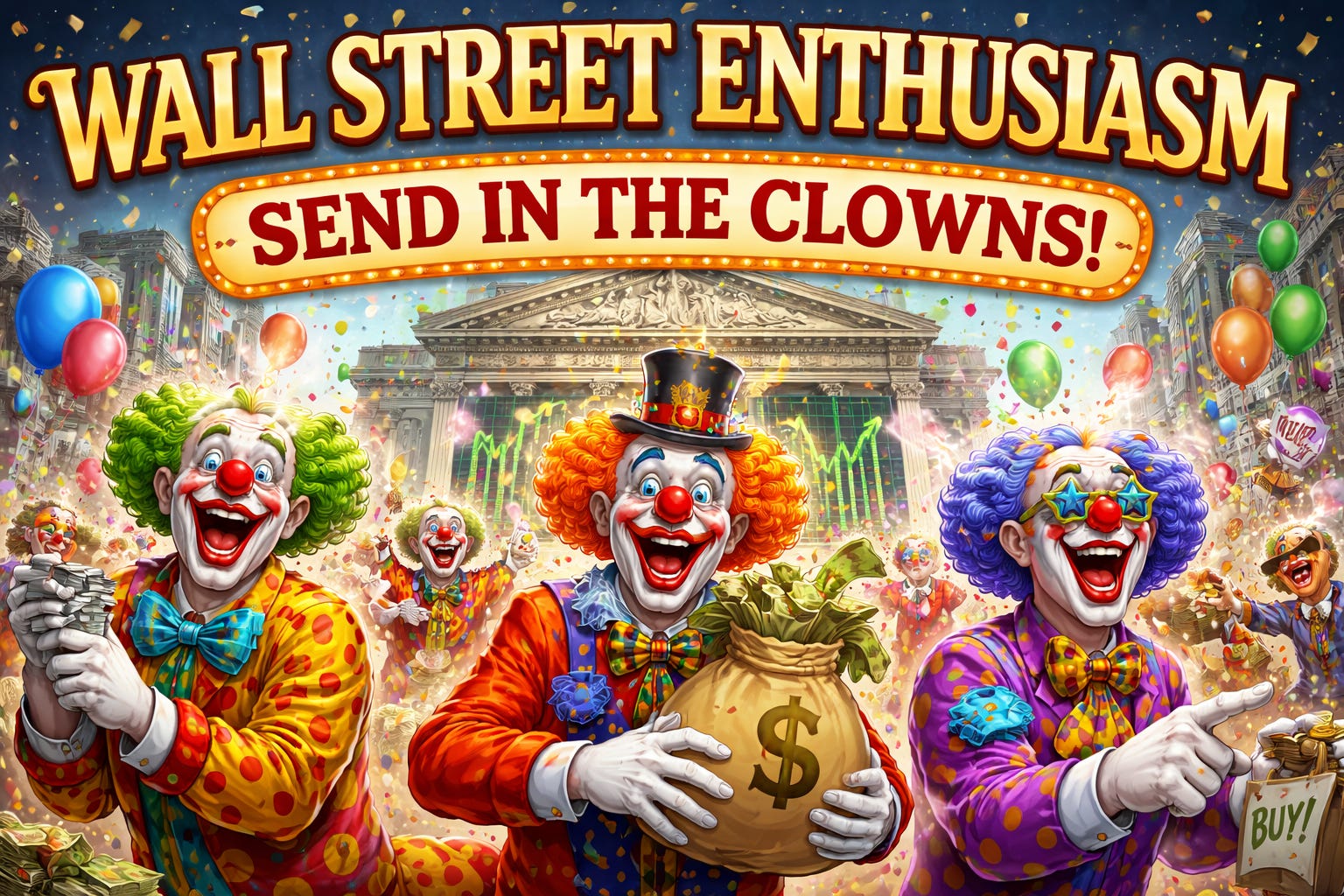
It doesn’t claim that risk has disappeared; it simply treats it as irrelevant. A ceasefire here, a soft inflation comment there, and the market clowns extrapolate stability into permanence. It’s the same intellectual shortcut taken in 2008, mistaking the absence of immediate stress for the presence of lasting strength.
There are lyrics to this:
Don’t you love farce?
My fault, I fear
I thought that you’d want what I want
Sorry, my dear
But where are the clowns?
Quick, send in the clowns
Don’t bothеr, they’re herе
Serious investment doesn’t require pessimism, but it does require due diligence.
Optimism, if it is to have any place at all, must be conditional, earned through evidence, not granted through exuberance by a self-serving billionaire class. We have stocks currently trading at 350 times earnings, which makes no sense at all under any circumstances.
When Las Vegas ‘roll ‘em again’ optimism becomes the foundation, rather than the result of due diligence, markets become theaters of belief.
At that point, ‘send in the clowns’ is no longer satire.
It’s description.
And way past time for a ‘too hot, too cold, too deep,’ financial bath.