
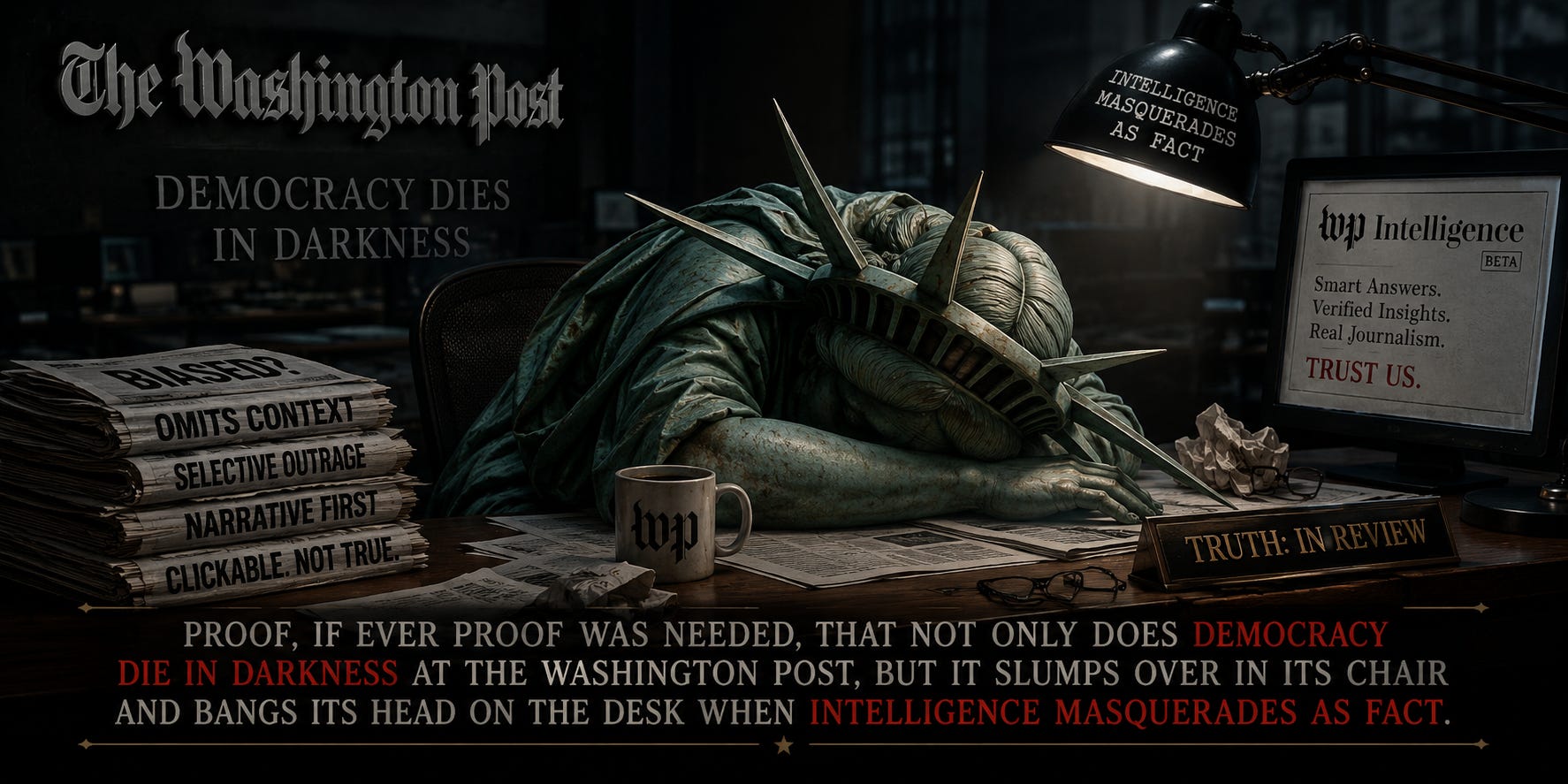
Even though we know that Washington is at its best (and least dangerous to itself and others) when it fails to mobilize, that is the headline of a Washington Post article by Josh Rogin.
Although he’s generally regarded as a well-sourced national security journalist, my take on it is that he, and most other ‘well sourced’ pundits on China are both dead wrong and highly dangerous.
Josh’s WP article runs 1500 words, and I need 1,000 to refute him, so settle down for a longish read…or not.
I give as my qualifications, over seven decades of paying attention and watching America consistently make wrong-footed decisions.
Occasionally, I find that having been a personal witness over my 91 years, and being a careful observer, as well as not having ‘well sourced connections’, is often the most powerful method of avoiding the political Kool Aid of the moment.
To begin with, as is best done in all serious conversations, we should agree among ourselves to define the terms.
Washington mobilization,
Artificial Intelligence, and
Chinese threat
Here are mine:
Washington mobilization, since 9-11, expanded from terrorism alone to include financial instability, geopolitical rivals, cyber threats, and technological competition, with a few wars thrown in. To say we are financially unstable is proven, by a national debt upon which the interest alone will soon absorb the entirety of just the interest on our GDP.
Our geopolitical rivals observe America’s over 800 military-CIA bases in more than 80 nations, a fact that suggests a thirst for empire and a disregard for the United Nations. Cyber threats and technological competition are the modern version of spy networks, and common to all great powers.
As to ‘a few wars thrown in,’ the longest war ever fought by America (longer than the Civil War, WWI and WWII combined) was George Bush’s war against Afghanistan. Every war since WWII, we have failed to win, although we fielded the mightiest military the world has ever seen.Artificial Intelligence is a hot topic now, even though neither an accurate description nor long-term impact is largely understood. I believe AI is the largest financial bubble ever known on American soil, with a high possibility of taking Wall Street and America’s other financial institutions into a long overdue crash.
Elon Musk has failed to convince me otherwise.The Chinese threat simply astounds me as a concept.
What wars has China engaged in, and in what foreign nations does it maintain military bases? Its military is increasing in size, but is still far behind the United States and is defensive rather than offensive in nature.
What some champion as the ‘Chinese miracle’ (me included) and others feel an existential threat, was created and financed by America’s export of our industrial base to China, as well as its acceptance into the World Trade Organization, three decades after the Nixon-Kissinger visit in 1971.
I was 31 years old in 1971, and Josh Rogin had not yet been born.
From 1971 to 1976, Nixon was trying to escape the Vietnam disaster, manage inflation and exploit the split between China and the Soviet Union. Plus, a minor burglary on the side. Watergate subsequently destroyed his presidency.
In China, Mao still ruled. China was poor and remained politically disordered by the Cultural Revolution. It feared the Soviet Union far more immediately than it feared America.From 1976 to 1980, Mao died and Deng Xiaoping emerged as China’s dominant leader, dismantling much of Mao’s economic system. In December 1978, China officially shifted from class struggle toward modernization and “reform and opening.”
Meanwhile, after Watergate and Vietnam, America suffered both inflation and energy crises. President Jimmy Carter emphasized human rights, as always, but also further normalized relations with China.From 1980 to 1989, Reagan rebuilt the military, cut taxes (mostly for the rich), establishing a Republican habit, deregulated industry, busted the trade unions, privatized what wasn’t nailed down, and pushed hard on the Soviet Union. American finance and technology expanded worldwide, while industry, along with middle-class employment, began a long decline.
Deng was busy with the opposite, introducing special economic zones, encouraging foreign investment and limiting market competition. China became increasingly entrepreneurial, looking for all the world like a marriage between the isms, capitalism and communism.
Few governmental organizations are as efficient as a benign dictatorship.
1989 to 2000 was a tough period for communists, with Tiananmen Square and the collapse of the Soviet Union. The United States emerged from the end of the Cold War as the world’s sole superpower.
China’s leadership concluded that Communist Party control must never again be allowed to collapse, as it had in the Soviet Union.
Relations sharply deteriorated, but neither side wanted a permanent break. America imposed sanctions while preserving trade and strategic contact. Globalization accelerated.
Under Clinton, America enjoyed strong growth, the internet revolution, relatively low inflation and apparent geopolitical supremacy. American companies increasingly shifted production abroad, and China became a vast manufacturing platform, combining inexpensive labor, modern infrastructure, and high-tech manufacturing, all of it under a combination of state direction and foreign investment.
American foreign investment was key and, thereby, a new class of American billionaires was born. While the United States was rushing headlong toward oligarchy, Josh Rogin was a 20 or 21-year-old, and still in college.
If you think I’m being unfair toward Josh, I understand that. But you are wrong. There is a difference between living throughout a period, and reflecting on it from a historical perspective.
For one thing, history is too often written by the winners of the moment, taking decades (and sometimes centuries) to get it right. A second truism is that statistics, if sufficiently tortured, will confess to anything.
From 2001–2008, Immediately after 9-11, America lost its head, fighting (and losing) wars in Afghanistanm and Iraq, seeing terrorism behind every rock, supercharging homeland security and spending enormous amounts on war to no purpose or avail. American infrastructure went unattended, while manufacturing continued its march toward China.
China joined the WTO in 2001, and its exports, factories, ports, cities and foreign reserves expanded extraordinarily quickly, another benefit of dictator-directed economic opportunities.
Was it a threat to American hegemony? From a Chinese perspective, it was the natural outcome of good managment, but it scared the shit out of Washington.
The 2008 to 2012 Financial crisis shattered America’s financial system, haunted an incoming president (Obama) and destroyed confidence both at home and abroad.
Meanwhile, in the meantime, in between time, China launched a huge state-directed stimulus, building infrastructure, housing and industrial capacity. Its economy continued an almost unprecedented expansion, while the US and other Western economies struggled.
During 2012 to 2016, Xi Jinping and Obama pivoted. Xi became the Communist Party leader in 2012. He centralized authority (a do or die for dictators), strengthened Party control (ditto), expanded surveillance, suppressed dissent and pursued a more ambitious foreign policy. For his part, Obama planned to reduce Middle Eastern commitments and ‘rebalance’ toward Asia, as were many allies at the time.
2017–2020, A strategic rivalry occurred, as Trump turned the new engagement consensus upside down, imposing unprecedented tariffs and describing China as an economic and strategic adversary. His administration restricted Chinese technology firms and pressured allies to do likewise.
So China expanded its navy and missile forces, tightened control over Hong Kong, cast an eye in the direction of Taiwan, as well as seeking greater technological self-sufficiency.
Checkmate!
2021–2024 was the period when competition became bipartisan, as Biden lowered the volume, but retained much of Trump’s strategic direction. Washington strengthened its badly wounded alliances, restricted advanced semiconductor exports, subsidized domestic chipmaking and encouraged ‘friend-sharing,’ whatever the hell that was.
For its part, China deepened its state direction of the economy, increased military pressure around Taiwan and aligned more closely with Russia, while for the first time facing property-sector debt, slowing growth and population.
So, you make your opinion known.
Which country was fighting wars that shrank its internal economic health, and which grew by leaps and bounds, raising an internal middle class and the standards of living for its people? Are we Americans under threat, or simply embarrassed at our wrong-footedness, and its outcome?
I admit, I’m prejudiced.
I think we are witnessing the beginning of the Chinese Century, and the decline of the West. And I was there to personally watch it unwind.
But then, I don’t write for The Washington Post Intelligence Report.
Any mobilization on Chinese AI will stand or fall on whether the rules can follow a model after release. Washington's instinct is ex ante, approvals and restrictions settled before anything ships. That worked for chips. A model keeps changing once deployed, through fine-tuning and new tool access, so the system cleared in January is not the system running in June. I wrote about why an ex ante product rule struggles with exactly this drift, and what it takes to govern the model's life rather than its launch date. Get that one design choice right and the mobilization matters long after the headline fades.
https://cyrilsimonnet.substack.com/p/why-an-ex-ante-product-rule-struggles?utm_source=substor&utm_medium=substack&utm_campaign=comment