
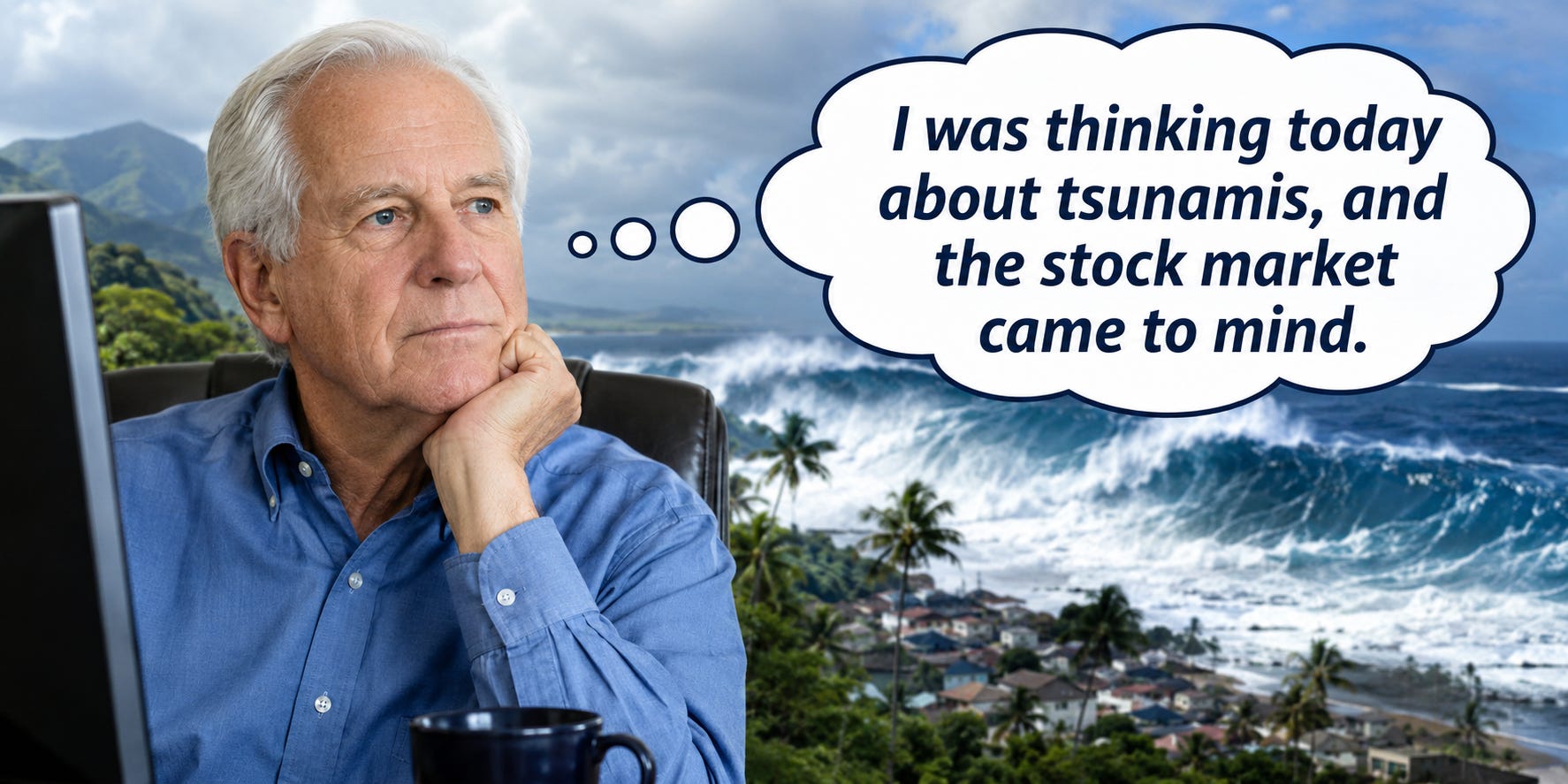
The interesting thing about tsunamis is that they are occasionally more destructive on their way back out. They sometimes scour away foundations, roads, railways, and bridges, dragging cars, boats, trees, debris, and stock investments out to sea.
A proper tsunami on Wall Street can pull investors into their current, making escape nearly impossible, drowning beaches of relaxation and harbors of safety, and sometimes causing severe long-term poverty.
On average, every four or five years we have flooded basements, stock-market wise, while in 1939 and 2008 a financial tsunami hit.
A New York Times article headlines “A $3.2 Trillion Deal-Making Frenzy Is Spurred by the A.I. Economy,” on the same day that a San Francisco real estate investor gushes that selling his home for a $million over asking price, allows him to “be a part of the excitement of the companies going public.”
When markets run on excitement and stocks sell for 300 times earnings, it’s time to pull a ‘Warren Buffett,’ and get heavy on cash for the coming (dare I say it?) tsunami.
In the cheap seats occupied by we common folks, several flashing lights are worth a look;
Mortgage debt remains the largest obligation. Most homeowners locked in low fixed rates before interest rates rose, which has prevented a housing crisis similar to 2008. However, mortgage delinquencies have begun rising, particularly in lower-income areas and places where home prices have weakened.
Credit-card debt is near record levels at roughly $1.3 trillion, and it carries the highest interest rates of any common household debt. Serious delinquency rates remain elevated, iand many households are struggling to keep up with payments.
Auto loans total about $1.67 trillion. While balances continue to grow modestly, many borrowers face higher monthly payments because vehicle prices and financing costs remain elevated.
Student loans have become one of the largest categories of household debt. About 42.6 million Americans owe federal student loans.
Outstanding federal student debt is approximately $1.7 trillion, with total student debt (including private loans) approaching $1.85 trillion.
The troubling part is repayment. Roughly 9 million borrowers are already in default, and millions more are delinquent or in forbearance.
Collections, wage garnishment, and tax refund offsets have resumed for many borrowers after pandemic-era relief ended. Of recent graduates, aged 22 to 27, approximately 42.5% are underemployed, the highest level since the pandemic and comparable to levels seen during the Great Recession.
That means nearly one out of every two new graduates, still owing an average $29-30,000, is working in jobs such as retail sales, food service, barista, administrative support, customer service, delivery, or other positions that generally do not require a bachelor’s degree.
Taken together, these debt categories paint a picture of two Americas:
The upper half owns appreciating assets, holds low-rate mortgages, has retirement savings, and benefits from rising stock markets.
The lower half, carries high-interest credit-card balances, faces expensive auto payments, owes student loans, may resort to payday lenders or similar short-term credit during emergencies, and has little or no emergency savings.
Nearly 100 million American adults lack enough readily available cash to absorb even a $500 unexpected expense without borrowing, selling something, or otherwise going into debt.
Do you think Bezos or Musk even realize that?
That divide matters because consumer spending accounts for roughly two-thirds of U.S. GDP (gross domestic product; the total market value of goods and services produced by workers and capital) in a calendar year. If enough households come under financial pressure at the same time, the effects can spread through the broader economy.
And, by the bye, in less than ten years, the interest alone on the American national debt will amount to more than our total GDP. To put that in perspective, it’s as though the monthly interest on your credit card was equal to your salary.
Very few Americans, other than those affected, are aware of these financial disabilities among enormous numbers of those living just down the block.
There are three kinds of men. The ones that learn by reading. The few who learn by observation. The rest of them have to pee on the electric fence for themselves.
-Will Rogers, American humorist in the 1930s
The billionaire class I keep raging about never had to pee on that fence, but tens of thousands of employees at Amazon, Wal-Mart, and Starbucks have had the experience, if they were given time off to pee at all.
It’s not an accident that the world’s wealthiest people, Bezos, Musk, Zuckerberg, Brin, Altman, Adelson, Murdoch, and Cook, attended multiple inauguration morning events, including standing closer to Trump at the actual swearing-in than his family.
These are, essentially, the owners of America, having bought the Supreme Court, the US Congress, and the presidency.
One widely cited analysis found that four of the most prominent technology billionaires—Elon Musk, Jeff Bezos, Mark Zuckerberg, and Jensen Huang—collectively increased their net worth by approximately $288 billion during the first year of President Trump’s second term.
That, in case such numbers are beyond your understanding (as they are mine), is 288 thousand million dollars…to four men in a single year, and that was just the additional iceing on their cake.
Holding about seven credit cards, the average Joe’s wages held either steady or flat. A favorite economist of mine had a word or two to say about widening gaps in the nation’s economic disparity:
In all life one should comfort the afflicted, but verily, also, one should afflict the comfortable, and especially when they are comfortably, contentedly, even happily wrong.
-John Kenneth Galbraith (Canadian-American economist, diplomat, public official and intellectual).
The billionaire class is not only wrong at this time in American history, it’s wrong at the top of its lungs.