
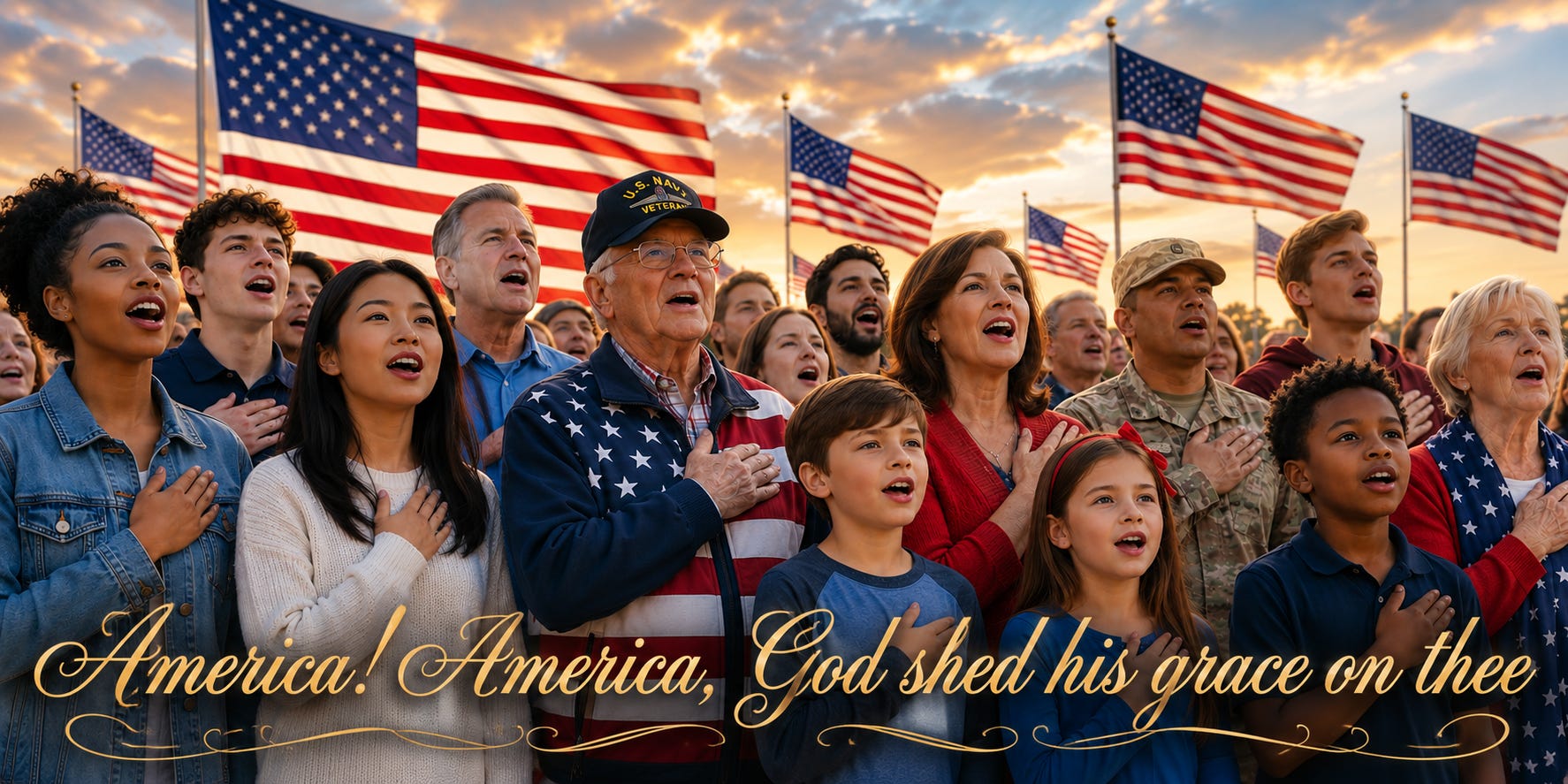
I say, ‘my America,’ and yet it is no more mine than yours.
Even so, at age ninety-one, having been born in 1935 (the middle of the Great Depression), I’ve witnessed all or part of ten decades. Only one percent of the tribe born in that year survive today, and I am among them.
But we’re leaving the scene quickly, and I awakened this morning with the lyrics to ‘America the Beautiful’ in my mind and could not shake it.
It’s there still, do you remember?
O beautiful for spacious skies
For amber waves of grain
For purple mountain majesties
Above the fruited plainAmerica! America!
God shed his grace on thee
And crown thy good
With brotherhood
From sea to shining seaOnly the first stanza is commonly sung, and probably not even that anymore. Most Americans have never heard, let alone sung, the other three.
But those were the times we keep being told we can no longer go back to, and I wonder why.
In the fifties, when I was twenty, we all paid our taxes, the wealthy as well as the rest of us.
We had no national debt,
no homeless except for a few hoboes along the railroads.
Anyone with a lawnmower and a pickup truck could go into business, and watch it grow, as quickly as the grass they cut.
There was farmland a block west of my home in Evanston,
WWII vets were just graduated from university educations given free, and
moving into Levittown homes with guaranteed mortgages at subsidized interest rates.
We were the industrial kings of the hill,
with a middle class where one wage earner could support a family.
A bit short of brotherhood, perhaps, but that was the promise.
Remember, the statement that ‘all me are created equal’ was not a fact in our slave-owned nation, but a promise of what was to come.
The second stanza is remarkably self-critical.
O beautiful for pilgrim feet
Whose stern, impassioned stress
A thoroughfare for freedom beat
Across the wilderness
America! America!
God mend thine every flaw
Confirm thy soul in self-control
Thy liberty in law!The poem was first printed in a weekly newspaper, The Congregationalist, on July 4, 1895, and soon set to music, already poking at the ‘flaws’ yet to come. We have always been an immigrant nation, having done what we could to eliminate the native population that preceded us by 12,000 years.
But, somehow, we are now accelerating that process with masked DHS agents intimidating, as well as kidnapping and deporting both citizen and non-citizen students and others without due process.
Stern, impassioned stress meets modern, armed technology, and passion comes second to racism. There are those, perhaps even more today, who would have our proud multiracial society remain steadfastly European and white.
Thy liberty in law line has become a sick presidential joke.
Looked at with care, the third stanza focuses on character over wealth.
O beautiful for heroes proved
In liberating strife
Who more than self their country loved
And mercy more than life
America! America!
May God thy gold refine
Till all success be nobleness
And every gain divineWhile the first part suggests an American willingness to die for freedoms, the second proposes that prosperity should be judged by ethics, not merely by riches. Written well before the bilateral (Republican and Democrat co-conspied) financial deconstruction of America, the final lines suggest its future.
Certainly the multiplication of millionaire status by a thousandfold was not yet in sight, divine or not.
The fourth (and final) stanza is unashamedly inspirational.
O beautiful for patriot dream
That sees beyond the years
Thine alabaster cities gleam
Undimmed by human tears!
America! America!
God shed his grace on thee
And crown thy good with brotherhood
From sea to shining seaAnd so we come full circle, not describing America as it was, but as it ought to become—a nation whose achievements are not built on suffering.
Our ‘alabaster cities’ are perhaps a bit less alabaster and a tad more falling plaster, Chicago having last attended to its infrastructure just after the Civil War. Undimmed by human tears is a bit of a stretch as well, with Mom, Dad, and the eldest child all working to keep the family boat afloat.
I was raised at family dinners, served precisely at 6PM, and eaten (if you can picture this) in candlelight, with conversation required among the four of us, my brother, Mom and Dad. Eighty years later, candlelight and conversation still dominates a slightly later dinner at eight.
As to God’s grace and brotherhood, it’s under increased stress.
Stressed indeed, as those we once looked up to for guidance in those matters have used their God’s financial grace to buy up and withhold the machinery of democratic government.
If that’s harsh, so it must be, as the billionaire class guards (and increases) its personal thousandfold stash of cash by demanding ever less tax burden and ever more worker concessions.
Taken together, America the Beautiful is less a patriotic celebration than a prayer.
Each stanza praises America, while immediately asking it to become better: more just, more self-controlled, more compassionate, and more noble.
We are constantly reminded that America is a continuing experiment in Republican Democratic Governance (hence the names of our two political parties) and, as Ben Franklin reminded us, “a Republic, madam, if you can keep it.”
I wonder, as I sleep less and wake earlier in my elder years, if we can keep it under present circumstances.
Many historians and literary scholars have noted that America the Beautiful was an anthem of patriotism tempered by moral responsibility, which is why the song has endured across political and cultural divides.
But has it endured? I’ve not heard it sung in recent memory.
The repeated refrain, “America! America!” is always followed not by triumph, but by a petition for grace, healing, refinement, or brotherhood.
That structure gives the anthem its distinctive character.
But begs the question of whether America’s distinctive character is itself at risk?
Sleep well.
Don’t let these questions interrupt your morning sleep, as they do mine…