
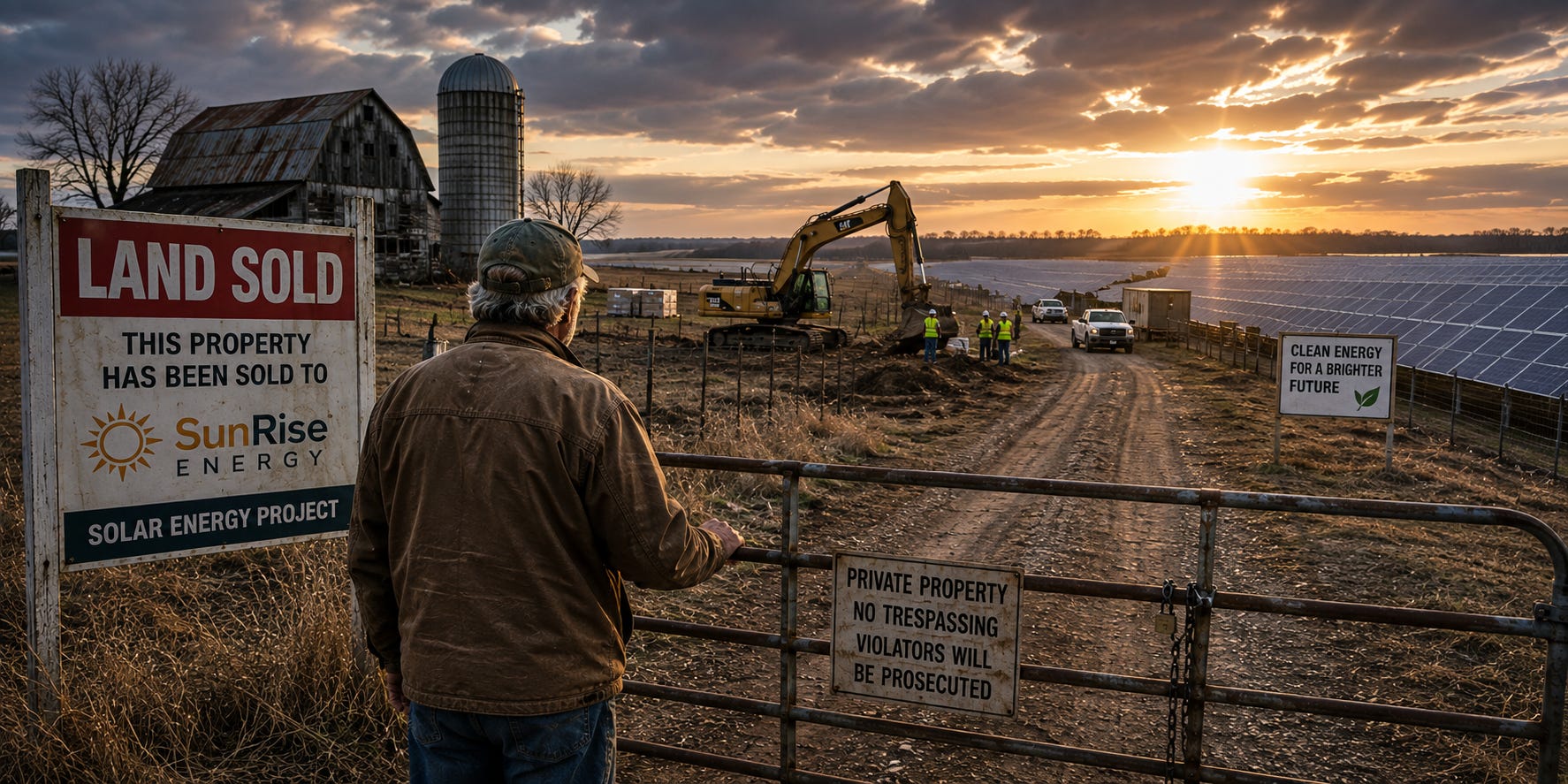
Quite rightly, there’s a growing outcry about the increasing use of farmland for solar farms.
Can it be that the wording is the problem?
Because we have chosen to call them ‘solar farms,’ America thinks they belong on farmland. Or, because farming itself has become such a race with the banks toward bankruptcy?
The answer is #3: None of the Above.
Then what?
Then (quite obviously) it must be something else, which is the essence of multiple choice. The ‘something else’ is neither complicated, costly, destructive of an asset, or hard to find.
In what has become a ‘Twenty Questions” style of national dilemma, it is “larger than a breadbox, but not the roof of your home.”
The solution (chime in audience applause) is all, or nearly all, of what follows, and not necessarily in the order of listing:
Flat roofs, wherever they may be found (shopping centers, filling stations, industrial buildings, and the like,
Parking lots in all-of-the-above, with the addition of schools, business parks, airports and sports facilities, as well as,
Inner-city apartment blocks.
I’ve missed a few obvious choices that you are free to fill in.
But, thus far, we have managed to avoid both farmlands and your or my private residence in the proposed solution. It might make a hell of a lot of sense for you or me, as well as our insurance company or mortgage holder, but that’s a personal choice, and we’re both off the hook.
My sources advise that, although it’s a tough matter to add all those varied ingredients, parking lots matter several times more than flat roofs.
I didn’t really know that, but it’s interesting.
Who hasn’t been virtually broiled alive, staggering across an enormous shopping center parking area, arms full of packages and having lost any idea of where the old Buick is parked? “Let’s see now, I came in at Nordstrom and back out again at Treasure Island, so exactly where the hell am I?”
If it’s pouring rain, so much the worse, but we’ve all been there, occasionally with a child or two in tow. While it has nothing to do with my premise, the day will come when huge parking areas will automatically mark your car location by GPS, and guidance back will be as simple as checking your phone.
Why, one might ask, have they not already done so?
So, back to concerning possible solar locations, while there are about 45 billion square feet of flat roofs there are 355 billion square feet of surface parking, almost eight times as much.
I come across the most interesting facts and figures, while researching problems like this. And yet the American public is focused on wars, Artificial Intelligence, and the upcoming mid-term elections at the moment, while solar power installations are destroying our farms and fields. All this, without a clue about looking into the alternate spaces available.
Covering only one-third of parking areas would still provide approximately 100 billion square feet, or nearly 3,600 square miles, of usable solar surface for development, without occupying even a smidgen of farmland or open countryside.
For those of you who aren’t as old-timey as me, a smidgen is a tiny or scarcely detectable amount. Scarcely detectable is what we’re trying to achieve in ‘farmland vs solar.’
So, now we come down to connecting the nitty with the gritty.
According to those experts of mine, pulling levers behind curtains like the Wizard of OZ: to generate all the electricity America currently uses, would take something close to 16-22,000 square miles of solar installations.
If covering a mere third of parking spaces gets us to 3,600 sq. miles, the whole of it amounts to 10,800, and we’re halfway there. Also, remember that construction is at ground level, not rooftops. It’s hard to fall off the ground and injure yourself.
Also, Artificial Intelligence can’t build it, which is a major side-benefit. As AI threatens mass unemployment, only skilled workers (at skilled-worker-wages) can get the job done.
Congress will love it…a little gravy for the pork-barrel in all legislative districts. Another opportunity to ‘bring home the bacon’ is always popular, and if you can shade a voter’s car in and out of the mall, all the better.
Just to wrap your head around what 22,000 square miles means.
It’s approximately 1% of America’s land, the size of the greater Los Angeles metropolitan region, and only slightly larger than all currently existing surface parking lots.
But here is the most interesting part of the idea to me.
If you also distributed those panels across the nation’s millions of commercial rooftops, warehouses, factories, shopping centers, schools, and airports, the country would accomplish the entire goal and barely notice their use.
Bottom Line: America would probably spend several trillion dollars rebuilding its energy system to solar. But here’s the kicker: The US would receive that money back through fuel savings, improved health and avoided environmental damage, becoming $1 to $2 trillion richer each and everey year than if it remained dependent on fossil fuels.
In the world of business assets, that’s a very quick return on investment. In the American world of government spending, it’s unheard of.
Plus (and this is a key argument), that asset would double its value every few years. Most government programs get more costly every year. This one simply makes governing more profitable.
Imagine the boost to industry and private ownership that cutting the costs of heating, cooling and running the machines by half (or more) would provide. Not coal or nuclear, but by a clean and environmentally sensitive renewable.
Of course there is maintenance, of course there are scheduled replacement costs and, of course there are middle class incomes for tens of thousands of skilled workers in all parts of the country.
But replacement and repair is the story of the light bulb..
Nearly all those necessary surfaces already exist—we simply use them today for roofing and paving rather than generating electricity.
Except, of course, for the farms we take out of production.
But, what the hell…
…they’re only farms…