
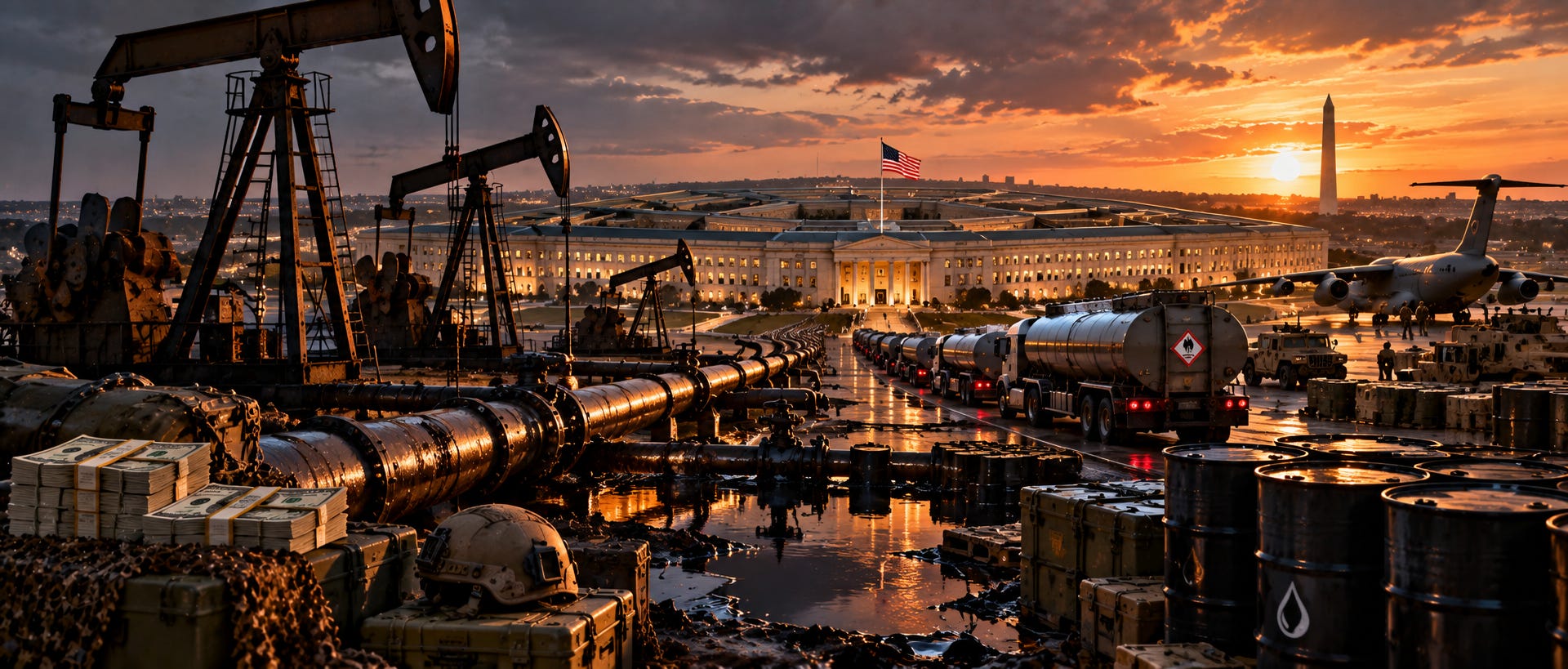
First of all, we need an idea of how we came to have a Pentagon in the first place.
It didn’t happen after WWII, it was begun in 1941, just before the United States entered World War II. Franklin D. Roosevelt approved the project, and it was completed with remarkable speed about 16 months later.
FDR recognized that Britain’s desperate WWII dependence on American power offered an opportunity to dismantle parts of the imperial economic order and replace them with an American-favored international system.
I smell blood in the water under those circumstances.
Britain was in the process of losing its territorial empire. America, with its enormous last-nation-standing post-war power, largely constructed an empire of access, obtaining bases, treaty rights, market access, financial influence, intelligence relationships and strategic control.
None of the pomp, all of the ceremony.
The U.S. failed to retreat to its former shell of non-intervention.
In the eighty intervening years, America exercised enormous imperial-style power, all the time insisting publicly that it did not conquer countries for their territory or resources.
If military intervention is suddenly followed by a Trump declaration (before the entire United Nations gathering) that “to the victor belong the spoils,” we are introduced to a whole new ballgame.
Pentagon financial interest in a defeated country’s oil (Venezuela, Iran), may herald the crossing from an empire of influence into an empire of resource extraction. And now, having set the background and terms of the discussion, we’re ready to unwrap this extraordinary circumstance.
The Pentagon was built and dedicated to the defense of the United States, headquartering the Army, Navy, Air Force and Marines. It maintains nuclear weapons, plans for, advises and fights wars. Neither it, nor our Department of State, was created to own pieces of oil companies, nor any ‘spoils of war.’
Our president, in one of his fairy-tale dreams of personal power, has cobbled together an economic coat-of-many-colors, to divide up those spoils of war he talks so ungallantly of before the U.N. The plan is to seize and divide the oil riches of a country he illegally attacked, kidnapping its democratically elected president.
His reasoning? He didn’t like the result of that election, so he felt it his duty to intervene. The fact that Venezuela has the world’s largest proven oil resources had nothing to do with it. Nor did the fact that Trump is our first president with a taste for enriching himself by force of Executive Orders.
Yet the Pentagon is now involved in an arrangement giving the U.S. government rights to 35% of North American Blue Energy Partners (NABEP), a private company receiving access to Venezuelan oil reserves.
An arrangement?
Oh what a tangled web we weave, when first we practice to deceive…
-William Shakespeare
How in hell did the Pentagon get into the Venezuelan oil business?
American military forces entered Venezuela and captured Nicolás Maduro.
Trump said, “to the victor belong the spoils.”
65 billion barrels of proven reserves at stake.
Sixty-five billion barrels is not an oil well. It is a geopolitical asset and, if America has no dreams of empire, it would eek no such assets.
Have I mentioned my adverse opinions on Private Equity?
A subject for a future discussion, but legalized theft is my opinion. Leaving that aside, a dude by the name of Stephen Feinberg came to the Pentagon after decades in private equity,having sharpened his knives on the dismemberment of various business enterprises.
Way down one of the less-known Pentagon corridors, exists something called the Office of Strategic Capital.
That’s what happens when you have empty offices to fill.
It was designed by God knows who to help finance strategically important industries. Probably stuff like the Military-Industrial-Congressional-Complex we only occasionally hear about (usually when they’ve has a cataclysmic failure). Why that would be such a self-serving office within the Pentagon is beyond me.
I thought the self-serving Congress was created for that purpose.
Somewhere between national defense and private equity, somebody appears to have discovered a new definition of the Pentagon.
Could it be Feinberg? And who, pray tell, authorized the Defense Department to become a participant in a foreign oil company? Please God, don’t let it be Hegseth.
But a new player has wandered onto the set from stage-left. A Venezuelan billionaire shows up, just when you need one, whose cloudy business history reaches back into the Hugo Chávez-era energy systems. Authorities in the U.S., Spain and Switzerland have scrutinized him in money-laundering investigations, which makes him a particularly spicy meatball.
Betancourt became an intermediary between Washington and Delcy Rodríguez during the transition surrounding Maduro’s kidnapping. Both sides apparently trusted him sufficiently to use him as a go-between, which means his meatball was sufficiebtky spicy for both sides.
And now, his company is the Pentagon’s partner. Wonders seldom cease, when the numbers are properly added among monied interests. One might notice there are no civil representatives in this mix, but we do have a lady in the wings and it is said that it ain’t over ‘till the fat lady sings.
This lady is not fat. She is the interim president of Venezuela.
If you have wondered (as I have) why Nicolas Maduro, the kidnapped former president of Venezuela, has not yet come to trial, perhaps the reason lies within the lies. Upset applecarts are not the stuff of billionaire negotiations, and sixty-five billion barrels of oil is a very large applecart.
Delcy Rodríguez, the interim president of Venezuela, is said to have cooperated extensively with Washington and has been negotiating energy and financial arrangements while consolidating political power at home. It seems to me she may be way beyond her depth in this swindle, but who knows?
Every writer loves a plot-twist, and an interesting question arises with Delcy’s cooperation.
Was Trump’s objective regime change, democratic transition, or a government in Caracas willing to make an oil agreement he thirsted after?
Looking at his history, the first two seem uninteresting to this man, while the third is a ball he has teed up more than once.
In what may be an overuse of metaphor, there are many more cards on the table, and a dealer with more to gain than ordinary morals would allow.
Stay tuned.
I’m not yet done with this.