
To quote Winston Churchill once again, “Americans can always be trusted to do the right thing, once all other possibilities have been exhausted.”
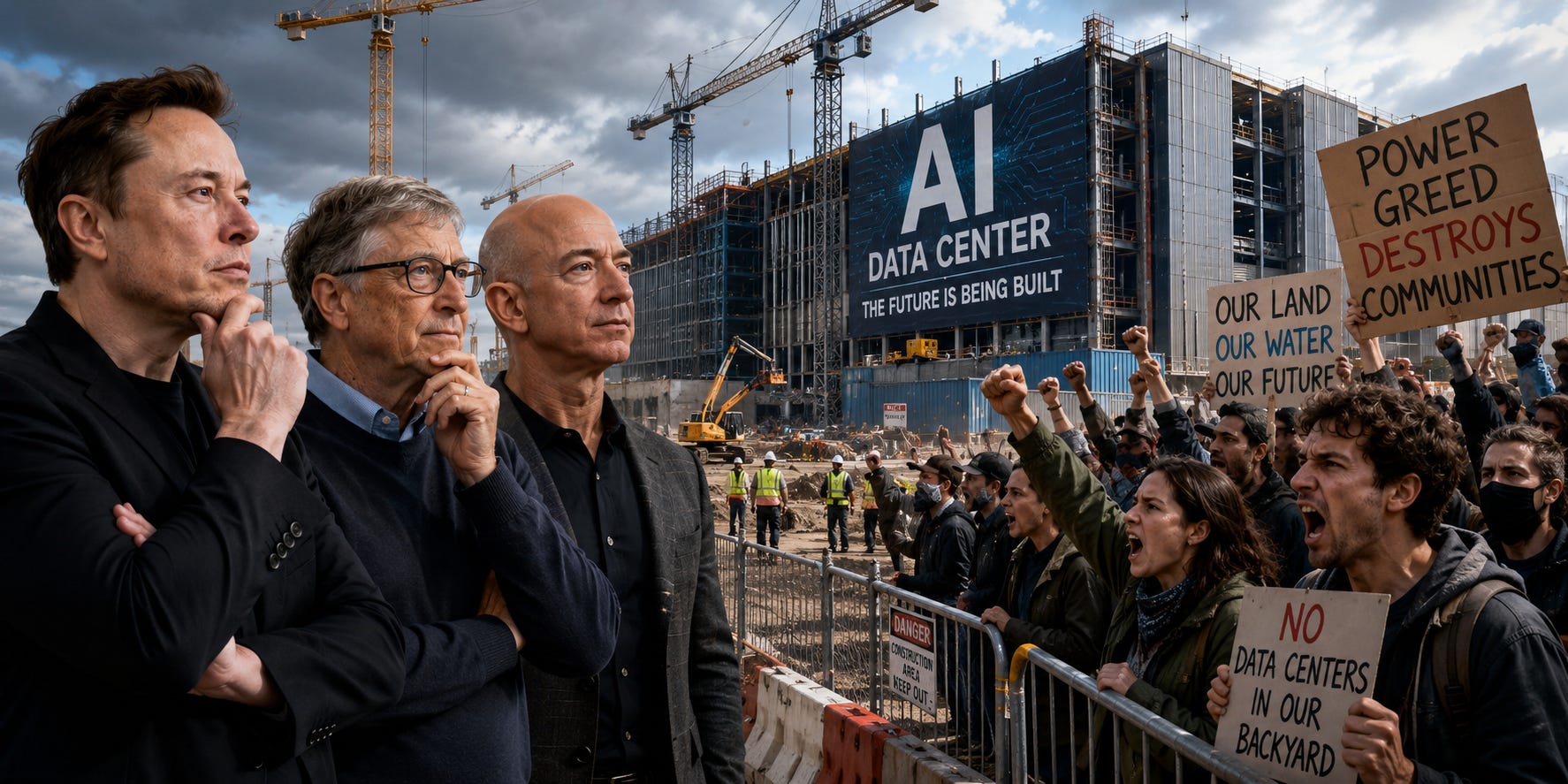
And so it is with our panicked run to build datacenters, no matter the cost. A recent article in the Guardian-UK headlines that “Large-scale datacentre projects around the world are being challenged or cancelled, as infrastructure’s energy demands ramp up.”
No doubt of that, as hundreds of datacenters (the preferred American spelling) all chase the golden ring on A merry-go-round that accommodates only one or two winners.
Why?
Too much water required,
too much electricity,
too much land, in areas where
too many object, and
way, way, way too much money,
all wagered on a bet without a definitive outcome.
It’s the American way.
Time-tested in the boiling cauldrons of the Las Vegas mirror image we call Wall Street, where every four or five years, on average, we avail ourselves of a financial reckoning. Thus, we boldly move where no man has gone before.
Wow, that’s enough to make Winston swallow his famous cigar.
My sources tell me that the major players; Amazon, Microsoft, Alphabet, Meta, and others—are expected to move nearly $600–700 billion in capital expenditures across the Black-Jack table this year alone, with the majority going to pay for infrastructure, servers, networking equipment, and data centers. Not all of this gamble is in the United States. Monte Carlo has its head in the trough across Europe as well.
Goldman Sachs, who is no stranger to financial disasters (having once bankrupted Greece), estimates that those with sufficient credit at the Vegas gambling tables will pony up about $5.3 trillion in AI chips through 2030.
Wise (or unwise) heads with credible (or incredible) projections, suggest the eventual American buildout might well run into multiple trillions of dollars by 2030. Multiple, means a number of Elon Musk type players are going to have to agree to spin the wheel, and see if red or black comes up.
Interestingly, these dudes may be laying down their bets on one of the largest private-sector infrastructure gambles in history.
I must admit, at my advanced age and experience, I’ve often wondered what the billionaire class would find interesting to do with their mega-bucks, once they’d tired of Bentleys, private jets, multiple mansions on multiple continents, and Yachts.
The answer seems to be, plunking down their chips (or the promise of chips) at a scale equal to the interstate highway system, the postwar suburban buildout, or the development of the national electrical grid.
Each of those, for better or worse, gave us roads to drive on (between fast-food interchanges), housing on flat ground instead of high-rise cities, and a national electric grid (that mostly didn’t burn down anything but California).
Unlike those earlier projects, much of this AI gamble is being bought and paid for (now that they own Congress) by a handful of private investors, whose ultimate return on that investment remains uncertain.
Will the gathering all of human knowledge for free, except for its infrastructure costs, and selling what was once free to us for money, actually indicate a solid business plan?
The answer to that may be that you and I are not the target market, we’re already too broke from being turned from a producer to a consumer generation.
The big bucks will become available from the Military and what has come to be known in these circles as ‘keeping-an-eye-on-the-public,’ which means you and me being surveilled, and watched over by your friendly, masked, ICE agent.
Meanwhile, what is China up to in the AI race?
As you might expect, because of some of the perks that come with being a dictatorship, you won’t find them rolling dice at the gambling tables. Where they are rolling, because of that dictatorial circumstance is;
China’s underwater data center program. In May 2026, a 24 megawatt facility began operating off the coast of Shanghai. The servers are submerged offshore, where seawater provides natural cooling, and the facility is powered by a nearby offshore wind farm.
Chinese authorities say the design uses 20% less electricity than comparable land-based facilities, and no fresh water required.
China currently consumes roughly 10,000 terawatt-hours of electricity annually, more than twice U.S. electricity generation.
It’s also adding enormous quantities of new electrical generation, transmission, battery storage, solar, wind, nuclear, and coal capacity.
All of these are areas where America is lagging, because we are a market based economy and capitalism, in its current construct, is sucking all the oxygen from the projects by tax cuts aimed at billionaires.
The United States has plenty of technological solutions to these problems. The difference between the US and China is primarily planning, approvals, and coordination.
China can say, we have electricity here. We have water here. We have wind and solar here. We have transmission capacity here. Therefore, this is where we will build our artificial intelligence infrastructure.
So, the data-center race may ultimately be less about who has the best AI models and more about which country can produce enormous quantities of reliable electricity cheaply enough to run them.
Which raises the next logical question of how do China’s electricity-generation and grid-expansion programs compare with America’s ability to supply power to the trillion-dollar AI data-center buildout?
The answer probably lies in the fact that China has spent the past two decades building far more electrical infrastructure than any other nation in the world.
It’s now the world’s largest producer of electricity, builder of power plants, installer of solar panels, wind turbines, batteries, and high-voltage transmission lines.
Need I remind you that dictatorships don’t have to pander to their interior markets, only those that affect foreign trade. Nor do they have to jump bureaucratic barriers, because there are none. China faces no four-year-term presidencies, allowing them to look far down historic roads, and act accordingly.
If that taints my opinions, cut me some slack. I’ve been watching China ever since President Nixon and Henry Kissinger went down there in 1972 and opened China to membership in the World trade Organization. That’s 54 years ago, and I was 37 at the time.
World commerce hasn’t been the same since.
Books could be written on that subject, and many have been.
Getting back to AI generation, China builds transmission before it’s needed, as well as constructing the world’s largest network of ultra-high-voltage transmission lines. These operate at enormous capacity and can move huge amounts of electricity over more than 1,000 miles with relatively low voltage losses.
The US has comparatively few viable long-distance transmission projects because each line typically requires approvals from multiple states, utilities, landowners, and regulators. The entire state of Texas continues to operate under both brownouts and electricity failures.
China supports planning that co-locates AI with power.
Rather than asking where should we put a power plant, China has the political power to ask, where is the electricity already available?
So, it locates AI facilities near massive hydroelectric projects, large windpower bases, solar installations, and existing transmission hubs, while the data moves over fiber-optic cables, so the electricity doesn’t have to travel nearly as far.
Many analysts now argue that the AI race is becoming an energy race.
Developing the next generation of AI models will depend not only on better chips from companies like NVIDIA, but also on who can reliably provide hundreds of gigawatts of electricity, expanding transmission capabilities, and cooling increasingly power-hungry computing clusters.
In that sense, AI is no longer just a software competition, it’s becoming a race in industrial capacity, such as electric generation, grid expansion, construction, and engineering. All those areas, you might recall, are where America shipped off its industrial capacity to ‘guess who?’
If trillions of dollars are being committed (or planned) for investment, it certainly isn’t going to be in China.
By the way, China does not currently have an operational space-based solar power station producing electricity for Earth. However, it expects to have one by 2030, about the same time Elon and the boys need to come up with another $5.3 trillion or so.
Just thought you’d want to know.
Sleep well, your billionaires are all working in your (or someone’s) best interests…